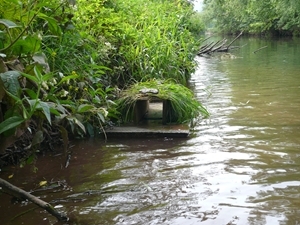
 We find it easiest to carry the raft base, tunnel, clay/sand mix, tracking basket, rope and tethering pole as separate items. At the chosen site, the foam is saturated with water (which takes a few minutes). The claysand mixture is then smeared on top and smoothed off. Finally the tunnel is screwed down onto the raft and the raft is tethered. You will need to carry a broad spatula and a flatbladed squeegee (for the clay mix), screwdriver, screws, knife (for the rope) and lump hammer or mallet (for the pole). You should also have personal safety gear (eg. waders, lifejacket, mobile phone).
Rafts are normally deployed at a rate of approximately one per kilometre of watercourse and we favour locations where the raft can be pushed into the emergent vegetation at the water’s edge, because we assume mink will hunt carefully through that habitat. However, where there is no vegetation (for instance on canalised and over-grazed sections of river) the rafts seem to work just as well. One advantage of vegetative cover is to hide rafts from passers-by who may vandalise the raft, trap or release a captive mink. We try to moor rafts where the only access is by wading or swimming. We also suggest fitting explanatory signs to the roof of the tunnel, such as those available from Perdix Wildlife Supplies.
Children are often the worst culprits and some sites are simply unworkable during school holidays because of easy access. We usually ‘dress’ the tunnel with local vegetation to camouflage it, and renew this at intervals to avoid it looking ‘tired’ and unconvincing, but be careful not to obscure the ends of the tunnel. Incidentally, publicity explaining the rationale of your work, and a raft and explanatory material left at a visitors' centre, are also important steps to reduce interference.
The tracking cartridge can be lifted out without removing the tunnel from the raft. It is important to keep the clay/sand mix in good working condition. At every check, remove debris and smooth over the surface with a wet rubber squeegee (best), spatula or wetted hand. At intervals (eg. every two to four checks) it will be necessary to resurface, flip over or replace the claysand layer, because the clay particles gradually wash away with repeated smoothing, leaving a depressed surface and a hard gritty mix. Strong drying winds or sub-zero temperatures can also require the clay to be resurfaced. We carry the clay/sand medium already mixed in plastic bags when checking rafts. It is a false economy to skimp on the clay. Riverside mud is inadequate.
Check rafts at one or two week intervals, depending on circumstances. More frequent checks are obviously desirable where you have recently returned a raft from trapping to monitoring mode, in case further mink remain to be trapped.
At certain times of year (eg. during autumn dispersal) a fast response may be important. In these circumstances, try a one-week check interval and run traps for a maximum of seven days. If you have not caught in this time, the mink has almost certainly moved on or been caught elsewhere.
Get your FREE Mink Raft Plans today
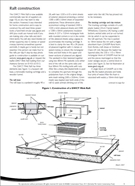 The award-winning GWCT Mink Raft was developed both as a means of detecting mink, and as a favourable trap site.
What you can download for free
✓ Mink Raft Guidelines
✓ Instructions & Plans
✓ How to Build the GWCT Mink Raft
Download now >