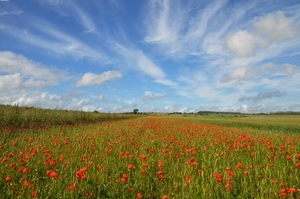
 Our study on the Sussex Downs is the longest-running monitoring project in the world that measures the impact of changes in farming on the fauna and flora of arable land. It started in 1968 with an investigation into the causes of the decline in numbers of the grey partridge.
The Sussex Study celebrated its 50th year in 2018. You can read more about the 50 years of the study from the National Geographic and download the study's first annual report from 1968.
The main reason for the decline was determined to be a reduction of chick-food insects in cereal crops caused by the disappearance of arable weeds. This followed the first use of herbicides in the late 1950s, and led to the starvation of partridge chicks. Since 1970, in addition to surveying grey partridges, we have recorded information on crop type, crop disease, arable flora and invertebrates in cereal fields across the 62km2 of the South Downs between Arundel in the west and Worthing in the east. Detailed information on field-scale pesticide use has also been collated from 1970 to 2004.
The Sussex Study has been instrumental in highlighting the impact of changes in farming on the cereal ecosystem. Our long-term monitoring of these changes documents both advances in technology and the effects of agricultural and environmental policy over the time of the study. Information gleaned from the Sussex Study informs all the Game and Wildlife Conservation Trust’s work on farmland and has been instrumental in the development of conservation headlands and beetle banks. There is also an understanding by many in the conservation world that an appreciation of past changes is needed to better inform present and future conservation policy.
Further reading
- Potts, G.R. (2012). Partridges. Countryside Barometer. New Naturalist Library Book 121. Collins, London.
- Sotherton, N.W., Aebischer, N.J. & Ewald, J.A. (2010). The conservation of the Grey Partridge. In: Maclean, N. (ed.) Silent Summer: The State of Wildlife in Britain and Ireland: 319-336. Cambridge University Press, Cambridge.
- Aebischer, N.J., Ewald, J.A. & Potts, G.R. (2002). Preliminary results from using GIS to examine spatial variation in grey partridge demography over 30 years in Sussex, UK. In: Thomaides, C. & Kypridemos, N. (eds) Proceedings of the XXIVth Congress of the International Union of Game Biologists: 23-33. Hellenic Hunting Confederation & Hunting Federation of Macedonia-Thrace, Thessaloniki, Greece.
- Ewald, J.A., Aebischer, N.J., Brickle, N.W., Moreby, S.J., Potts, G.R. & Wakeham-Dawson, A. (2002). Spatial variation in densities of farmland birds in relation to pesticide use and avian food resources. In: Chamberlain, D.E. & Wilson, A. (eds) Avian Landscape Ecology: Pure and Applied Issues in the Large-Scale Ecology of Birds: 305-312. International Association for Landscape Ecology (UK).