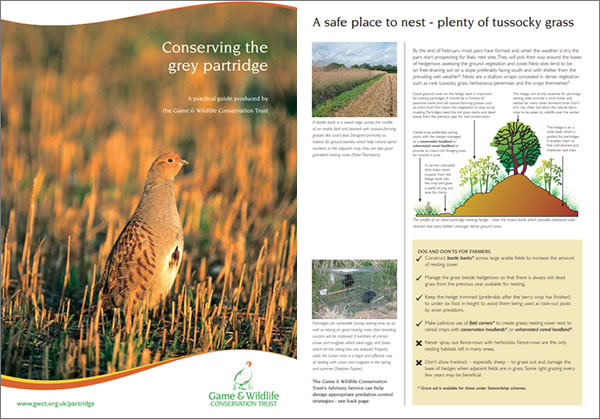
The Grey Partridge Recovery Project at Royston began in 2002. As lead partner for the grey partridge under the UK government's Biodiversity Action Plan, we set up the project to demonstrate the feasibility of restoring numbers of wild grey partridges on farmland. It has shown convincingly that it is possible to restore numbers to over 15 pairs per 100 hectares (250 acres) within a modern farming environment.
The demonstration (keepered) area is in northern Hertfordshire, south-west of Royston, on 1,000 hectares (2,500 acres) of mainly arable land on chalk. It is surrounded by a reference area (not keepered) of similar size and topography. Based on the landscape, farming and management, we predicted in 2001 that we should be able to achieve a spring density of 18.6 grey partridge pairs per 100 hectares.
| Set-aside type | |||||||
| Demonstration area | 2002 | 2003 | 2004 | 2005 | 2006 | 2007 | 2008 |
| Rotational | 6.2 | 12.4 | 7.9 | 7.6 | 6.9 | 2.6 | 0.5 |
| Non-rotational | 1.9 | 7.1 | 4.3 | 4.9 | 1.8 | 2.2 | 2.4 |
| Total | 8.1 | 19.5 | 12.2 | 12.5 | 8.7 | 4.8 | 2.9 |
| Reference area | 2002 | 2003 | 2004 | 2005 | 2006 | 2007 | 2008 |
| Rotational | 1.3 | 1.8 | 3.2 | 3.2 | 3.7 | 1.6 | 0 |
| Non-rotational | 2.3 | 2.2 | 2.8 | 2.5 | 2.3 | 1.9 | 2.0 |
| Total | 3.6 | 4.0 | 6.0 | 5.7 | 6.0 | 3.5 | 2.0 |
| England (Defra statistics) | 2002 | 2003 | 2004 | 2005 | 2006 | 2007 | 2008 |
| Rotational | - - - - - not available - - - - - | 4.0 | 3.5 | 0.5 | |||
| Non-rotational | - - - - - not available - - - - - | 4.0 | 3.7 | 1.9 | |||
| Total | 11.3 | 13.2 | 10.3 | 9.2 | 8.0 | 7.2 | 2.4 |
Management includes habitat creation, year-round predation control targeted at foxes, stoats, rats, crows and magpies, and supplementary feeding of wheat in hoppers from autumn to spring (at least two hoppers per grey partridge pair). We count the partridges in March (spring pair counts) and just after harvest (autumn counts). The sex of all grey partridge adults is recorded, as is the number of young birds present in each covey in the autumn.
A big agricultural change that took place in the UK in 2007 was the reduction of the set-aside requirement to zero for 2007/08. Set-aside has been a valuable tool for habitat creation at Royston, so we measured the percentages of arable area at our study site that were in set-aside in June of each year, and compared this with equivalent values for England compiled from Defra statistics (see Table 1). Nationally, set-aside peaked in 2003 and declined thereafter. At Royston, the difference in percentage set-aside between demonstration and reference areas lay mainly with rotational set-aside, where levels were close to double or higher on the demonstration area than on the reference area throughout the study period. Whereas the amounts of both types of set-aside fell after the switch from set-aside payments to arable area payments, rotational set-aside bore the brunt of the zero quota in 2008, being reduced to only 0.5% on the demonstration area and disappearing completely on the reference area. The percentage of non-rotational set-aside, by contrast, remained relatively constant after 2006. In habitat terms, it is set-aside as winter cover that has suffered most, falling by 82% on the demonstration area and 93% on the reference area between 2007 and 2008.
The density of grey partridge pairs in spring 2008 was 15.8 per 100 hectares on the demonstration area, down 14% relative to the 18.4 of spring 2007 (see Table 2). On the reference area, the 2008 spring count was 4.7 pairs per 100 hectares. The 2008 breeding season began with a cold dry April followed by a fine dry start to May. This was spoilt by a 10-day wet period from the end of May into the first week of June totalling 104 mm (four inches) of rain. Subsequently, July was the coldest it had been for eight years, with 11 days of rain (65 mm), and August was the wettest for 100 years (110 mm of rain). The main harvest was delayed by two weeks, and the partridge stubble counts were similarly late. Grey partridge productivity in 2008 was as poor as 2007, with an identical young-to-old ratio of 1.5 on the demonstration area and a disastrous 0.8 on the reference area. The overall densities of grey partridges in the autumn were 70.0 birds per 100 hectares on the demonstration area and 15.0 on the reference area, a 16% drop from 2007 (see Table 2). It is not possible to separate out the effects of the weather from those of the loss of set-aside on either the drop in spring densities or the poor productivity, but it is likely that one exacerbated the other.
| a. Spring pairs per 100 hectares | ||||||||
| Area | 2002 | 2003 | 2004 | 2005 | 2006 | 2007 | 2008 | Predicted |
| Demonstration | 2.9 | 5.1 | 8.0 | 11.2 | 13.0 | 18.4 | 15.8 | 18.6 |
| Reference | 1.3 | 2.1 | 1.4 | 2.1 | 2.8 | 4.2 | 4.7 | 3.7 |
| b. Autumn birds per 100 hectares | ||||||||
| Area | 2001 | 2002 | 2003 | 2004 | 2005 | 2006 | 2007 | 2008 |
| Demonstration | 7.6 | 28.8 | 39.2 | 53.4 | 60.8 | 87.8 | 83.8 | 70.0 |
| Reference | 8.1 | 6.4 | 18.3 | 11.8 | 18.6 | 25.9 | 17.9 | 15.0 |
| Bold denotes years/area management for grey partridges | ||||||||
Alex Butler, one of our advisory team, organised visits to the demonstration area in 2008 for members of our county committees, the Country Land & Business Association and the Hertfordshire and Middlesex Wildlife Trust. More visits are planned for 2009 and Alex would be pleased to organise others on request. We are most grateful to all the farmers on the study area for their co-operation in the many aspects of this project.
| Figure 1. Distribution of grey partridge coveys at Royston in autumn 2008, showing barren pairs, single males and brood sizes |
![]() |