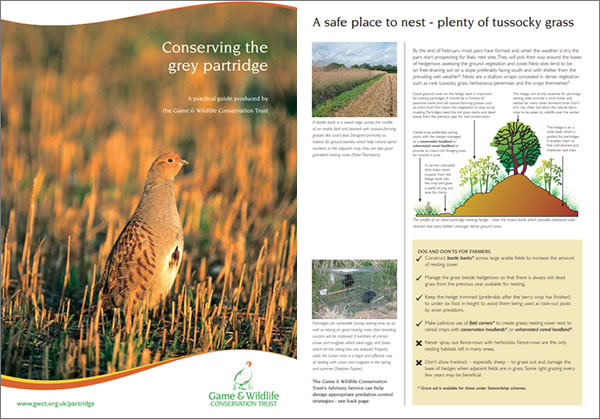
The decline in numbers of grey partridges in the UK, and indeed across Europe, is well recognised. The UK government officially monitors national bird abundance through the British Trust for Ornithology (BTO)'s Breeding Bird Survey, which replaced the earlier Common Birds Survey in 2000. Together, they have documented a partridge decline of 86% from 1967 to 2000.
The magnitude of the decline has led to the grey partridge being declared a Biodiversity Action Plan (BAP) species, and we were nominated as lead partner. The BAP targets were reviewed and revised in 2006. They are to ensure that the population is above 90,000 pairs by 2010; 120,000 by 2015 and 160,000 by 2020 and to expand the range of the grey partridge across the UK from the current 1,450 occupied 10 km squares, to 1,530 occupied 10 km squares by 2015; 1610 occupied 10 km squares by 2020.
Thanks to our members, we have information on how numbers of grey partridges have changed from two sources. One is the Partridge Count Scheme, which is based on counts of live birds on the ground. Since 1950, a total of 257 long-term participants have contributed data on grey partridge spring pair density (see Figure 1).
We have taken changing estate participation into account in our statistical analysis of long-term trends, and present average annual spring densities as an index relative to 1960 (index value of 1). The pattern of decline is similar to that from the BTO surveys, with densities at the turn of the century (1999-2001) averaging only 17% of the densities recorded in the early 1960s, ie. showing a decline of 83%.
| Figure 1. Grey partridge index of spring pair density 1960-2007 from the Partridge Count Scheme, relative to 1960 |
![]() |
The other source is the National Gamebag Census, which contains information on numbers of partridges shot per unit area. Based on information extracted from game books, several bag series extend back over 200 years, so that the census provides a unique insight into historical trends (noting that bags reflect shooting effort as well as partridge abundance).
Between 1804 and 2002, a total of 1,186 estates contributed data on grey partridge bags. Analysis showed that the decline since the 1950s was only part of the picture (see Figure 2). The broader time-frame revealed that in fact there had been large-scale increases in the bag during the course of the 19th century, peaking around 1900.
During this period, the agricultural revolution led to an increase in the arable habitats favoured by partridges, land enclosure provided hedgerows and hence nesting habitat, predator control reduced mortality, numbers of partridges soared and partridge management for shooting became widespread. Comparing the early 1800s with the late 1900s, it is apparent that the situation now, under intensive agriculture, is considerably worse (on average, about 80% lower) than that 200 years earlier, before the increase.
| Figure 2. Grey partridge index of bag density 1804-2002 from the National Gamebag Census, relative to 1804 |
![]() |
So what is the current situation, particularly with respect to the BAP targets? Since 1999, the Partridge Count Scheme has been expanded as part of our commitment to the UK Grey Partridge Biodiversity Action Plan. The annual pattern of change in spring pair density is similar for new recruits and long-term contributors (see Figure 3).
Both groups show encouraging spring densities from 2000 to 2007, averaging +12% per year. This differs from the BTO's Breeding Bird Survey figure for the period of 1994 to 2007 of -39%. Our data suggest that farms in the Partridge Count Scheme have halted the decline - a most encouraging result.
Sadly, the picture in the wider countryside is still uncertain. There must therefore be no relaxation in the on-going information campaign to farmers, land owners and shoot managers, who are the people best placed to help restore the fortunes of the grey partridge.
| Figure 3. Grey partridge spring pair densities 1990-2007 from the Partridge Count Scheme. Data from long-term contributors and new recruits since the scheme was relaunched in 1999 are presented separately. |
![]() |
| Long-term contributors | |
| New recruits to Partridge Count Scheme |