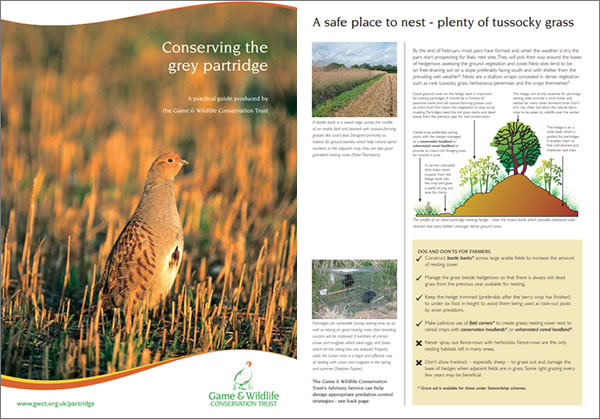
Perdix perdixThe grey partridge was originally a bird of temperate steppe grasslands. It has adapted readily to open arable landscapes and, accordingly, vastly expanded its range as agricultural development spread westwards across Europe over the last eight millennia. After the last Ice Age, the grey partridge arrived naturally in Britain.
The combination of land enclosure, increased cultivation and intensive predator control in the 18th and especially the 19th century boosted its numbers considerably and it became the most popular sporting quarry of the last century. Bag records show that the largest numbers were shot between 1870 and 1930, during which period around two million grey partridges were killed annually.
The same bag records indicate that, after the Second World War, the numbers of grey partridges dropped by 80% in 40 years. Our research has established three main causes for the decline:
These findings have been confirmed by separate experiments showing that where predators are controlled, chick food insects restored (Chick Food Favourites pdf) and nesting cover replanted (Partridge Factsheet 2 pdf), grey partridge density increases.
A range of factsheets on grey partridge conservation and population recovery are available in for download in PDF format. If you have any grey partridges on your land we would urge you to join our Partridge Count Scheme. We also support a network of regional grey partridge groups that hold demonstrations and field visits organised by our advisory and research staff. In addition to this our training team organises courses providing useful and practical information on grey partridge management and conservation.