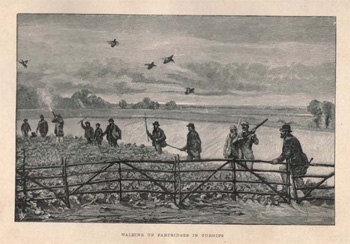
The year 2009 was the bicentennial of the birth of Charles Darwin (1809-1882), who revolutionised biological thinking with The Origin of Species published in 1859. At that time, shooting was a popular country sport, and Darwin was clearly aware of the importance of game management when he wrote: 'There seem to be little doubt that the stock of partridges, grouse, and hares on any large estate depends chiefly on the destruction of vermin'. Game and predator bags are part and parcel of game management, so it seems appropriate to consider the historical perspective and to place our National Gamebag Census (NGC) in the context of other long-term datasets held by others.
Many of the species covered by NGC are monitored by other UK schemes, but no other annual scheme matches the historical depth of the NGC, whose earliest records extend back to 1793. The reason for this is that country estates recorded their bags in game books, and many such historical data series have been offered to the Game & Wildlife Conservation Trust or its predecessors for incorporation into the NGC.
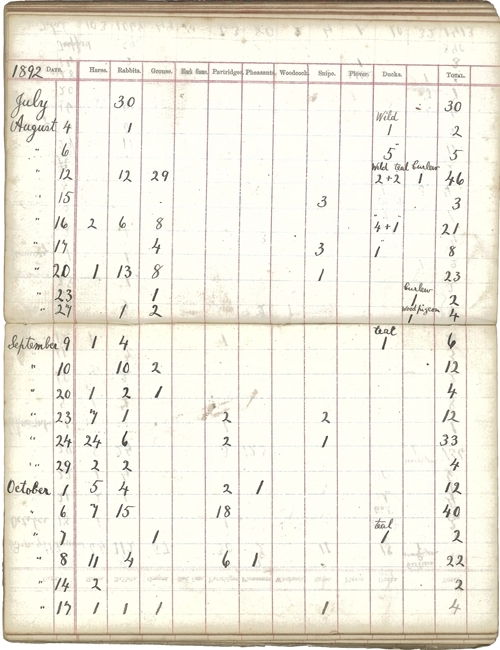 An estate game book open on 1892
For comparison, the British Trust for Ornithology's Common Birds Census, from which grew the government's breeding bird monitoring scheme, began in 1962. The equivalent scheme for mammals, under the Tracking Mammals Partnership, begins its time-series in 1995. The NGC has good coverage for almost all its species back to 1961, and for many back to 1900. To find out how far back it was possible to go while still producing reliable trends, we examined bag data for the grey partridge, red grouse and woodcock. For each species, we based analysis on sites with two or more annual returns, and we included all years with five or more sites. We have taken shoot turnover into account in our analysis of long-term trends, and we present changes in the average annual number of birds shot per 100 hectares as an index relative to the situation in 1900 (index value of 1).
Grey partridge
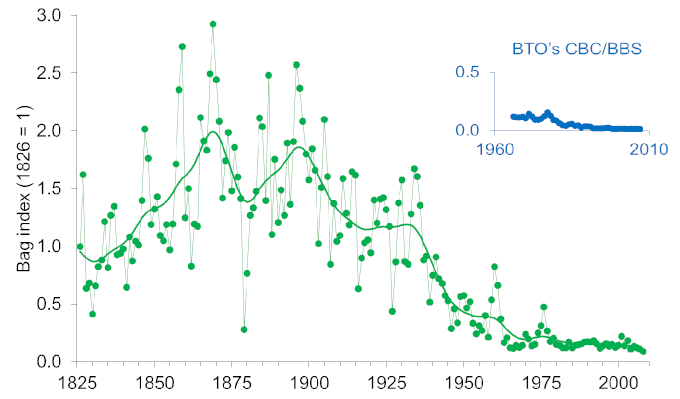
 Grey partridge bags form the longest series in the NGC. We were able to produce trends in annual bag density that started in 1826, when Darwin was only 17 years old. There are large annual fluctuations, most probably linked to weather. Indeed, the collapse of bags in 1869 corresponds to the coldest year on record since 1740. Despite large swings from year to year, the underlying pattern (green line) charts the rise in popularity of this gamebird during the first half of the 19th century and its heyday during the second half of that century up to the First World War. The high average bags reflect the high densities arising from the extensive mixed agriculture that developed especially after the repeal of the Corn Laws in 1846, the ruthless elimination of predators by private gamekeepers and improvements in shotgun design. Partridge bags remained high until the Second World War, but declined thereafter, especially after the introduction of herbicides and the increase in agricultural mechanisation in the 1950s and 1960s. The BTO index (inset) starts in 1966, and catches the tail end of the decline.
Red grouse
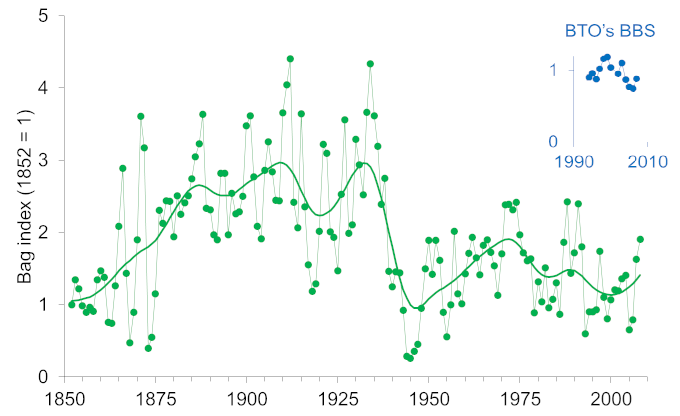
The earliest year for which we were able to produce a bag index for red grouse was 1852, just seven years before the publication of The Origin of Species. The index captures the rise in popularity of grouse shooting during the second half of the 19th century, which was helped considerably by the development of rail links between London and Scotland in the 1840s. By the end of the 19th century, rotational heather burning was part of moorland management for grouse, as was intensive predator control. Walked-up shooting was replaced by driven shooting, which increased the bag, and has become the tradition of grouse shooting ever since. The bag remained high until the Second World War, when shooting and moorland management largely ceased. After the war, management for shooting resumed and many stocks were rebuilt, only to decline from the mid-1970s, particularly outside England. This coincided with increasing pressure on red grouse and its habitat from grazing, afforestation and predators. The BTO index (inset) begins in 1994, too late to detect any long-term trend.
Woodcock
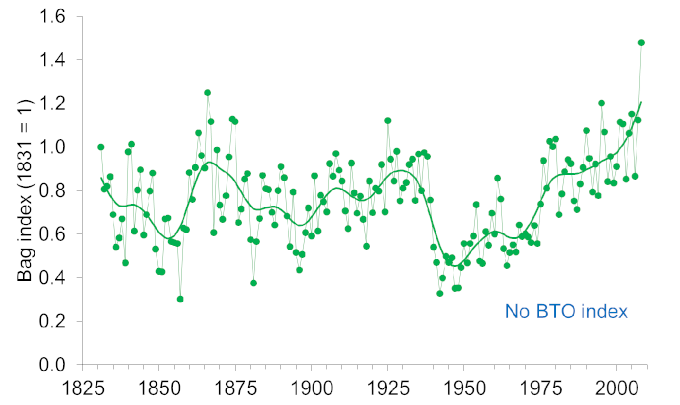
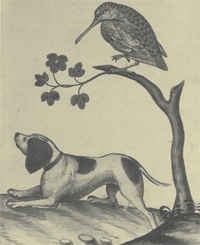 The start year for woodcock was 1831, only five years later than that for grey partridge. Unlike the previous two gamebirds, the woodcock is migratory and the bag comprises mainly wintering birds. Ringing returns suggest that approximately one in seven is local, the others arriving from Scandinavia, the Baltic States and Russia. Weather affects the movements of woodcock and hence the bags, with lower bags reported in milder winters. For instance, the low bags around 1850 correspond to a period of relatively mild winters. Shooting largely ceased during the Second World War, and bag sizes recovered slowly until the mid-1970s. Thereafter they increased rapidly, to levels that exceeded those 100 years earlier. The trend in the woodcock bag is thus very different from the grey partridge and red grouse. Part of the increase may be due to more pheasant shooting days produced by pheasant releasing and hence a higher shooting pressure, but the source populations are stable. The high bags may also reflect a rise in UK wintering numbers in response to extensive woodland plantings or maybe climate change. There is no BTO index for this species, and the bag data are the best source of information on the status of the UK wintering population.