 Climate projections present a challenging future for our upland peatlands and the carbon stored in them. Good peat management that keeps the carbon in the ground is by far the biggest contribution that upland land managers can make to mitigate climate change impacts whilst also benefiting a range of other public goods such as biodiversity, flood mitigation and water quality. But little analysis has been made of the effectiveness of the peatland restoration techniques employed, given the investment of taxpayers’ money by government. Peaky BlindSpots was a project funded by Defra that sought to fill this gap.
In the Peak District the majority of peatland restoration work is undertaken by the National Park through the Moors for the Future Partnership, who employ contractors to do the work. Peakland Environmental Farmers Limited (PEF) was created in 2022, and its 80+ landholding members, responsible for over 40,000 hectares of upland territory, wished to identify the most effective and cost-efficient ways of adopting sustainable farming and environmental practices.
Given the nature of the uplands on which the PEF landholdings lie, good peatland management was a key focus. As they do for their farming practices, PEF members wanted to understand what the best approach to peatland restoration on their land was and so how the best results could be achieved. This led to the Peaky BlindSpots project, which assessed the effectiveness of three approaches and who delivered them (contractor approach) to peatland restoration in the Peak District so that PEF members could learn what has worked and apply that to a new ambitious restoration programme. This was important as the group’s landscape scale Conservation Plan is designed to meet or beat the government’s environmental targets for land and species recovery within the context of a changing climate.
The project evaluated the success of peatland restoration, its cost-effectiveness, operational effectiveness and efficiency through both a literature review and a site-based quality control check on previous work on PEF land holdings. The three techniques assessed were bracken control, Sphagnum introduction and gulley blocking with variation in success due to a number of factors including contractor approach. The final report with full analysis can be found here.
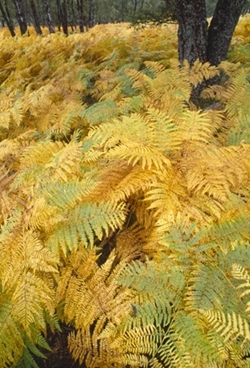
When it comes to bracken management, the project confirmed that persistence is key. There was little difference between third-party contractor approaches to bracken control, but the approach undertaken by farmer and moor owner Geoff Eyre on his own moor demonstrated that the best control and subsequent recovery of vegetation is generated by long-term follow-up treatments. The methods used in the successful approach (burning and herbicide treatments) are currently denied to landholdings on SSSI sites, but the results are significantly different and so this needs revisiting on sites where bracken is significantly affecting the species or feature for which the SSSI was designated.
Gullies are considered a feature of a degraded peatland resulting in carbon losses. Consequently, gully blocking has been adopted as a restoration technique to stabilise the gullies and raise the water table. The project found that there was little difference between dam-building materials (although rock dams were poorest which is interesting given their cost is significantly more than using heather bales for example). Instead, the key determinant of success was the position of the dam in the gully. Those at the top of the gully on flatter ground were more effective and retained their functionality better than those downstream which were often blown or damaged. Steeper gradients on free draining peatland in the Peak District may not be suitable for gully blocking, and certainly not cost effective.
Alongside gulley blocking, Sphagnum introductions are considered critical for restoring degraded peatlands. The literature review demonstrated that restoring sustained high-water tables is a pre-requisite for success and so site preparation before introducing Sphagnum via plugs can be effective. However the mixed results achieved (including no Sphagnum detectable at all) suggest that the significant financial investment required for this approach is inefficient and that more work needs to be done to understand the possible mechanisms behind success and failure. Similar to gully block effectiveness, observations from the study suggest that methods and locations need to be better understood to provide cost effective and productive results.
However of most concern was the finding that no one from the contributing farms/estates, contracting agencies, contractors or funding agencies had any idea as to whether their actions had achieved the long-term objectives as no or very little follow-up monitoring had been done.
Has this money simply been wasted? Clearly we hope not, but without ongoing monitoring of the method employed and approach taken and engagement with the individual farms/estates on whose land the work is being done, there is no way of judging the success of the interventions undertaken. Peaky BlindSpots has filled this gap to an extent, but its assessment of the effectiveness of techniques must be taken further to ensure that peatland restoration achieves the desired outcomes at reasonable cost.
Photo credit: Laurie Campbell