Thought and reflections from the winners and judges of the 2026 Schöffel Countryside Awards – in partnership with the GWCT
More than 80 people gathered at a ceremony in central London on 9 November to see the winners of the 2026 Schöffel Countryside Awards being crowned and celebrated for their incredible dedication to wildlife management and conservation.
The awards – led by the GWCT and country clothing brand Schöffel Country – recognises individuals, farms and partnerships throughout the UK for their efforts to deliver ‘working conservation’: practical, on-the-ground action that proves wildlife recovery, biodiversity restoration and food production can go hand in hand and is the force behind a thriving British countryside.
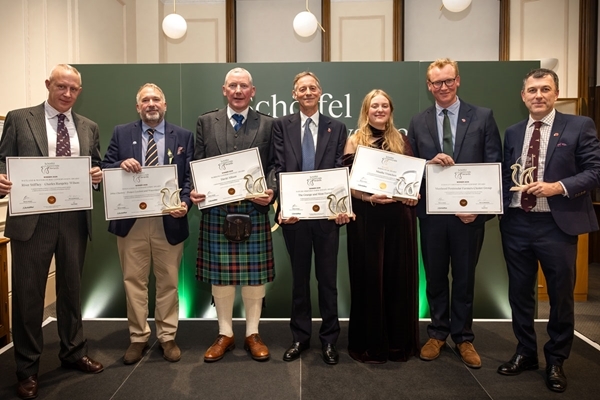
Here the winners of all six categories answer the question:
Why are awards like this, that recognise and celebrate those going above and beyond in the countryside, important?
We also find out what the judges thought of them and what made them worthy winners of their categories.
David Allison – Working Conservationist Award winner, Grosvenor Reay Forest Estate, Sutherland
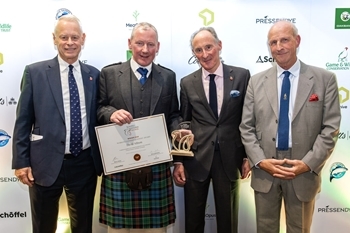 “I think it’s great to celebrate the, quite often, unseen work and to recognise the people that are behind that. Very often – certainly in my own case here – I’ve been given the opportunity to work with some exceptional people, and I’m sure that's the case elsewhere. So I think, yes, being able to get [that] third-party recognition is really important for those that are working really hard, trying to do their best for nature [and] people.”
What the judges said about David
David Allison’s passion for wildlife and deep understanding of the landscape have helped transform the Grosvenor Reay Forest Estate's approach to conservation.
During his 19 years there, as Head Stalker and Conservation Manager, he has championed a whole-ecosystem approach that combines traditional land management skills with scientific research and long-term monitoring. His work recognises that restoring biodiversity is not about managing individual species in isolation, but understanding how deer, woodland, rivers and wildlife interact across an entire landscape.
The development of Project Laxford - an ambitious ten-year partnership working to restore the River Laxford and improve conditions for endangered wild Atlantic salmon - has been one of his most significant achievements.
Alongside this, David has overseen a carefully planned deer management programme to reduce grazing pressure and encourage natural woodland regeneration, as well as a major initiative to plant more than one million native trees. Early results include the return of native vegetation to areas where it has been absent for generations, improvements in deer condition and the restoration of vital riverside habitats. Rigorous monitoring, including biodiversity surveys, water-temperature recording and salmon tagging, is helping to measure the impact of the measures and shape future management.
What particularly impressed the judges was David's ability to bring people with him.
Drawing on a lifetime of practical experience, he has embraced new scientific approaches while encouraging colleagues, local communities and other land managers to share his vision. His commitment extends beyond the estate through initiatives supporting young people working in rural communities and encouraging knowledge sharing across the sector.
In the judges’ view, his practical expertise, leadership and determination to deliver lasting environmental change made him an outstanding example of a working conservationist and winner of this category.
Andrew Pitts - Nature-Friendly Farm/Estate Award winner, alongside his brother William, Grange and Moat Farms, Whiston, Northamptonshire
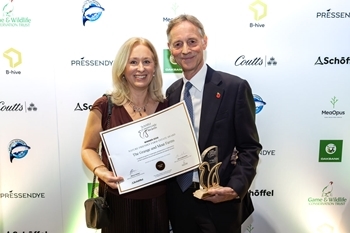 “[The awards] are really relevant for us. They help celebrate excellence. Farmers are forever being put down, but this gives us an opportunity to show how good we are at something. They give us credibility when we’re talking to government, to NGOs, to help them understand how they can make different rules that are more effective, so we can manage the environment more effectively and still produce food. They change the narrative. It shows that there is environmental excellence out there.”
What the judges said about Grange and Moat Farms
Brothers Andrew and William Pitts have demonstrated how a successful commercial farming business can produce high-quality food while making a significant contribution to wildlife recovery.
They have spent more than two decades developing an approach that integrates conservation into every aspect of their farming operation on their 600 hectares in Northamptonshire. Their move towards direct drilling, careful management of soils and nutrients, and the creation of wildlife habitat on areas of less productive land has enabled them to maintain a commercially successful arable business while providing valuable resources for farmland birds, insects and other wildlife. Grey partridge conservation has been a particular focus, with carefully planned habitat management providing nesting cover, insect-rich areas for chicks and winter food.
During their visit the judges noted that the extensive network of connected habitats across the farms, including wildflower areas, hedgerows, woodland edges and carefully managed field margins, were alive with birds and insects. The Pitts’ innovative 'Farm in a Field' project brings together different crops, habitats and management techniques in one demonstration area, allowing farmers and others visitors to see how conservation measures can work together in practice. Other initiatives include research into regenerative farming, the integration of livestock into crop rotations and ongoing work to improve soil health.
Andrew’s knowledge, enthusiasm and willingness to share what the family has learnt impressed the judges. Through partnerships with agricultural businesses, research organisations and policymakers, the brothers have played an important role in demonstrating how nature-friendly farming can work commercially, as well as encouraging others to adopt similar approaches.
Their commitment to continuous improvement, alongside the impressive wildlife habitats they have created, makes Grange and Moat Farms’ commitment to continuous improvement, alongside the impressive wildlife habitats they have created, convinced the judges they were an outstanding example of productive farming and conservation working hand in hand, making them a worthy winner of this category.
Charles Rangeley-Wilson - Wetland & Watercourse Conservation Award winner, River Stiffkey, Warham, Norfolk
“I think [awards like these] work on a number of levels. They’re important because they encourage people. And also they spread information and education, so that we can swap ideas and see what other people are doing and lift the game. I think that's really, really key. A lot of the time you're working in this space and it's enormously good fun, but the idea of getting an award for your work - it's a huge uplift. So I think as an encouragement for others to get out there and do exciting things, for landowners to be brave about what they can imagine for their landscapes, I think [they] play a really key role.”
What the judges said about Charles Rangeley-Wilson OBE
Working in partnership with Norfolk Rivers Trust and Holkham Estate, chalkstream conservationist Charles Rangeley-Wilson OBE has led an ambitious restoration project which has seen a 2.5km stretch of the River Stiffkey in north Norfolk transformed and a historic watercourse brought back to life after centuries of modification. The work has helped the river return to its original meandering course, reconnecting it with the surrounding floodplain and restoring the natural processes that support healthy freshwater ecosystems. The project has combined detailed scientific research, historic mapping and innovative restoration techniques to recreate the conditions needed for wildlife along the river to flourish.
The judges noted that the results have been remarkable - clear water now flows over clean gravel through a varied landscape of pools, riffles and wetland habitats, while characteristic chalkstream plants, including water crowfoot and starwort, have returned to sections where they had been absent for generations. Brown trout, eels and other fish have recolonised the restored channel, alongside a recovering community of freshwater invertebrates.
The surrounding floodplain is also attracting an increasing variety of wildlife, including kingfishers, curlews, egrets and otters, while orchids have appeared in the newly restored wetland meadows. The speed of this ecological recovery has impressed and surprised those involved, and help demonstrate the extraordinary potential of restoring natural river systems.
Charles has spent more than 30 years championing the conservation of England's internationally important chalk streams, combining scientific understanding with a practical approach to restoring damaged rivers. His work on the Stiffkey is one of his most ambitious projects to date and provides a powerful example of how carefully planned intervention can reverse historic environmental damage and create thriving habitats for future generations.
The scale and ambition of the restoration, as well as the expertise and determination required to deliver it, particularly impressed the judges.
Maaike Vrancken – Rising Star Award winner, Atlantic Salmon Trust, Edinburgh
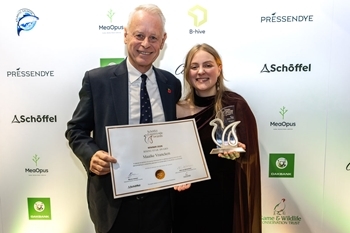 “They shine a light on the people, projects and initiatives working hard to make a positive difference to our countryside. They recognise that the work being done, often behind the scenes and without much recognition, really does matter.
“They also provide an opportunity to share ideas, celebrate progress and inspire others. In today's climate, it's important to highlight the positive things happening around us and remind people that there is so much we can do to protect, restore and build resilience within our natural environment for future generations.
“Sometimes seeing what others are achieving is all the encouragement someone needs to make a small change of their own and those small changes can collectively make a huge difference.”
What the judges said about Maaike Vrancken
As a research assistant for the Atlantic Salmon Trust, Maaike has already made an impressive contribution to the conservation of wild Atlantic salmon, despite being at an early stage in her career. She has quickly established herself as a valuable member of the team, combining scientific research with practical fieldwork to improve understanding of the pressures facing this endangered species. Her work includes co-ordinating tagging programmes involving thousands of juvenile salmon, helping researchers track their migration and survival and identify where conservation action is most urgently needed.
Alongside her fieldwork, Maaike has contributed to detailed analysis of salmon populations, improvements to fish-monitoring infrastructure and the development of innovative technologies, including AI-assisted sonar analysis. Her research is strengthening the evidence needed to guide river restoration projects and secure funding for conservation measures.
She is also investigating wider ecological pressures, such as habitat conditions and predator-prey relationships, recognising that successful salmon recovery depends on restoring the health of entire river ecosystems rather than focusing on fish populations in isolation.
The breadth of Maaike's achievements in such a short time, her enthusiasm, scientific understanding and ability to communicate complex findings to different audiences, really impressed the judges. She shows a strong commitment to collaboration, working with fisheries trusts, researchers, land managers and conservation organisations to support practical solutions.
Maaike is set to make a lasting contribution to UK conservation and her determination to build a career dedicated to restoring Britain's rivers, combined with her technical ability and willingness to embrace new approaches, makes her a worthy winner of the Rising Star category.
John Chantry - Innovation in Conservation Award winner, Project Laxford and Watershed Connections, Perthshire
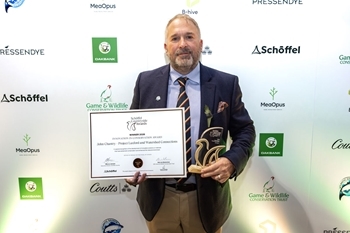 “Awards of any type that recognise what is happening in the environment, especially within the world of nature restoration and trying to save a particular species [make a difference]. It’s quite difficult to get recognised, because everything we do is in the wilderness. It's not public-facing, so people don't see it every day. You'll see people receive MBEs for the things they've done, and it's all public-facing, it's all with the public. We don't get that exposure, and awards like this really help show people what is happening beyond the visual, beyond where they live, out in the wilderness, and that it is making a difference.”
What the judges said about John Chantry
As programme co-ordinator for Watershed Connections and Project Laxford at the Atlantic Salmon Trust, John Chantry has developed an innovative approach to river conservation that is transforming how important freshwater habitats are surveyed, restored and monitored. He has combined drone technology, sophisticated mapping and environmental monitoring to provide a much more detailed understanding of river catchments.
By bringing together LiDAR, thermal imaging and high-resolution photography, features that conventional surveys often miss can be revealed, such as riverbank erosion, changes in habitat and areas of cooler water that provide essential refuges for wild Atlantic salmon.
The technology is now being used to support restoration across several Scottish river systems, including the River Laxford in Sutherland, where John has created a detailed 3D model of the entire 170-square-kilometre catchment. The information helps conservationists identify where tree planting, riverbank restoration and habitat improvements will have the greatest impact, while repeat surveys provide evidence of how the measures are working.
The approach can make surveys 80% faster and 60% cheaper than conventional methods, potentially making high-quality environmental monitoring more widely accessible to conservation organisations and land managers.
John’s ability to turn complex technology and scientific data into practical information that can be used by those managing the countryside particularly impressed the judges.
Having served in the military and worked in business, he brings a different perspective to conservation, identifying opportunities to apply existing technology in new and effective ways.
The technical innovation behind his work, as well as its potential to improve conservation decision-making, reduce costs and deliver better outcomes for rivers and wildlife across the UK, made John a shining example of what this category aims to celebrate.
Manhood Peninsula Farmers Cluster Group - Farm-Environment Partnership Award winner represented by founders Andrew Gentle and Thomas Monnington, Chichester, West Sussex
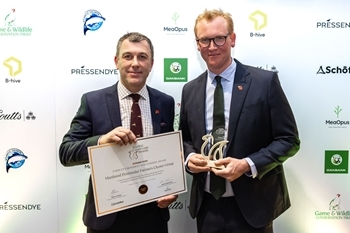 Andrew Gentle: “These awards are a great way to shine a light on all the passion, dedication, and commitment so many people who manage the countryside have that would otherwise go unnoticed. These people are the heartbeat of the British countryside.”
Thomas Monnington: “Hopefully the awards will help the industry to reach a wider audience and showcase some of the great things that we are all doing for the benefit of nature, local communities and for future generations.”
What the judges said about The Manhood Peninsula Farmers Cluster Group
They have demonstrated what can be achieved when farmers collaborate to improve biodiversity across a wider landscape. Established in 2022 by Andrew Gentle and Tom Monnington, the group brings together six family farms covering around 2,000 hectares between Chichester Harbour, Pagham Harbour and the RSPB's Medmerry reserve.
The farms include a diverse mix of arable, dairy, beef, vegetable and organic enterprises, but they share a commitment to producing food while creating better habitats for wildlife. Their initial concern over the decline of wild grey partridges sparked their interest to work together, but this has now grown into a much wider programme to support farmland birds, improve habitats and strengthen connections between the countryside and local communities.
Working collaboratively, the farmers have planted and restored hedgerows, created large areas of specialist farmland bird habitat, improved ponds and established supplementary winter feeding programmes. They have also installed nearly 30 nesting boxes for barn owls and kestrels and developed a grey partridge recovery programme using broody hens to rear birds for release. Released partridges have subsequently bred successfully in the wild, marking an important step towards re-establishing a nationally declining species locally. The group is also working to connect habitats between individual holdings, demonstrating how conservation measures can have a much greater impact when planned and managed together.
The determination of these farmers to work together, share knowledge and engage with their local community impressed the judges. As well as collaborating with conservation organisations and taking onboard expert advice, the group has involved schools, volunteers and local organisations through farm visits, educational activities and projects. Their efforts to build public understanding of farming and conservation, while building culture of collaboration for future generations, were seen as a particular strength. The judges felt The Manhood Peninsula Farmers Cluster Group group was an inspiring example of how farmers can achieve far more for wildlife by working together, than they could individually.