Joe Stanley, Head of Sustainable Farming, The Allerton Project
The transition to regenerative agriculture is an opportunity for farmers to improve soil health, strengthen resilience and reduce reliance on costly inputs. But what does that transition actually cost, and who should bear the risk? A new report - From Risk to Reward - produced by the Allerton Project with support from Andersons and funding from Nestlé, tackles these questions head on.
From Risk to Reward: Modelling the cost of the regenerative transition
British agriculture is navigating a period of unprecedented change. Farmers are facing mounting pressures from climate change, geopolitical and market volatility, changing support schemes and rising production costs. At the same time, there is increasing demand for food systems that are both environmentally sustainable and economically resilient.
Regenerative agriculture has emerged as a promising solution. By focusing on practices such as reduced tillage, cover cropping, returning crop residues to the soil and integrating livestock into arable systems, regenerative farming seeks to improve soil health, enhance biodiversity and strengthen resilience to extreme weather. However, while the long-term environmental and systems-resilience benefits are increasingly recognized (not least via research conducted at the Allerton Project), the economic realities of transition remain less well understood.
From Risk to Reward sets out to address this evidence gap. Using detailed modelling, we examined the financial impact of a five-year regenerative transition on three representative 600-hectare arable farms located on loam, clay and sandy soils in eastern England. The study was also informed by surveys of 32 farmers, in-depth interviews with 12 producers and consultation with financial institutions.
A challenging transition period
One of the clearest findings is that the regenerative transition can present short-term financial challenges.
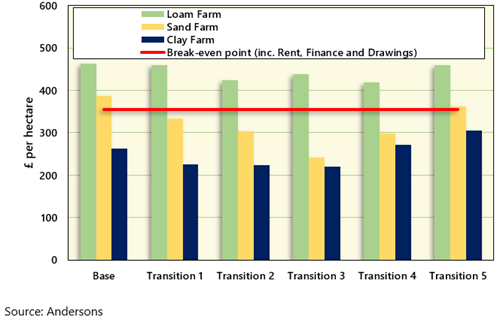
The transition was modelled in the absence of any external support (such as the Sustainable Farming Incentive or private sector schemes) and therefore purely on farming income. Across all three model farms, profitability declined during the initial years of transition. Modest yield reductions, the costs of establishing cover and catch crops, investment in new equipment and reduced income from activities such as straw sales all contributed to lower margins.
The impact varied according to soil type. Clay Farm recovered most quickly and exceeded its baseline profitability by year four. However, Loam and Sand Farms had not returned to pre-transition profit levels by year five. The total profitability deficit over the transition period ranged from £73/ha on the clay farm to almost £399/ha on the sand farm.
These figures highlight an important reality: regenerative farming may deliver long-term benefits, but farmers can carry substantial financial risk during the early years of adoption as systems bed in.
Sharing the risk
The report makes a compelling case that the burden of transition should not rest solely with farmers.
An overwhelming 93% of surveyed farmers agreed that transitioning to regenerative agriculture increases short-term business risk, while 82% believed those risks should be shared more evenly across the supply chain.
This reflects a growing recognition that the benefits of regenerative farming extend beyond individual farm businesses. More resilient agricultural systems support processors, retailers, consumers and financial institutions through greater supply security and reduced vulnerability to environmental shocks. If society values these outcomes, there is a strong argument that investment and risk-sharing mechanisms should support farmers through the transition.
Climate change raises the stakes
The urgency of regenerative transition is also being intensified by climate change.
Recent years have demonstrated the vulnerability of UK agriculture to extreme weather, with poor cereal harvests and major financial losses linked to drought and other climate-related events. Farmers interviewed for the report stressed that truly understanding the benefits of regenerative practices requires time, often several years, particularly as weather patterns become more variable and unpredictable.
This creates a challenging paradox: climate change makes transition more difficult, but also makes it more necessary.
Building long-term resilience
While short-term profitability remains a concern, the report concludes that resilience is perhaps the strongest argument for regenerative farming.
Farmers surveyed identified resilience as a key motivation for adopting regenerative practices. Financial institutions consulted during the research echoed this view, highlighting that robust and adaptable businesses are often more valuable than those chasing short-term profit gains.
Healthier soils, lower dependence on external inputs and improved ability to cope with extreme weather can all contribute to stronger businesses over time. In an increasingly uncertain world, these qualities may prove invaluable.
Knowledge exchange is critical
The report also highlights the importance of farmer-led learning and collaboration. Successful regenerative transition is not simply about changing practices; it requires new skills, new networks and often a new mindset.
Farmers consistently emphasised that knowledge exchange works best when it is delivered by farmers for farmers. Peer-to-peer learning, trusted evidence and practical experience all play a crucial role in accelerating adoption and reducing risk.
Creating the conditions for success
The report's message is clear: regenerative agriculture offers a pathway towards a more resilient and sustainable farming future, but the journey is neither necessarily easy nor cost-free. Government, supply chains and financial institutions all have a role to play in sharing farm risk, providing long-term support and building the confidence needed for change.
To bring regenerative practices to the mainstream of our food system, the transition must be treated as a collective investment in the future of British agriculture rather than a challenge for farmers to face alone.
Download the full report.
Listen to the Allerton Project podcast to learn more: 'From Risk to Reward: Can Regenerative Farming Pay?'