By Phil Warren, Black Grouse Recovery Officer and Holly Appleby, Uplands Ecologist
After decades of dedicated conservation effort, black grouse have enjoyed their most remarkable resurgence in a generation. GWCT's long-term monitoring has recorded a staggering 61% increase in displaying males across 6 key moors in just one year, making it the largest annual rise in the 35-year history of surveying. For one of the UK's most threatened upland birds, whose remaining population is largely confined to the northern Pennines, the results provide compelling evidence that sustained, targeted habitat management is delivering real conservation success.
Black grouse are a species of high conservation concern, with the remaining 1000-1500 males now largely restricted to moorland in the northern Pennines.
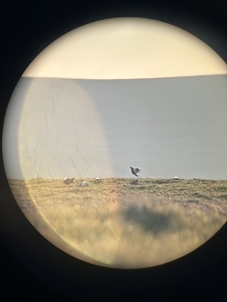 To monitor black grouse numbers, the GWCT, gamekeepers and land managers annually count the numbers of males displaying at leks each spring. These counts, which started in the early 1990s, and since 1998 leks on 18 estates have been counted in most years. The males on these 18 sites are estimated to represent about half of the UK population of breeding males. These counts, therefore, provide an important indicator of the health of the population.
Counts this year showed the largest year-on-year increase recorded in 35 years of monitoring. With numbers of black grouse males recorded at leks on these 18 estates increased from 557 males in 2025 to 894 this spring, a 61% increase. The numbers of males on six moors counted since 1991 were the highest since records started with 480 males in 2026, compared to 206 males in 1991. Some eastern moors reported record highs this spring. Lots of young males in the population have led to some unusual observations. At some larger leks, young males formed satellite leks close to the larger lek, one of which was even in the middle of a road. Our repeat second counts conducted in late April and early May usually record slightly higher numbers of males than the early counts, but this year we noted that some leks had doubled in size.
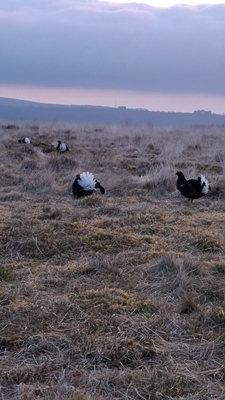 These increases are testament to years of management across the study area, where black grouse benefit from reduced predation due to predator control provided by moorland gamekeepers, traditional farming practices and grouse moor management which maintain the mosaic of hay meadows, rough pasture and moorland favoured by the birds.
2025 was a good breeding year for black grouse, with females averaging 2.6 chicks each. This success is attributed to warm, dry weather and abundant insects when chicks hatched in June.
Lek surveying through the eyes of a student
By Adriana Dermetzis, Uplands Placement Student
Early mornings are never an easy feat to overcome, but waking up at dawn was worth it to see my first black grouse lek whilst on placement. Upon arrival to the lek site, the fields came alive with the sound of cooing filling the air. In the distance, black and white dots moved and flapped around, and upon closer look with a pair of binoculars, the image became clear: 20+ black cocks with their white flared tails and stunning red eyebrows puffed up.
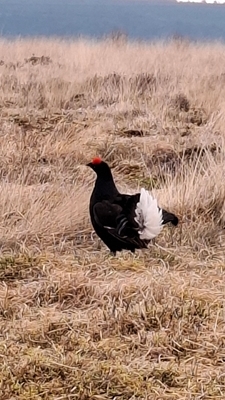 As they moved around marking their territory, their chests puffed up and shrunk rapidly, whilst they produced their characteristic bubbling calls. Whenever two would encounter or challenge another’s place on the lek, they’d make intimidating hissing noises, sometimes meeting mid-air to fight. With the help of binoculars, females could be see watching either from a distance or right in the middle of the lek, observing the males to gauge which was the fittest. If a female was in plain sight of the male, the hissing and fighting would dramatically increase, a last ditch effort for the males to show they’re the best on the lek. This experience has been my favourite so far whilst on placement.