By Henrietta Appleton, Policy Officer (England)
 There has been a lot of media commentary on the firewave that England is currently experiencing and, quite rightly, there have been calls for greater management of the vegetation (fuel load) within semi-natural habitats and on the rural-urban fringe.
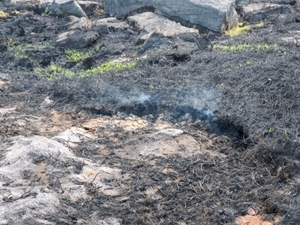
Photo: An example of the damage to peat by the Tintwistle wildfire (Source: Peak District Moorland Group)
There have also been calls for greater action on climate change and its causes.
The media comments reflect the increasingly polarised debate on how to address the significant threat of wildfire to our croplands, rural-urban fringe and semi-natural habitats. But arguably much of this is ‘hot air’, simply repeating the same statements and policies, and not the much-needed calls for more to be done now, such as vegetation (fuel load) management, to avoid annual firewave events becoming perpetually ‘the worst year yet’ and their associated risk to life. At the end of this blog the GWCT outlines its seven-point call for action.
But first some context. Fire is a natural ecological process that has been adopted and adapted by man over centuries to achieve desired outcomes – whether that the cultural traditions of slash and burn (swidden farming) in the Amazon or the Aborigines in the bush of Australia, or indeed upland management in the UK for livestock grazing and grouse shooting. Such cultural and traditional knowledge is being embraced globally to address wildfire concerns. The Kananaskis Wildfire Charter, of which the UK is a signatory, embraces the importance of indigenous and local fire stewardship and demonstrates the need for an equitable, effective and ecologically grounded approach (Yakav, Croker, Ford et al 2026). But due to ideological debates on the pros and cons of vegetation management in the UK (and grouse shooting in particular) this approach is being resisted, and controlled fire is being seen as a foe, not a friend.
Whilst fire is a natural process, climate change is increasing the frequency of severe (high temperature) wildfires in the UK and therefore altering the fire-regime (the fire return interval and fire intensity). This will affect an ecosystem’s ability to recover. Climate change is forecast to continue to drive ever frequent fire weather in the spring and summer whilst the warmer and wetter winters will support greater amounts of vegetation growth and therefore available fuel for a wildfire. So, we need to do more to protect our ecosystems in the short term.
| What is pyro-convection? |
|
Pyro-convection has two stages. The first stage is when the buoyant hot gases contained within a fire plume force the plume to rise, causing an indraft of air at the ground level that can alter fire behaviour.
The second and more dangerous stage is caused when the latent heat stored in the fire plume is released when it reaches the cooler condensation level of the atmosphere. The plume then descends, sometimes violently, in a downdraft that results in unpredictable and extreme fire behaviour.
|
Severe wildfires burn hot, so hot that in some cases they create their own energy and micro-climate causing pyro-convection fires (see box), which are particularly dangerous and difficult to suppress. Severe wildfires remove not only the surface vegetation but also burn down into the peat as was seen last year at Fylingdales/Langdale and this year at Tintwistle/Crowden (see photo above). The damage can extend to a depth of 20-30cm. Research from last year’s Fylingdales/Langdale fire by the UK Ideal Fire team has shown >25,000 tonnes of carbon were lost with burn depths up to 20cm. If you take the rule of thumb that peat accumulates in the UK at 1mm p.a. if conditions are perfect, then it will take at least 200 years to replace that which has been lost.
The heat and flame length is generated by the available fuel load. As a rule of thumb, a wildfire flame with no wind is approximately twice the height of the vegetation, with wind and aspect increasing this a further 2-3x. But if you want a scientific answer look at the FireInSite model produced as part of the UK Fire Danger Rating System project. The day the Tintwistle wildfire started (24 June) the predicted flame length was 2-2.3m for taller high fuel load heather and 0.8m for shorter low fuel load heather (aka managed). Within 24 hours this had jumped to predicted flame lengths of 3.9-4.7m for tall heather (the average height of a UK adult male is 1.78m) and 1.6m for managed heather (low fuel load). Direct attack by firefighters is only possible on fires with a flame length of below 2.5m.
Such data emphasises the importance of changing the focus of wildfire policy away from the ignition source (e.g. banning disposable BBQs). Whilst public information and education and the effective use of Public Spaces Protection Orders are part of wildfire preparedness and prevention given all fires need a source of ignition, the severity of a wildfire (and its extent) is determined by the availability of fuel (vegetation). It is the fuel load that converts a flame into a wildfire.
So, the quick and only answer to reducing the threat of a severe wildfire given we can’t alter the weather is to manage the fuel load. Whether this is by grazing, cutting or prescribed ‘cool’ burning will be site dependent.
The solution proposed by Natural England, the IUCN UK Peatland Programme and other eNGOs of rewetting the peat is the long-term option and will be dependent on sufficient rainfall in our evolving climate scenario to maintain water table depths at circa 10-15cm. There is still no data on how much of our uplands can be rewetted and this is important if it is to be seen as an effective wildfire mitigation tool. One of the oft-cited examples of where rewetting stalled a wildfire is in the Elan Valley in Wales. Yet more detailed analysis shows that only 50 acres was rewetted out of a total area impacted by the wildfire of c20,000 acres. In addition, as Natural England has acknowledged, there is a need to ‘mind the gap’ in the intervening decades before the water table is restored to near surface and to manage the surface vegetation given the annual threat that wildfire presents.
The trend towards rewilding or ecological restoration to address the climate and nature crises is resulting in reduced vegetation management and a greater fuel load in the short term. The reason is the focus is on carbon sequestration. Yet there is a lack of acknowledgement that emissions from management will be a fraction of those from a severe wildfire.
As a result, some media comment has rightly highlighted concern that the current restrictions on heather ‘cool’ burning on peatlands is compounding this problem by removing a key management tool – and one that is appropriate to the fire-adapted species that comprise our peatlands and heathlands. The smoke or heat enhances their reproductive ability or encourages early successional species (Simpson, Belcher & Baker 2025, Smith, Carpenter, Holland et al 2023).
The restrictions on heather burning on deep peat are principally to address concerns about carbon emissions at the time of the fire and the belief that this activity has negative impacts on peatland condition causing further carbon losses (a concern that GWCT contends). Yet, as for rewilding, the unintended consequence of this is the build-up of fuel and the prospect of an accidental or deliberate fire becoming a severe wildfire that releases significantly greater emissions over a far wider area as well as burning down into the peat, affecting human health through impacts on air quality, and destroying wildlife including important soil bacteria. Destruction is pretty much 100% at worst, with prospects for restoration significantly impaired due to physico-chemical changes in the soil as well as the loss of the seedbank.
The GWCT has calculated that using prescribed fire management to create firebreaks only releases 3% of the carbon emitted during a single wildfire over the same area (based on three wildfire examples). Recent calculations by the UK Ideal Fire team of the impacts of the Fylingdales wildfire in 2025 show that on areas where surface vegetation had been managed, peat carbon loss was avoided – in fact 7,000 tonnes of carbon was ‘saved’. These areas of reduced fuel load also provide opportunities for firefighters to directly control a wildfire as the reduced fuel load generates a lesser flame length, and present possible areas of shelter for species during a wildfire, providing a source for habitat and species recovery.
Whilst the licensing system does allow for applications to burn surface vegetation on deep peat for wildfire mitigation purposes, we understand no licence has yet been awarded for a protected site. This reflects concerns about the licensing system being fit for purpose and has unfortunately resulted in land managers feeling it is pointless applying as they will be refused. But the GWCT is concerned that unless land managers apply, the lack of demand will be seen as lack of need. We, along with the Moorland Association, National Gamekeepers Organisation and regional moorland groups, are therefore calling on landowners and managers to apply to prove the extent of the need to manage our uplands for conservation and wildfire mitigation purposes.
Given the focus on peatland restoration (rewetting) and the significant government money being invested in it, there should be an assessment of the effectiveness of the measures used, particularly given the reliance on this to address wildfire. It also raises the question as to whether the availability of government monies to fund restoration works (plus calls for membership support too) is perhaps providing an ‘insurance policy’ for those involved in peatland restoration. They do not need to be concerned about short-term measures to protect their investment as they can simply apply for more money to repeat the exercise. Surely all peatland restoration projects should have accompanying wildfire risk assessments and management programmes that address the need for fire breaks and their ongoing maintenance.
This is not new news to Natural England – their commissioned report on three wildfires on their own reserves recommended this and, as I have reported before, fuel load action was taken. This underlines the need for NE to fill a policy gap and be given a duty to address wildfire risk more widely, not just on their own reserves, in order to protect the semi-natural habitats that form the bedrock of our biodiversity including red-listed species such as the curlew.
To conclude, here is the GWCT seven-point call for action. We can’t continue to let the moorland fires burn and wait for peatland rewetting to work. Accountability and action are needed.
- Give Ministry of Housing, Communities and Local Government (who oversee the Fire Service) and Defra (who oversee the environment) ministers separate responsibility for wildfire risk and mitigation to ensure proper accountability in assessing capability for suppression and mitigation of damage to habitat from wildfire respectively.
- View wildfire as more than an environmental disaster caused by climate change. Wildfires have social and economic costs too. Such costs need to be recorded.
- Wildfire policy must encourage the management of the fuel load and not just focus on the source of ignition (public messaging/banning disposable BBQs). Fuel load defines the spread, intensity of the fire and success of suppression regardless of the ignition source.
- Make the heather burning on deep peat licensing process fit for purpose to allow for fuel load reduction to protect peatlands. Natural England’s duty is to biodiversity. Its strategy focuses on recovering nature through restoring natural processes. This is at direct odds with risk-assessed fuel load removal and management. There needs to be a balancing duty to account for the threats of wildfire to its general purpose of conserving, enhancing and managing the natural environment for the benefit of present and future generations.
- An immediate assessment of the percentage of peatlands that can effectively be rewetted under future climate change scenarios and can be depended on as a wildfire mitigation tool. High water table ombrotrophic bogs require more rainwater to enter the system than leave. By 2061 this looks increasingly unlikely in all but the far northwest of the UK.
- Require all nature restoration (rewilding), peatland restoration and carbon code projects to have an effective wildfire risk assessment and active management plan in place.
- Peatland restoration policy to focus on climate-aware zoning and adaptive management to avoid the one-size-fits-all approach that currently prevails.