Joe Stanley, Head of Sustainable Farming, Allerton Project
A decade on from the vote to leave the European Union (EU) and its Common Agricultural Policy (CAP), English farmers were, in June, presented with the Farming Roadmap 2050, this Labour government’s view on what the next 25 years holds for the sector.
Farming demands the application of long timescales, but as a political document we might be justified in looking somewhat cynically at quite such a long view from a political system in which -since the document dropped mere weeks ago - the secretary of state who penned the foreword (the ninth since 2016) has been replaced by the tenth. In reality, any meaningful detail in the document peters out around 2030 at the end of this current parliament, with the following 20 years largely left to the reader’s imagination. When you consider the scale of unexpected change experienced in the world since 2000, perhaps that is for the best.
The Roadmap seeks to outline a vision for combining food production with delivery of nature and climate services alongside rural economic growth. Much of what is written is laudable and certainly aligns with much of our own vision at the Allerton Project, not least that food production and a thriving environment need not be competing aims, but complimentary to each other. It’s also positive to see calls for more collaborative working between farmers and land managers, as per the Farmer Cluster and Environmental Farmers Group (EFG) model. As can be seen below, by 2050 government wants to see an agricultural sector in England which is profitable, productive, sustainable and resilient. These are broad aims we can all agree with.
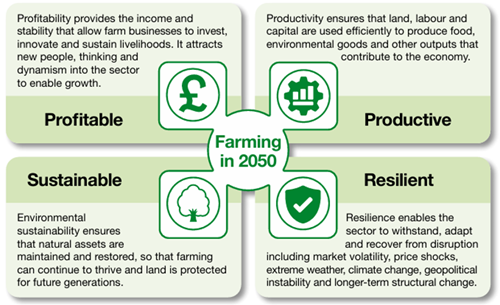
Credit: GOV.UK
Private Money for Public Goods?
Yet what consistently jumps out from the Roadmap is the clear desire from government to reduce its exposure to the Public Goods it committed to fund under Michael Gove (with Public Money for Public Goods (PMfPG) being the bedrock concept of post-CAP Environmental Land Management (ELM) schemes). Instead it wants to shift much of the responsibility for PMfPG to farmers and the private sector. Payments for ‘mitigation options’ such as buffer strips which reduce the environmental impact of farming will be replaced with higher regulatory standards – i.e. the carrot is to replaced by the stick. ‘Conversion actions’ such as payment for the use of cover crops are also to be offloaded, with the costs either to be covered by the supply chain or by farmers themselves. What the Roadmap does see public money continuing to fund are a narrower definition of ‘public good actions’ – largely taking land out of agricultural production for habitat creation. As such, more of the Sustainable Farming Incentive (SFI) budget is forecast to transfer to Countryside Stewardship Higher Tier (CSHT) and Landscape Recovery (LR) projects from 2030.
What is also strongly trailed is a desire to ‘spatially target’ ELM from 2027, in part using Local Nature Recovery Strategies (LNRS) which – let’s be honest – were always going to be used for this purpose. What we can see here is the convergence of a limited budget with highly ambitious targets for nature restoration and climate action, but the absence of any meaningful target on food production. As such, by 2030 Government expects even the indirect public money food producers currently receive through SFI options such as cover cropping and reduced tillage to be swept away, with a much narrower definition emerging of what a public good looks like. Farmers and landowners who have to date paid little attention to whether their land sits within a priority area for nature within their respective LNRS may in future find the issue to be of much greater import.
The big question, then, is what is the private sector – the food value chain – willing to finance in future in terms of more sustainable production, and what (like Government) will it simply require as part of its baseline standards, at the cost of farmers? The Roadmap calls for ‘a lower-impact, market-led and climate-resilient [farming] system’, yet I would suggest that within the current economic model that is an oxymoron: supply chains are still overwhelmingly focussed on cost and efficiency, which tends to be the enemy of sustainable resilience.
The Roadmap talks of Government’s role in ‘crowding in’ private sector finance, but to do so on a meaningful scale by 2030 is a Sisyphean task which consecutive governments have shown little talent for. The reality remains that in the later years of direct payments, subsidies accounted for 62% of the average English farm’s income. In a future world where – by design – remaining payments are spatially targeted, what does that mean for those farms sitting outside priority areas? The fairness in the supply chain reforms suggested by the Roadmap (with little detail) will have to be transformative indeed to leverage the redistribution of profits needed from the wider £153bn food sector toward the farm gate.
Road to nowhere?
It’s welcome that a government in its relatively early days commissioned a comprehensive review of where we are and where we want to get to. In the normal run of politics we would expect a first-term party to be in power for most of the next decade. But while heavy on ambition this Roadmap remains light on detail – or the means to generate the change desired. Too much of the responsibility and risk is pushed back onto the already overburdened shoulders of farmers, and it should be remembered that discussion of IHT was expressly forbidden in this process. What’s more, despite repeated assertions that ‘food production remains the primary purpose of farming’, the lack of any meaningful target on food security will always leave it as the poor cousin to environmental outcomes – as evidenced by this very document.
We must treat this Roadmap as the starting point in the journey of the rest of this parliament and beyond. There are some good objectives within, but much remains to be done to create a credible pathway to a more sustainable, resilient and profitable industry in the coming years.