Black grouse
A moment in life that will stay with me forever
 I have heard it said many times, “choose a job that you love, and you won’t work a day in your life”, and in part that is true, for me at least. I am extremely fortunate to have made a career out of my greatest passion: nature. I love what I do but I do enjoy a day off too… for a busman’s holiday to go birdwatching!
But I think I had one of the best 24 hours in my career at the end of April this year, when I was kindly invited to join a group of people to stay up on the moors in the North Pennines to discuss moorland management and see black grouse (Tetrao tetrix) lekking at dawn. It is a moment, and a sound, that will stay with me forever, so this Species of the Month is all about the red-listed black grouse.
Identification
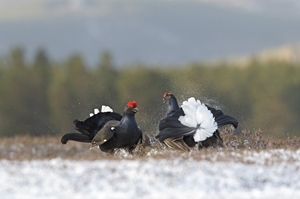
Male black grouse (blackcock) are very distinctive. They are jet black, have a bright red wattle (bit of skin) over the eye and show a striking white stripe along each wing in flight. They have long, curling tail feathers a bit like a wingnut when it is fanned out and raised, showing the white under-tail feathers when displaying. The females (greyhens) are smaller and not so ‘showy’ as the males. They are cryptically coloured, mottled grey-brown, and have a slightly notched tail.
Statistics
About the same size as a pheasant.
- Length: 40-56cm
- Wingspan: 72cm
- Weight: 900g-1.2kg
- Average lifespan: 5 years
Lekking
The black grouse has a spectacular communal breeding system, which I was so lucky to watch for a couple hours. In spring, males congregate on traditional display grounds (referred to as a lek) at dawn. One of the fascinating things is that those lek sites have probably been used for centuries! Here they stake out small patches of ground, onto which they entice females for mating through displaying and calling – lekking. It was so mesmerising to watch, the behaviour between the males fighting for prime position, but controlled by one or two dominant males.
It was interesting to watch the females too. As you can imagine, they aren’t the ones making the most effort in this situation (that effort comes later with nesting and raising the chicks!). They fly into the lek from afar, which can crudely be described as an arena of males posturing and displaying with continual hisses and bubbling calls and jumping into the air when the females arrive. Despite all the commotion, the females land and calmly walk among the males, watching each one and assessing which is dominant. However, there were times when there was fighting between the females too, and even females fanning their tails at each other. I was told that the females can visit the lek several times over the course of a few days, but when they have mated once, they won’t return again.
Nesting
The females lay 6-11 eggs, with an average of 8, in thick ground vegetation within a kilometre or so of the lek. Most black grouse chicks hatch in mid-June and they remain as a family covey until September. After hatching they take their broods to feed among the tall grasses, rushes and heathland shrubs where they feed first on insects then buds, flowers and seeds. Young males tend to reside close to the home lek whereas females often disperse several kilometres to other areas of suitable habitat where there are other populations of black grouse.
Nutrition
The staple foods of adult black grouse are heather and bilberry, but black grouse like buds, leaves, flowers, seeds, stems and even the spore capsules of mosses and twigs of several trees.
Population
According to the BTO there are 4,850 breeding males in the UK. The population is centred on a few key upland areas of Scotland, northern England and Wales. According to the GWCT, 150 years ago black grouse were more numerous and widespread, and they could be found on many heaths of southern and eastern England. The decline and contraction of range seems to have begun about a century ago following gradual improvements in farming. Most worrying is that in the late 1990s the black grouse was declining at a rate of some 8-10% per year, with a geographical range that was continuing to contract.
Today’s continuing loss seems to stem from the following:
- Loss of habitat mosaic. Land use used to be mixed. Black grouse favour a patchwork quilt of farmland adjacent to moor and forest, and they need a sweep of suitable countryside to sustain their population. Contiguous areas have been broken up by block forestry and intensive farming.
- Over-grazing. High densities of sheep and red deer eat out ground cover, thereby reducing the abundance of caterpillars that grouse chicks need.
- Changes in forestry. Black grouse like the ground cover in young plantations, but as these develop into solid conifer thickets they tend to leave. Forest edge used to melt into heathland through a transition of scattered trees; today’s forests are hard-edged.
- Increased mortality. Because they are now more common, crows, foxes, stoats and some birds of prey cause a high annual loss. In addition, forest deer fences kill many birds.
- Drainage. Bogs are ecological assets on any moor and should be retained, as should in-bye rushy pastures.
- Pheasants. Releasing hand-reared pheasants or red-legged partridges along the moorland fringe, although a useful supplement to shoot finances, could displace black grouse.
Is all lost?
Restoring black grouse populations in the UK is complex, as birds frequent different habitat mosaics between regions. These habitat preferences differ between regions too. For example, in England they are a bird of the moorland fringe with few trees, whereas in the Scottish Highlands they are found on the edges of woodland.
The GWCT has undertaken a lot of research on this species and has led on the recovery and re-colonisation of formerly occupied areas between currently isolated populations in some areas of Northern England.
One of the main symptoms of our declining black grouse populations has been their poor breeding success, and the number of chicks reaching maturity is insufficient to maintain numbers. Although poor summer weather can exacerbate this, there are number of things that can be done to improve success.
- Improve hen nutrition: In the weeks before egg-laying, greyhens need food rich in protein and energy. They also need to lay down fat for incubation. Herbs from in-bye fields, flowering cotton grass, and the buds of larch, birch and willow should be available.
- Improve insect abundance: Young chicks foraging with the hen need to consume insects at a rapid rate. Caterpillars and sawfly larvae are important foods, as are ants in pine forest fringe habitats in Scotland. Experiments show that restricting grazing may be the key to improving insect abundance in some areas.
- Provide cover: Nesting hens need good shrubby ground cover for nest sites and with their young broods they like to forage among tall grass stems and low shrubs. This hides them from predators.
- Reduce predation pressure: Losses to predators can be crucial in some areas. Foxes, crows and stoats are significant predators in the breeding season and predator control may be appropriate.
- Management of the heather: Creating a mosaic of different age structures of heather through burning and cutting
As you can see, protecting and enhancing the habitat for black grouse is complex, and it is key that those managing the land have the ability to use all the tools in the toolbox – from removing stock to burning where possible.
If you have the chance to see black grouse, do it, but with care and caution. As with all species, it is incredibly important that you keep far away (at least 100m) to avoid disturbance, especially during the lekking season. While they are on the lek, do not to approach the grouse on foot and always make sure you have permission to be where you are. The breeding success of this species is far more important than a photograph! Also, while walking on the moors, please make sure you keep your dog on a lead or under very close control.
Megan Lock
Advisory
Photo credit: David Kjaer