By Jayna Connelly, Science Communicator
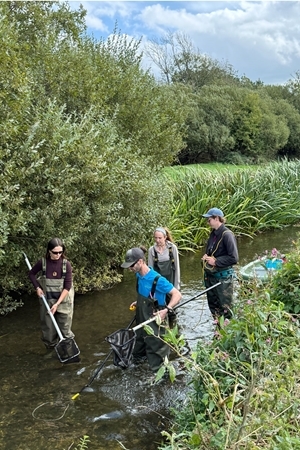 This year, like last year, was a challenging one for fish in the River Frome. Trout and salmon have been two focal points of GWCT Fisheries research for decades, providing valuable insights into the health of the wider river ecosystem. Helping the Fisheries team with parr tagging offers a vivid reminder of the many pressures these fish face throughout their lives.
It seems like they’re being hit from every angle: water quality, water temperature, water clarity, and that’s before you start worrying about lice, genetic quality, interbreeding between domestic and wild populations, overfishing, and other factors affecting their survival at sea.
While many of the challenges are indeed at sea, the rivers themselves are much more within our control. The River Frome is just one example of a wider network of rivers that we all have a responsibility to look after. A number of factors can limit our ability to manage these rivers optimally, and the relative importance of different pressures varies between catchments. On the River Frome, sediment runoff is one of the most visible and persistent challenges.
When you visit a river today, murky water is often just the start of a much deeper issue.
Hostile nesting habitat for delicate eggs
As someone who has only visited the River Frome parr tagging scheme for the past two years, I do not have the same perspective as our long-standing Fisheries scientists. They speak of a time when the shingle was looser, rubbly and, arguably, more difficult to walk on. Now, as I walked along the riverbed, it was almost like walking along a road. Easier for people, perhaps, but it’s hard to imagine how fish eggs could nestle themselves amongst the stones when sediment, sand and mud have taken their place.
Before the eggs are even laid, female salmon excavate shallow nests, known as redds, by beating their tails against the riverbed and clearing away finer material. The eggs are then deposited amongst the clean gravel and covered, where they may remain for several months through the winter.
During this time, the spaces between the stones are every bit as important as the gravel itself. These gaps allow cool, oxygen-rich water to circulate around the developing eggs and carry away waste products. Hidden beneath the riverbed, the embryos gradually develop, drawing on the nutrients stored within their yolk sacs as they prepare to hatch.
What appears from above to be little more than a stretch of loose stones is therefore one of the most important habitats in the salmon’s life cycle. When sediment fills those gaps between the gravel, it not only makes it harder for salmon to create suitable redds in the first place, but it can also reduce oxygen availability and trap developing eggs beneath a compacted layer of mud and silt. The result is that a river can appear healthy on the surface while conditions beneath the riverbed, where the next generation of fish should be developing, have become increasingly hostile.
The dark reality of a riverbed cave
A striking example of just how severe the sediment issue has become occurred while we were walking down the river on the last day. In one section, the sediment in the riverbed had compacted so much that it was behaving almost like cement. The water had scoured down into the compacted material, aided by the flow around a partially fallen tree. Rather than the shingle sloping gently down towards a pool, it had been replaced by a sharp cliff edge dropping away, much like the potholes we’re all familiar with across the UK.
In places, this cliff-like structure had even begun to erode from underneath. Small caves had formed where the pebbles lower down in the riverbed had remained less compacted and therefore washed away, while the overhanging section was held firm by this new concrete-like layer of sediment.
A silver lining for 2026?
There is, however, a positive lesson from this unusual year.
The dry conditions have been difficult for many farmers and, in some cases, have led to maize being harvested earlier than normal. The resulting reduced biomass and financial consequences are serious. However the earlier harvest appears to have created an opportunity for some cover crops to become more established before wetter autumn weather arrived. Parts of the catchment fields that would normally be largely bare at this time of year are already showing green growth and developing ground cover.
This matters because vegetation offers a far greater protection than bare soil. Roots help hold soil in place, but the leaves are equally important because they reduce the force of the rainfall reaching the soil surface. If enough cover can establish before heavy rain arrives, less sediment may be washing into nearby watercourses. Of course, nothing is viable unless is it financially sustainable. How these threads of ideas could be subsidised would require lengthy new discussions.
Other factors for sediment pollution
There are a number of factors involved in limiting sediment entering rivers. Well-managed riverbanks are one. Fencing livestock away from riversides not only reduces direct bank erosion but can also create a buffer strip that slows run-off before it reaches the river. It also allows riverside vegetation to develop. These plants help stabilise banks, provide food and cover for fish, and can help create narrower, deeper channels during low flows that are often more beneficial for fish than wide, shallow stretches.
Of course, limited livestock access to the river requires some extra thought from farmers.
Until my discussions with the Fisheries team, I was completely unaware of the concept of pumped drinkers. Solar-powered systems have become increasingly popular, pumping water from the river to troughs further away in order to minimise bank erosion and river disturbance. What I found even more fascinating, however, was the idea of pumps operated by the cattle themselves. By nudging the mechanism, livestock can pump water up to a trough. I thought this was fantastic on a number of levels. Not least because it must provide some interesting enrichment for the cattle using it.
Another concept I’d never really considered was how the location of a gate might influence runoff. Gates naturally tend to end up at the lowest point of a field, close to roads and areas that often become muddy. Better for the farmer, but inevitably every convenience has a cost.
In this case, the cost is borne by the fish.
Sediment runs downhill, through a gate, towards a road and, eventually, into a river. Moving a gate can sometimes help reduce runoff, but it also creates trade-offs. Preventing water from escaping through a gap in a hedge may leave an area of the field wetter and more prone to waterlogging. As is often the case, solutions involve balancing environmental benefits with practical farm management. The Allerton Project has also explored the use of interception ponds designed to capture sediment before it enters watercourses. Results on clay soils have been mixed, partly because very fine particles can pass straight through these systems. The sandier soils found across much of the Frome catchment may respond differently, although more research is needed to understand where and when these approaches are most effective.
Until then, what can we do?
So we raise a series of important questions. Could earlier crop establishment or targeted cover cropping help reduce sediment loss in sensitive catchments? Are there practical ways to support farmers in adopting these approaches where they deliver wider environmental benefits?
These kinds of questions require long-term research, understanding not only what works, but also what is economically realistic for farmers, will be essential. If sediment really is one of the key pressures facing our rivers, then finding practical and workable ways to keep soil on the land and out of the water may prove crucial for the future of fish populations.