Written by Jayna Connelly, Science Communicator
Many of us have heard of the cuckoo bird – famous for laying its eggs in the nests of other bird species so that its young are raised by an unsuspecting host. But fewer people realise that the world of bees contains its own lesser‑known cuckoos.
These cuckoo bumblebees have a life cycle remarkably similar to that of the cuckoo bird. The females sneak into the nests of their host bee species, lay their eggs, and leave them to be fed and raised by the host’s workers. Although this often comes at the expense of the host’s own young, cuckoo bees are still a positive sight in the landscape. They generally do not pose a significant threat to the overall population of their hosts. In fact, their presence is usually a good sign: cuckoo bees can only survive where there is an established, healthy population of their host species.
Identifying cuckoo species
Cuckoo bumblebees are particularly interesting because they have evolved to look surprisingly similar to their host species. This can make identification tricky and adds an extra challenge for our field researchers during surveys. However, there are a few reliable differences to look out for:
- Darker wing membranes are common in cuckoo bumblebees.
- They lack the specialised hairs on the back legs known as pollen baskets, as they don’t need to collect large amounts of food for their young.
- Cuckoo species are also less hairy overall, which means their exoskeleton is more exposed, giving them a shinier appearance.
In spring, freshly emerged individuals of all bumblebee species, cuckoo or not, are much easier to identify than they are later in summer, when they become worn, faded, and even a little bald. This makes the next couple of months the perfect time to get outside and try spotting some cuckoos!
Cuckoo bee specifics
Every cuckoo is linked to their own specific host species (or group of host species), meaning they each have individual habitat preferences, nesting hotspots and variable emergence times. Some of the more likely cuckoos to spot include the impressive Red-tailed cuckoo (Bombus rupestris), Southern cuckoo (Bombus vestalis), Field cuckoo (Bombus campestris) and Gypsy cuckoo (Bombus bohemicus).
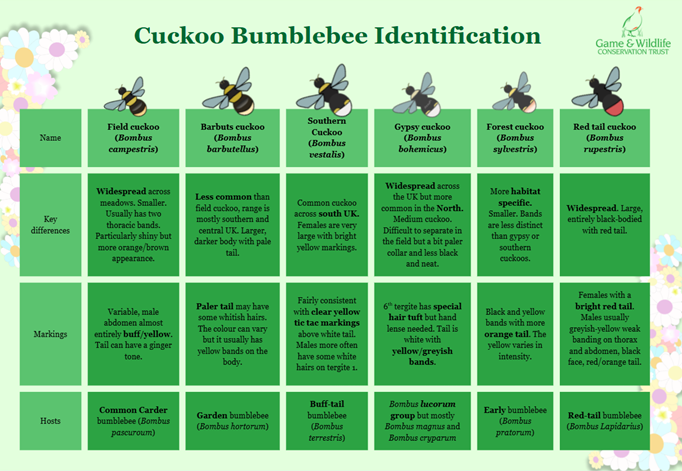
This is where things start to get quite confusing as there are a number of similar looking cuckoo and social bumblebee species. Often confident identification cannot be done in the field and requires investigation of specimens under microscopes, however some contextual factors such as the location, known social bumblebee species in the area and the cuckoo behaviour can help narrow it down. The table here depicts some characteristic features and explains the differences across some of the key cuckoo species to consider.
The Red‑tailed cuckoo bumblebee (Bombus rupestris)
Large, striking and almost entirely black with a vivid red tail, the Red‑tailed cuckoo is often noticed first by observers. Its dark wing membranes and sparsely haired body give it a glossy look, helping separate it from similar red‑tailed social species. This cuckoo depends almost exclusively on the Red‑tailed bumblebee (Bombus lapidarius) as its host, making it a useful indicator that strong red‑tailed bumblebee populations are present in the area.
The Field cuckoo bumblebee (Bombus campestris)
More variable in appearance than other cuckoos, the field cuckoo can show anything from yellow‑banded forms to much darker individuals. It is widespread in meadows and grasslands, particularly where its host, the common carder bumblebee (Bombus pascuorum),is abundant. Because carder bees are frequent and adaptable, Field cuckoos can also be relatively common, especially in flower‑rich habitats.
The Gypsy cuckoo bumblebee (Bombus bohemicus)
The gypsy cuckoo is more northern in distribution and can be trickier to tell apart from pale‑tailed social species. Look for its paler tail, dark wing membranes, and subtle greyish facial colouring. Buff-tail and white-tail social bumblebee species are often grouped together as they are difficult to distinguish in the field…it seems gypsy cuckoos also do not bother to separate them either. They parasitise the white‑tailed bumblebee group, but particularly Bombus lucorum. Because these hosts are widespread across the UK, gypsy cuckoos can occur across many habitats, though tend to be most frequently seen in cooler or upland regions.
The Southern cuckoo bumblebee (Bombus vestalis)
Also known as the vestal cuckoo, the southern cuckoo is one of the most frequently encountered cuckoos in England and Wales. These bees closely shadow the distribution of their host, the buff‑tailed bumblebee (Bombus terrestris), and can be found in gardens, hedgerows and parks wherever this abundant social species thrives. Females are strikingly black‑bodied with a single yellow band on the thorax and a neat white tail, often framed by two lemon‑yellow patches, a key hint for identification. Like all cuckoo bumblebees, they have darker wing membranes and lack pollen baskets. Their life cycle is tightly synchronised with that of their host: females emerge from April onwards and infiltrate buff‑tailed nests, relying entirely on the host workers to rear their offspring. Though B. vestalis can look confusingly similar to the Gypsy cuckoo, the larger, clearer yellow patches at the side of the tail, along with the presence of B. terrestris in the area, can help point you in the right direction.
A quick buzz about bee‑flies
Just as cuckoo bumblebees mimic their hosts, another group of springtime insects are out there doing their very best to look like bees… but aren’t bees at all! Bee‑flies are some of the first pollinators to appear each year, hovering low over warm ground with a high‑pitched, almost comical whine. While also cute and fluffy, but like cuckoo bees, they live surprisingly dramatic lives - their larvae are parasites of solitary mining bees, sneaking into their burrows to feed on the developing young. Despite this grisly childhood, bee‑flies are fantastic early pollinators and a welcome sight in gardens and parks.
Two species are especially worth looking out for:
Dark‑edged bee‑fly (Bombylius major)
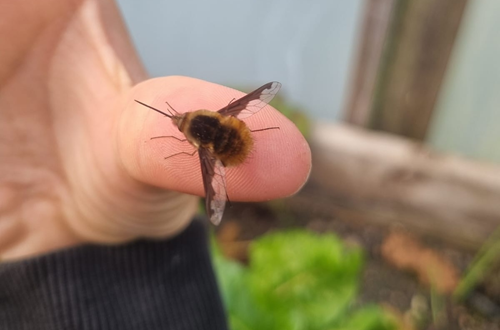
This is the UK’s most common bee‑fly and the one most people spot first. It’s round‑bodied, teddy‑bear fluffy and golden‑brown, with a distinctive dark band along the leading edge of the wings, the best clue to its identity. Its extra‑long, rigid proboscis looks like a sting, but it’s just a nectar‑sipping straw. Dark‑edged bee‑flies emerge from March, often appearing in warm spells, and zip between spring flowers like primroses and hyacinths. Females search for the nest burrows of solitary mining bees and cleverly flick their eggs towards the entrance, a perfect ambush for the unsuspecting host’s young.
Dotted (sometimes referred to as “spotted”) bee‑fly (Bombylius discolor)
A little more localised but spreading northwards, the dotted bee‑fly is a treat to find. At first glance it looks similar to the dark‑edged species, but when it rests you’ll spot the giveaway: neat rows of dark spots where the wing veins meet. It favours sunny banks and sandy paths, especially in the south of England and along the south Wales coast, though records are increasing. Like its cousin, it parasitises Andrena mining bees, part of why seeing one is a great sign your patch is healthy and buzzing with wild bee diversity.
Each of these cuckoos and bee-flies highlight a fascinating element of bumblebee ecology: their presence relies entirely on healthy populations of their host species. So when you spot a cuckoo bumblebee, you’re not just seeing a clever parasite at work, you’re also witnessing a sign of a functioning, biodiverse bumblebee community.