Written by Henrietta Appleton, Policy Officer (England)
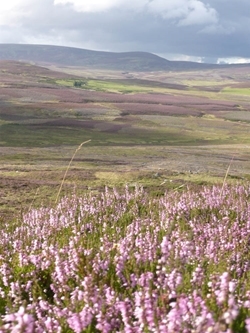 I recently attended the Future Countryside event at Raby Castle, Co. Durham, and a Moorland Matters event in Arkengarthdale, North Yorkshire. The idea of both was to bring the different interests in the countryside together to explore opportunities for working collaboratively. One of the main conclusions I reached was the importance of language.
At the simplest level, this comes down to ensuring a broad understanding of terms used. Too often we sit in our various roles, comfortable in the knowledge we have and the language we use, without considering how others might perceive what we are saying or even understand. For example, we often use the term ‘recruitment’ in the context of wildlife populations. Recruitment is used by scientists for adding new individuals to a population, but it is not one that is perhaps widely understood. Referring to ‘breeding success’ or the number of young each adult pair raises could achieve the message better.
Context is therefore an important determinant of ensuring that the message is received by the widest possible audience. Misunderstandings are what underpins the principle concern I have about language – and that is its ability to reinforce conflict. The term peatland burning to describe controlled/prescribed burning on grouse moors comes to mind here. It is factually incorrect as the peat is not burnt during a controlled/prescribed burn, but it reinforces the message that those opposed to grouse moor management want to get across – that it has negative effects on peatlands.
Recently I was listening to an interesting interview of Tim Christophersen (author of Generation Restoration), who made a very important point that is relevant to how we use language – and that is fear is not a good driver of policy. So, to my mind the constant use of the terms ‘nature crisis’ and ‘nature-depleted’ is not helpful, as it leads to a short-term drive to address the risk without considering the longer-term implications of those actions. These actions are being held to account by legally embedded targets – again encouraging short-term approaches and, as Tim Christophersen put it, “fear leads to hoarding and greed and competition”. Not the basis for sound long-term solutions.
In addition, the need to address the nature crisis has led to the development of natural capital and measures to put a price on biodiversity. As Tim Christophersen says, there is no easy answer as to whether this is constructive. With the focus on the economics of biodiversity came concerns by practitioners (led by indigenous peoples across the world) that commodifying nature had unintended consequences as it created an unlevel playing field, with some nature being easier to monetise than others – hence the focus on woodland carbon but little value (yet) on farmland birds, for example. But as value is the language that the world speaks, you have to put a price on nature to avoid it being subjugated to other capital and social values.
Many of the terms that have been used to create fear have also created conflict. They have driven the polarisation of viewpoints as stakeholders strive to prove that their approach will address the nature crisis that we are facing. The debate about land sharing and land sparing or the conservation model of moorland management and grouse moor management are examples of the point that Tim makes about fear leading to competition. This does not encourage collaboration and a common language.
This also brings me to the idea of environmental justice. There is a real inequality in the voices and language being heard. Whilst ‘engagement’ is a widely employed policy tool, it has become a simple box-ticking exercise. Stakeholders are invited into a workshop or to contribute to a consultation but there is very little clear evidence of genuine participation. Synonyms for engagement are meeting/get together/invitation; those for participation are contribution/collaboration/involvement. The latter embeds a co-existence model of working, which the former fails to do, thereby reinforcing polarised views and conflict.
But different languages can also be spoken by different interests such as government, academia and farmers, thereby making communication for the purpose of creating policy and regulation difficult between these groups. Governments often look for easy wins with their voters or to address their political ideologies and beliefs. Whereas for academics it is all about the data and evidence, and for farmers it is all about their connection to the land. Whilst the economics of farming might suggest that planting crops for the 2027 harvest will be a loss-making exercise, many will decide to go ahead because that is what they do – produce food.
The GWCT will continue to explore opportunities to encourage co-existence and collaborative working between all interests and communities. But until policy mechanisms underpin such approaches through genuine participation and good governance, there is little motivation for all stakeholders to seek resolutions to the conflicts that hinder our ability to address nature’s recovery.
(Note: These monthly musings are intended as interest pieces and to provoke thought. I do not pretend to have deep knowledge about the subjects I am covering or indeed to be comprehensive in my coverage. I hope you enjoy reading them as much as I enjoy researching and writing them.)