A female curlew at the centre of a study by the Game & Wildlife Conservation Trust (GWCT) has broken the UK longevity record at the age of nearly 34.
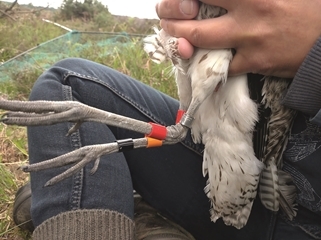
The bird was spotted last week, identified through her colour rings and her age confirmed as 33 years and 8 or 9 months.
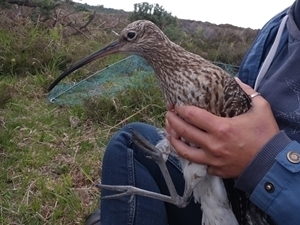 Initially ringed as a juvenile on Brownsea Island in September 1992, she would have hatched that summer. In 2022, researchers from GWCT recaptured her in the New Forest, colour ringed her and fitted her with a satellite tag. That summer, with the help of Forestry England rangers who monitored and supported curlew breeding in the area, she successfully fledged one chick at the age of 29.
Her movements continued to be tracked over the next couple of years and showed her feeding in the Avon Valley in March-April prior to spending the breeding season in the New Forest and the winters in Brandt’s Bay and on Studland Heath.
In 2023 and 2024 she continued to attempt to breed in the New Forest but did not manage to hatch any more chicks. Researchers nicknamed her Mrs Ogdens, after the hamlet near Fordingbridge where she was tagged in 2022.
The previous UK & Irish longevity record (BTO) was held by a bird that was recovered in 2011 and its age confirmed from its rings as 32 years and 7 months.
Elli Rivers, GWCT researcher who is writing her PhD based on her studies of Mrs Ogdens and other curlew breeding in the New Forest, says: “It’s great to see that this female has survived long enough to break the longevity record. However, it shows how urgently we need to protect the nesting efforts of our local birds and bring more juveniles into the breeding pool. If she’s representative of the age range of her fellow birds, there’s a risk the population could suddenly crash.”
Lee Knight, Forestry England, forest keeper in the New Forest who monitored and supported her nest in 2022, says: “It’s a great privilege to be involved in the conservation of such an iconic New Forest bird. My hope is that with our help, we will see these birds recover and stabilise well into the future for the next generations to witness.”
 Mike Short, head of predation management research at GWCT, says: “The support of the local Forestry England team has been vital. It has monitored breeding curlews in this area for over a decade. Curlews are very site faithful, yet as far as we’re aware, chicks had never been recorded fledging from this territory. It’s plausible that Mrs Ogdens has attempted to breed in this patch of the forest her whole life, yet failed to rear chicks. Then in 2022, with the support of Forestry England keepers’ predation management, we recorded her successfully incubate her clutch of eggs, and one chick fledging.”
“It just goes to show that even in this busy, human-dominated landscape here in the south of England, if you get the breeding conditions right for wild curlews, they can actually successfully reproduce even at the ripe old age of 29.”
Flo Blackbourn, of Curlew Action, says: “A new record age for a Curlew is remarkable and a reminder of how long these birds can share our landscapes with us. However, their longevity masks a conservation crisis - too few Curlews are fledging for their numbers to remain stable.
The Eurasian Curlew has declined by around 50% in the UK in just 25 years. Turning that around will require urgent action on the ground, backed by clear policy support. This is the aim of the new UK Curlew Action Plan launched in January 2026.”
- END -
Please note: The curlew in these photos is part of licensed bird ringing activities, carried out by fully trained BTO bird ringers and was handled as part of our research.
The Game & Wildlife Conservation Trust – providing research-led conservation for a thriving countryside. The GWCT is an independent wildlife conservation charity which has carried out scientific research into Britain’s game and wildlife since the 1930s. We advise farmers and landowners on improving wildlife habitats. We employ more than 60 post-doctoral scientists and other research staff with expertise in areas such as birds, insects, mammals, farming, fish and statistics. We undertake our own research as well as projects funded by contract and grant-aid from Government and private bodies. The Trust also has a dedicated professional advisory service to make sure that the results of its research are easily available to farmers, landowners, gamekeepers, and others delivering practical conservation.
Forestry England is the largest land manager in England, responsible for managing and promoting publicly owned forests, ensuring they are accessible for people, wildlife, and businesses.
Curlew Action is a UK-based conservation charity founded in 2019 to reverse the decline in the Eurasian Curlew and promote better nature literacy in society. The charity does this by celebrating and raising awareness about Curlews worldwide, giving regular talks and holding events about Curlew conservation and nature education more generally. The charity's mission is the give Curlews a secure future through advocacy, supporting conservation efforts, engaging science and policy, highlighting the cultural importance of Curlews, and by promoting natural history education. Curlew Action's Founder & Director, Mary Colwell, established World Curlew Day in 2017 - a day on which Curlews around the world are celebrated.
For more information, please contact:
Eleanor Williams – GWCT Media & Communications Manager