Our tagged snipe have begun their migrations... where will they end up staying for the breeding season?
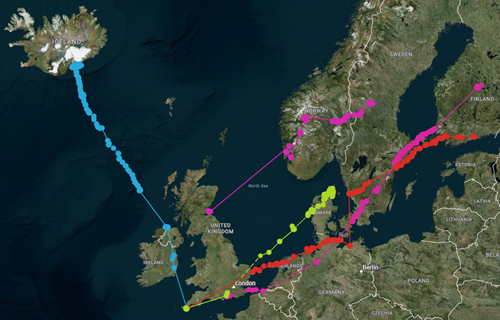
New data from seven common snipe being tracked as part of the Game & Wildlife Conservation Trust’s (GWCT) project to map the routes to their breeding grounds has so far shown five of the birds travelling to Finland, Sweden, Denmark, Iceland, Norway and Germany.
Researchers caught and fitted the birds with GPS tags in March this year - six in Cornwall and one in Fife, Scotland - in a bid to see where these elusive waders go to breed after spending the winter in the British Isles.
Bleddyn Thomas, who captured the birds and tagged them at both sites, says: “It's great to see that five of them have left their tagging sites and at least started their spring migrations. Four have travelled eastwards to Fenno-Scandinavia, whilst one has travelled north-westwards to Iceland.
“It's not possible yet to say with certainty whether these are where our tagged snipe will breed, as they could continue to travel further. Nevertheless, the differences in the directions taken by these snipe highlights the geographic variation in the breeding locations of the UK's overwintering snipe.
“We will now wait and see where they remain over summer.”
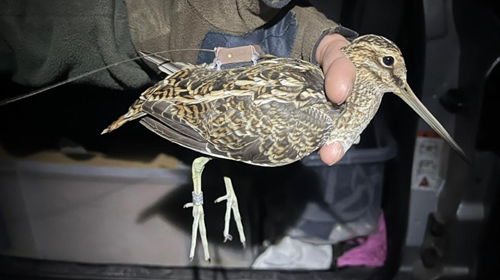
Figure 1: Polquest, a snipe tagged at Lanarth in March 2026. Polquest has since left Cornwall and made its way northwards to County Donegal, Ireland.
The tags used are some of the smallest tags available for bird migration studies and weigh only 2g, but when the leg harnesses and foam bases are added to the tags, the weight increases to 3g. The weight of the tag should not be over 3% of the body weight of the bird to ensure that the tag does not impede on its natural behaviour.
This meant that even though the study team captured 14 snipe across the two sites, only half of them could be tagged as they weighed above 100g and were therefore deemed large enough.
Of the snipe tagged in Cornwall, the first to depart was Treskewes, which left Lanarth on 26 March, only nine days after being tagged and travelled over 1,500 miles in 19 days. Treskewes, followed the south coast of England and cross to Belgium, then on to Bremen in Germany, followed by Copenhagen in Denmark, up across Sweden to Stockholm before crossing the Baltic Sea to Finland. Treskewes has since remained in Keski-Suomi Province in central Finland.
Another Cornish snipe, Polquest, left on 6 April and flew across to County Donegal in Republic of Ireland, before carrying on north to Iceland where it remain in the south of the island.
A third bird, Dee, travelled to Norfolk before crossing to the Netherlands and onto northern Germany, an 800-mile journey over four days. Dee then headed across to Sweden, before crossing to Finland.
The last Cornish bird to have left was Goon late on 1 May. Goon travelled across the UK and the North Sea to Denmark on 2 May and has since remained in northern Denmark.
Neuk, the only snipe tagged in Fife in 2026, left the site where it was tagged on the evening of 8 April. By the morning of 10 April, Neuk had reached the coast of Norway, travelling nearly 400 miles across the open ocean in just over a day. Neuk continued to travel north up to Husnes, before turning and going back south to Sveio in Vestland where Neuk remains.
There are still two tagged snipe in Cornwall that have not left – Pascoe and Turncoat. Their recent transmissions suggest they have not moved from their tagging locations.
Bleddyn adds: “It is possible that these birds could still migrate, as snipe have been recorded migrating into May. This happened with some of the snipe we tagged in 2025.
“However, it’s also entirely possible that they don’t leave at all - several snipe tagged in 2025 never left, and anecdotal evidence suggests that there may be more snipe remaining around the Lizard Peninsula than previously thought.”
Once a familiar sight in our wetlands, breeding numbers of snipe have notably declined across the UK lowlands and in many parts of Europe, and this has affected our wintering populations.
Historical changes in land use have been the main driver of the decline, with wet meadows being drained and wetland habitats being lost or degraded. Climate change may also be affecting their breeding and migration patterns.
Researchers hope that the study will help us better understand the reasons behind their decline and how best to support their conservation.
Ends
VIDEO: Sniping - discover the secrets of the snipe!
Help discover the secrets of the snipe
You can play a role in helping to reveal the secrets of the snipe. In the run up to Christmas the GWCT is running a Snipe Appeal to raise funds for this vital project. By contributing, you could help fund the technology and expertise needed to reveal the hidden life of the common snipe and ensure they remain part of our wild world for generations to come.
Common Snipe (Gallinago gallinago) Facts - BTO
Snipe breed throughout Britain, although in smaller numbers in the south and east following the drainage of much of our lowland wet grassland. Numbers are, however, much greater in the winter when the migratory wintering birds arrive.
Breeding pairs: 67,000
Migratory/wintering individuals: 1.1 million
Decline: Breeding pairs dropped by 17 % between 1995 and 2023 (28 years). The wintering population reduced by 38.7% from the winter of 1993/94 to 2018/19 (25 years).
Notes for editors:
The Game & Wildlife Conservation Trust – providing research-led conservation for a thriving countryside. The GWCT is an independent wildlife conservation charity which has carried out scientific research into Britain’s game and wildlife since the 1930s. We advise farmers and landowners on improving wildlife habitats. We employ more than 60 post-doctoral scientists and other research staff with expertise in areas such as birds, insects, mammals, farming, fish and statistics. We undertake our own research as well as projects funded by contract and grant-aid from Government and private bodies. The Trust also has a dedicated professional advisory service to make sure that the results of its research are easily available to farmers, landowners, gamekeepers, and others delivering practical conservation.
For more information, images or to arrange an interview please contact:
Eleanor Williams
ewilliams@gwct.org.uk
07592 025476