By Joe Stanley, Head of Sustainable Farming, the Allerton Project
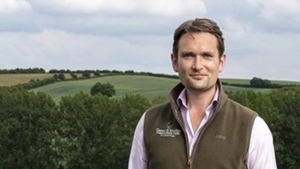 2026 sees the GWCT’s Big Farmland Bird Count (BFBC) return to its spiritual home of the Allerton Project, the GWCT’s research and demonstration farm on the Leicestershire-Rutland border, where it was originally launched in 2014. This engaging initiative was a response to long-term declines in UK farmland birds such as the skylark, yellowhammer and lapwing, and the aim was twofold: to collect large-scale, farmer-led data on winter bird numbers and to engage farmers and land managers directly in conservation monitoring.
Held annually each February, the count asks participants to record bird species and numbers on their land during a 30-minute standardised survey period. What initially began as a modest initiative has – to our great joy – grown over the past decade: in recent years some 1,700 counts have been held annually recording hundreds of thousands of birds and dozens of amber and red-listed species.
My own engagement with the BFBC only began after I arrived at the Allerton Project in 2021. I had previously spent a lifetime on the land on my own family farm, but had never taken the opportunity to engage with the wildlife to be found there. I always felt I was too busy rushing hither and yon doing the business of, well, ‘farming’. Little did I realise the value that was to be gained from – just occasionally – taking the time to sit, watch, listen and observe the activity of the natural world outside my tractor cab.
For me, this is a hugely important element of the BFBC – not only allowing farmers to demonstrate the benefit they are having on farmland bird populations via careful stewardship but also to engage those farmers who are less familiar with the bounty on their doorsteps and to get them excited about the prospect of doing more in future, especially the younger generation. This is a golden opportunity in the calendar to do just that.
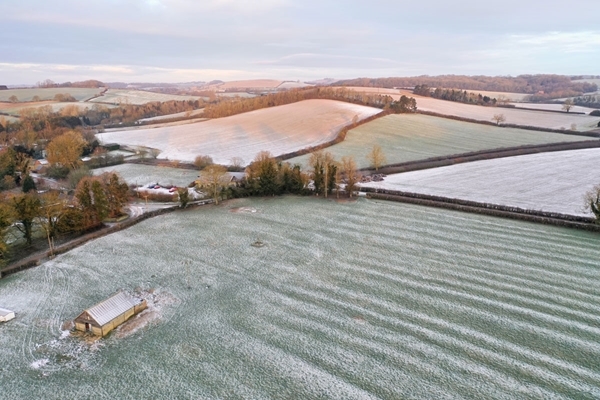
The Allerton Project, January 2026
The Allerton Project has been at the forefront of demonstrating how farming and food production can sit alongside a thriving natural environment since we began operations in 1992 on the generous donation of our 320ha estate by the previous owners, Lord and Lady Allerton. We are a working research and demonstration farm; we have arable crops and permanent pasture which hosts livestock, but we also have a full-time team of research scientists who conduct field and landscape-scale data collection on everything from biodiversity to water quality; greenhouse gas emissions to soil health. Every year, we host some 2,000 visitors from the food and farming sector, as well as politicians, civil servants and many others, to demonstrate the complex interplay between a requirement to feed a growing population but to do so in a more environmentally friendly way than has hitherto been the case.
We believe that we can demonstrate many of the solutions to this challenge, and over the decades many of the approaches we have pioneered have been integrated in national agri-environmental policies, from beetle banks to reduce the use of insecticides to supplementary feeding to close the ‘hungry gap’ for farmland birds through the winter months. Today, we are a leading pioneer in the frontier of soil science, demonstrating how our farmland soils can be more sustainable managed for future generations and to meet our current climate and environmental goals.
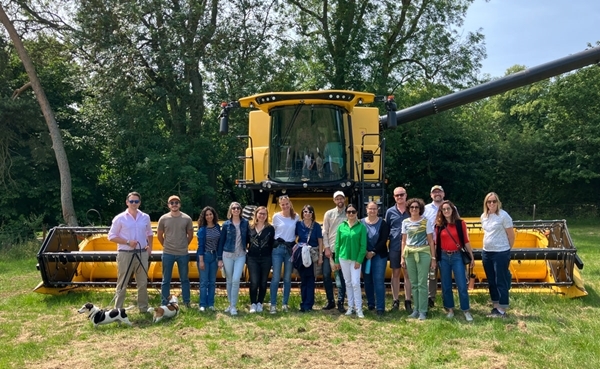
The Allerton Project is a place where those with an interest in sustainable food systems can come to deepen their understanding of a truly complex subject.
One of the key pieces of research carried out at the Allerton Project from our earliest days and continued to this day is a long-term look at how our ‘three-legged stool’ approach to wildlife conservation can be effective in boosting farm wildlife numbers. In 1992 we conducted a baseline survey of key species on the farm, and then recorded their response to a three-pronged approach to increasing their populations: by providing high quality habitat, supplementary winter feed and predation control.
The results were remarkable. Within three years songbird numbers had increased by 75%; by year eight they had doubled from the baseline. Brown hare numbers increased by some 1500% in three years. Wild pheasants (a proxy for ground-nesting birds) increased by some 280% in four years. These results came alongside what would today be considered still very intensive food production within our fields, but with our woodlands managed to improve the quality of the habitat provided, new hedgerows established, grass and flower-rich margins established on the least productive parts of field margins, and the establishment of winter bird seed mixes (non-harvested seed bearing crops designed to feed birds in the late autumn and early winter). Alongside this, we also conducted a targeted programme of predation control, reducing the populations of foxes, corvids and rats.
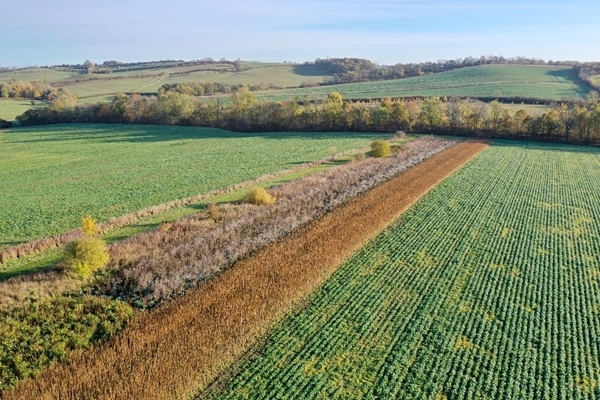
Winter bird seed mixes planted in strips connecting woodland habitat at the Allerton Project, autumn 2025
What makes this study of particular note, however, is what we did next. In year 11, we removed one of the legs of the stool and stopped controlling predators. Immediately, the metrics began to go backward at pace; within four years (2005) our hare population had collapsed back to near its baseline in 1992. Yet after five years, we then removed the supplementary winter feed, as well. By 2009 the gains made in our farmland bird populations in the first decade had also been lost, while wild pheasant numbers were a quarter of those at the beginning of the trial.
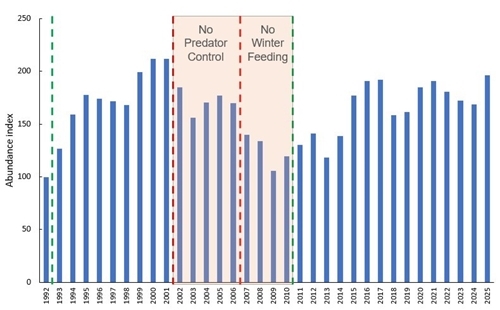
Allerton Project songbird numbers, 1992-2025
In 2011 we instituted the full three-legged approach once again, and to our relief once again saw our wildlife populations climb. Today, our farmland bird numbers stand 92% higher than the level first recorded in 1992 and brown hare numbers are some 800% higher. To us, this demonstrates the need to institute all three elements of our three-legged stool; habitat creation alone – often the sole element to be seen in agri-environment schemes – is not enough. Today we have thriving populations of many amber and red-listed bird species; yellowhammer, greenfinch, skylark, kestrel and spotted flycatcher to name but a few. It’s always great to catch sight of them in our annual BFBC count.
Over the past three decades we have had other successes too; our macro-moth numbers have seen significant increases against a national backdrop of significant decreases: 2023 saw our year of highest species diversity to total 337 species recorded since monitoring began in 1992. In that time, 26% of our species have increased in abundance and 70% have recorded no significant change. Only 4% have decreased. Nationally, 41% of species have decreased with only 10% increasing. Again, this is against the backdrop of a modern, commercial farming operation producing commodity crops and using fertiliser and synthetic plant protection products. The key to our success is that we have also retasked some 15% of our arable area to habitat creation. Now, the least productive parts of our farm are delivering for nature, while the most productive (and profitable) parts continue to produce food for the nation.
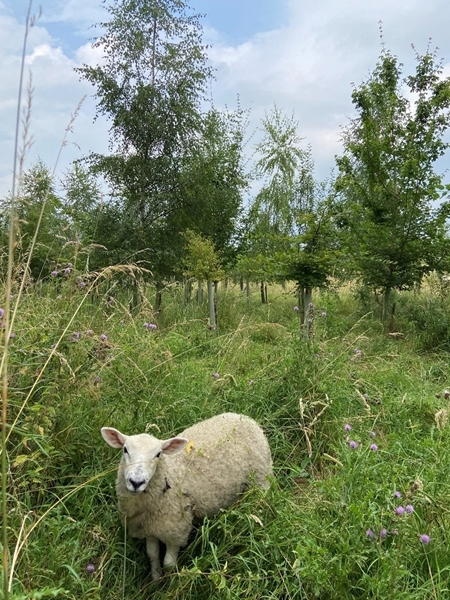 We know that our agroforestry silvopasture field has had a beneficial impact on our macromoth and wider invertebrate populations
We are proud of the work we are continuing to do at the Allerton Project to demonstrate how food production and a thriving natural environment can work hand-in-hand; indeed, how the one can benefit the other. The BFBC gives us an annual opportunity to showcase some of the successes we’ve achieved here over the past 34 years – successes which can be replicated on any farm across the country, given the will and the investment. Thriving farmland bird populations are just the tip of the iceberg when it comes to nature-friendly farming indicators, but they’re also one which bring great joy to many of us.