By Jobe Burnham, Allerton Project Conservation Officer
This spring, we have established 6.7 hectares of AB9 Winter Bird Seed Mix across our 320-hectare farm at the GWCT Allerton Project in Loddington. This is part of our Countryside Stewardship Mid Tier (CSMT) agreement that has been extended for 2026, after last year’s Sustainable Farming Incentive (SFI) mishap. For 2027 we will, hopefully, establish winter bird seed mixes under SFI26, where we have to learn new codes (AB9becomes CAHL2), and we’ll be paid less per hectare, even though it will cost us more! We establish the bird seed mixes where they deliver the greatest environmental benefit while also providing valuable holding and feeding cover for the shoot.
Selecting the correct seed mixture is fundamental to delivering a continuous supply of food and habitat throughout the winter months. All our environmental mixes are supplied by Frontier Environmental, with a range of mixtures chosen to suit differing soil types, management objectives and wildlife requirements. These include Campaign mix South, Take Off, Winter Wildlife Holding, Universal Brassica, Super 10, and the Grey Partridge Mix. Together, these diverse mixtures provide an effective combination of cereals, brassicas, legumes and flowering species, producing both autumn and winter seed resources alongside valuable nesting and brood-rearing habitat.
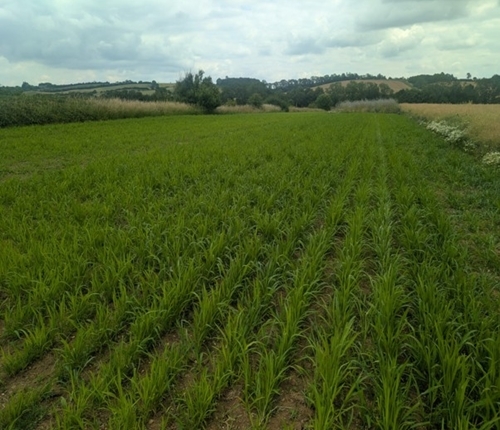 Campaign mix south
Successful establishment starts with the seedbed
As with any arable crop, successful establishment begins with attention to detail. Winter bird seed mixtures perform best when drilled into a fine, firm seedbed, ensuring consistent seed-to-soil contact and even emergence across the plot. On our heavier ground, the most reliable establishment has been achieved through ploughing followed by power harrowing, producing the level and consolidated finish required for these relatively small-seeded mixtures. This can however leave us wide open for an own goal by losing all the moisture, which in 2025 proved disastrous with 40% of the winter bird food areas needing reestablishing, some even twice. Fortunately, timely rainfall during late May and into June this year provided excellent establishment conditions across much of the farm. However, the recent period of exceptionally high temperatures will inevitably place stress on younger plants. Where root development has been limited by slower emergence or variable seedbeds, some plots may struggle to withstand any prolonged dry conditions.
Brassica establishment and cabbage stem flea beetle
Brassica-based mixtures continue to provide an excellent source of winter forage and structure within AB9 options, and have the economic benefit of being biannual mixes, but their establishment is increasingly challenged by cabbage stem flea beetle.
Adult flea beetles feed on newly emerged cotyledons and young leaves, creating the familiar shot-hole damage which can rapidly reduce plant populations where pressure is high. Since the withdrawal of neonicotinoid seed treatments, growers have become increasingly reliant on strong establishment rather than chemical control. Warm, dry weather also encourages flea beetle activity while simultaneously slowing crop growth, leaving young brassicas vulnerable for longer periods. Achieving rapid establishment remains the most effective way of allowing crops to get beyond the susceptible growth stages.
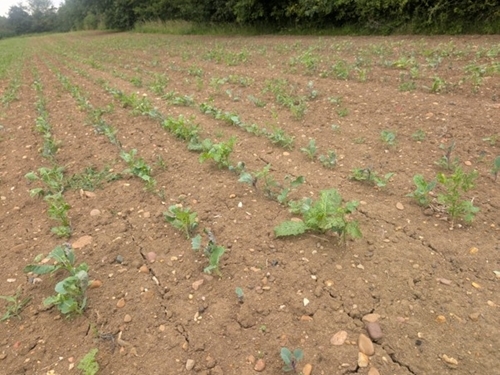 Universal brassica mix
Minimising weed competition
Effective weed management is equally important in producing a successful winter bird seed crop. Early weed competition reduces light, moisture and nutrient availability, limiting the establishment of the desired species. Where appropriate, pre-emergence herbicides remain an important management tool, helping maintain clean plots during the critical early stages of crop development.
Weed burden also tends to increase where stewardship plots are established in the same location year after year. Over time, weed seed banks accumulate, resulting in greater competition and increasing management challenges. Rotating AB9 locations, where practical, helps reduce this pressure while maintaining the long-term effectiveness of the option.
Maintaining soil fertility
Repeatedly growing stewardship mixtures on the same areas can also contribute to declining soil fertility. Continuous removal of nutrients without replacement can lead to deficiencies that ultimately reduce crop performance and the quality of wildlife habitat produced.
To improve both soil health and long-term resilience, we have incorporated farmyard manure into our stewardship programme while also utilising catch crops within the wider rotation. Organic manures replenish nutrients, increase soil organic matter and improve soil structure, while catch crops help recycle nutrients, protect soils from erosion and encourage biological activity.
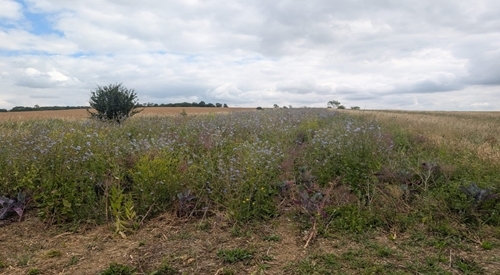 Second year winter wildlife holding