By Alastair Leake, Director of Policy & Allerton Project
 I visited one of our longest established floral field margins over the weekend. Stepping out of the truck prompted four skylarks to ascend, filling the sky with birdsong. This part of the farm is the bastion of the skylark, away from the wooded areas down by the village, these large open fields are their favorite place. Although numbers are stable, I’m reminded of a PhD study carried out here twenty-five years ago which recorded chick mortality. In hot, dry conditions our clay soils crack, and these crevices can prove fatal to young chicks moving out from the nests. Recent years have all been cracking ones, which got me wondering if this is now impacting on our population.
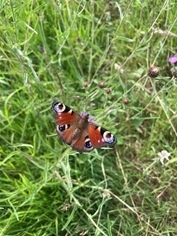
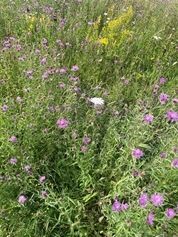
As I wandered into the floral strip a cloud of peacock butterflies took off from feeding on a huge clump of knapweed, now in full bloom, the collective beat of their wings audible. Less conspicuous are the meadow browns, but never-the-less plentiful, flitting among the grasses and birds foot trefoil. With each swing forward of my foot, the vegetation about half a metre ahead twitches with the body mass of grasshoppers leaping ahead of my threatening foot. There were no grasshoppers here when we inherited the farm 35 years ago, but our subsequent management has seen them return in abundance. This is the very same strip which announced the arrival of spring with a stunning display of cowslips, the succession of flowers of different types following on all the way into autumn. It is also funded by our 2020 mid-tier Countryside Stewardship agreement, which expired last year but was, at the last minute, reprieved by a one-year roll-over. With no opportunity to re-apply until at least September the future of this wildlife haven looks increasingly uncertain.
 Minister Eagle had explained to me earlier this summer that it was the government’s intention to “support smaller farmers” and those who had not accessed environmental schemes previously. At 800 acres and decades of participation in delivering “public goods for public money” that excludes me. I have nothing but admiration for small farmers, many of whom juggle farming with other work, but the few I have spoken to don’t have the time or inclination to grapple with the red tape of an environmental scheme when the amount of money they are likely to get is so small. It begs the question as to whether the government wants to use the money to get the best environmental outcomes or to use the money as some sort of social payment. The capping of payments at £100k for larger farmers and landowners means many of the farms in the best position to deliver wildlife across landscapes will have their ambitions stifled, and there are wider questions regarding the total funding pot too.
So I anticipate a tricky discussion with our Farm Manager coming up. We have been one of the areas in the country which has felt the impact of climate change in recent years, particularly increased intensity, volume and frequency of rainfall, making work windows too narrow with measurable impacts on yield and profitability. We have lost money at an unsustainable rate over the past 2 years, and the farm manager is at the forefront of rectifying that. If we find this strip loses its source of income the only alternative which can contribute towards the bottom line is to grow food on it again. I don’t want that, I’m sure the public would not want it either, and certainly not the butterflies and grasshoppers.
Photo credit: Alastair Leake