 A group of local farmers has set-up a new on-farm water testing laboratory to monitor the health of the Bourne, a tributary of the River Avon. This is the fifth such facility launched by members of the Environmental Farmers Group (EFG) across the Hampshire Avon catchment. The goal is to better understand how farming practices contribute to nitrate, phosphate and sediment levels and to take practical steps to reduce pollution.
Farmers recently met at Manor Farm near Winterbourne Earls, in Wiltshire, for hands-on training in water sampling by Game and Wildlife Conservation Trust (GWCT) scientist, Will Beaumont and ecologist, Robin Leech, who is carrying out similar monitoring on the river Wylye.
Initiated by the GWCT in 2022, EFG is a farmer-owned, farmer-led cooperative working to protect and enhance Nature for public benefit. The new lab directly supports EFG’s three environmental priorities of improving water quality, recovering biodiversity and species, and reaching net-zero carbon farming by 2040.
Philip Harvey and his son Joe run Manor Farm, where the lab is located. Philip said: “We are delighted to be joining our fellow EFG members in starting to test water quality on the Hampshire Avon catchment. As farmers we are very conscious of the need to look after the environment, especially as we live and farm in the largest chalk stream catchment in England. It’s important to be able to distinguish the impact of farming practices on the river from other sources of pollution and like all farmers we are at the mercy of the weather, but we don’t want to see our precious soil ending up in the river and carrying phosphates with it. We have to use nitrate fertiliser to grow food to feed the nation, but we need to use it efficiently to cut costs and minimise run-off.”
The on-farm laboratory has been supplied by Rothamsted Research through its Resilient Farming Futures Institute Strategic Programme, funded by UKRI-BBSRC.
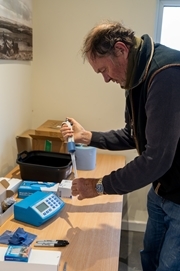 Programme lead Prof Adie Collins said: “This ground-breaking initiative empowers farmers to understand the pressures on their rivers and to take evidence-based action. By collecting data themselves, they can pinpoint likely pollution sources and put solutions in place where farming is a factor. We encourage more farming groups to adopt these low-tech, accessible methods to build long-term, locally driven evidence for action.”
Tim Palmer, EFG’s lead for water and river restoration, added: “EFG farmers in the Hampshire Avon have been testing water quality at four other points in the catchment for up to 2½ years now. We aim to produce a long-term database for nitrate, phosphate and sediment and to gain an understanding of what remedial actions work best. By using low-tech colour analysis to identify sources of sediment delivered into the river, we can cut existing problems off and because sediment and phosphorus are closely linked, we can gain insights into the sources of that priority water pollutant too."
"With increasingly limited public funding this voluntary effort is critical to improving the health of our rivers. For example, one year of weekly sampling along the river Wylye at 16 different sites plus analysis in the lab adds up to 364 hours or about £7,200 worth of volunteer time. With two more labs planned for the Avon Catchment, that total is the equivalent of an annual contribution of £43,000 from our farmers, with more to come.
Looking ahead, EFG continues to deliver similar projects across the country with a new water-testing lab commencing in North Lincolnshire in the New Year.