By Felix Meister, D.Phil., Advisor Scotland
 10 December marks the official end of the grouse-shooting season in the UK. Thus, it provides an excellent opportunity to update on the results of the health testing in red grouse carried out by the GWCT Advisory Services in Scotland in 2025.
Samples
Grouse health testing depends to a large degree on birds shot during the grouse-shooting season. It is possible to calculate strongyle-worm numbers outside the shooting season, by counting the number of worm eggs found in the caecal faeces of live birds. However, the majority of strongyle worm analysis is traditionally done by counting worms in the guts of shot birds. Likewise, testing for Louping Ill Virus (LIV) is best done by analysing blood samples extracted from recently shot birds.
Following improved breeding success of grouse in 2025 compared to 2024, many estates across Scotland decided to hold shoot days and either sent samples to the GWCT for analysis or invited a GWCT advisor to collect them on the day. Overall, a total of 1,181 samples were analysed for strongyle worms, comprising 932 (79%) gut samples and 249 (21%) caecal samples. For LIV testing, a total of 908 blood samples were analysed.
These figures represent a marked improvement compared to 2024, when exceptionally poor breeding success of red grouse meant that few estates were able to hold shoot days and health testing had to be limited. In fact, the number of strongyle worm samples analysed in 2025 exceeded those analysed in the very good season of 2023, while the number of LIV samples is almost identical.
Regions
Estates and farms commissioning GWCT for grouse health testing are assigned to one of seven regions to allow identification of trends across these larger geographical units: Angus, Borders, Dee/Donside, Dumfries & Galloway, Highlands, Moray & Nairn, and Perthshire.
All seven regions supplied either gut or caecal samples for strongyle worm analysis in 2025. The highest number of samples was supplied by Borders, which supplied more than half of all samples (51%, n = 606), followed by Angus with 15% (n = 178) and Perthshire with 11% (n = 126) of all samples.
For LIV testing, six regions supplied samples, Dumfries & Galloway not being represented. Borders again provided the highest number with 43% (n = 390) of all samples, followed by Perthshire (13%, n = 114) and Dee/Donside (12%, n = 110).
Results
The 2025 results for strongyle worm testing (caecal egg counts and worm counts combined) and LIV testing are detailed in tables 1 and 2 below respectively.
For strongyle worm testing, a total of 1,181 samples produced an overall mean worm burden of 52.9 worms per bird. This is considered a low worm burden. No region was found to be entirely free of strongyle worms. Among the seven regions represented in 2025, Borders returned the highest average worm burden with a mean of 151.2 worms per bird. The lowest average worm burdens were returned by Dee/Donside and Dumfries & Galloway with 9.1 and 9.0 respectively.
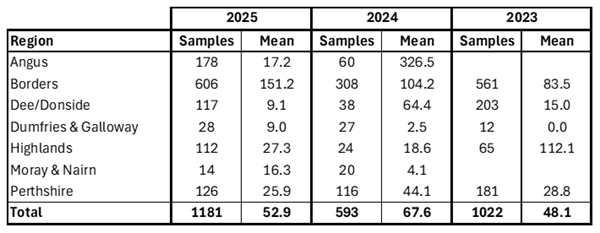
Table 1: Mean worm burdens per region 2023-2025
For LIV testing, a total of 908 samples returned 100 positive cases (11.0%). This figure is cause for some concern, especially as no region tested was found to be entirely free of LIV. The number of positive cases varied markedly between regions. Highest numbers were observed in Angus (21.5%), Dee/Donside (18.1%), and Highlands (15.8%). The lowest number of positive cases was found in Borders (2.1%) and Moray & Nairn (7.1%), though the latter region supplied the lowest number of samples overall (n = 14).
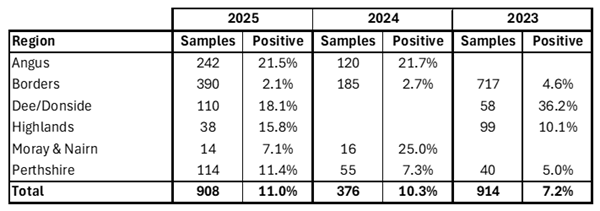
Table 2: Number of positive LIV cases per region 2023-2025
Looking back: 2024 and 2023
Tables 1 and 2 also detail the results of 2023 and 2024. Comparisons across years are difficult, since monitoring is not usually consistent across estates and beats. With that in mind, it appears that the total mean worm burden of 52.9 in 2025 is similar to that of 48.1 in 2023. (An apparent rise in 2024 was driven by data from Angus, which did not supply samples in 2023.) Among the individual regions, Angus returned a markedly lower worm burden based on a larger sample size compared to 2024. Likewise, Highlands was lower than in 2023. Dee/Donside and Perthshire were similar to 2023. Borders and, to a lesser extent, Dumfries & Galloway noted continuous increases in worm burdens observed across the three years.
For LIV testing, the total prevalence would appear to have increased from 7.2% in 2023 and 10.3% in 2024 to 11.0% in 2025. However, figures for individual years are driven by different regions tested. An apparent overall increase in 2024 was caused by data from Angus and Moray & Nairn, which did not supply samples in 2023. Likewise, an apparent increase in 2025 is explained by data from Dee/Donside and Highlands, which did not supply samples in 2024. Within the regions, Angus was similar to 2024 despite a doubling in sample size. Borders managed to reduce LIV prevalence across the three years, and Dee/Donside was lower with a more robust sample size compared to 2023. Highlands was slightly higher than in 2023, but based on a smaller sample size, and Perthshire more than doubled its prevalence since 2023.
Looking ahead: 2026
The fate of grouse across the UK over the last years has illustrated the complexity of grouse population dynamics. There is now a general consensus that weather, especially in May and June, has played an important role, both in the dramatic crash of 2024 and in the improved breeding success of 2025. While weather is beyond human control, the testing data obtained by the GWCT demonstrates that other factors also continue to restrain grouse breeding success.
Chief among these is LIV, which is particularly prevalent in regions where densities are already low. Grouse recovery in these areas will depend, at least in part, on targeting LIV, through a combination of a commercially available Louping Ill vaccine (currently developed by the Moredun Research Institute) and a rigorous tick-management regime.
Strongyle worm numbers tend to correlate with red grouse numbers. Hence, high worm burdens are not usually found where grouse densities are low, which explains the low total mean worm burden observed in 2025. However, individual high burdens were returned in some regions, especially in the Borders, and here medicated grit will have to play a role in preventing more severe outbreaks of strongylosis. Where worm burdens are consistently low, we would strongly advise against using medicated grit in order to reduce the risk of flubendazole resistance in strongyle worms.
Land managers wishing to discuss their testing regime with one GWCT’s expert advisors are encouraged to contact scottishadvisory@gwct.org.uk.