Written by Adriana Dermetzis
When I started my degree in Environmental Science at the University of Sheffield, I knew I wanted to do a placement year, it was just a question of what. I chose Sheffield because of its proximity to the Peak District’s open landscapes, and throughout my first year I developed a keen interest in wildlife and conservation through several modules. Once these interests formed, I knew wanted to find a placement where I could translate those into a career.
When I entered my second year and began my search for placements, I was overwhelmed with most positions being office based or looking for much previous experience, both of those being an issue for me. It was a long few months of applications and rejections before I encountered the GWCT for the first time through a conservation module, where Professor Nick Sotherton, the former Director of Research, as well as Advisory and Education of the GWCT, gave a talk about predator control strategies. This piqued my interest in the organisation, and as I researched the charity further, I gained respect for their long-term commitment to conservation. When I discovered they offered placement positions, I could not have applied quicker.
When I applied to the Uplands team, I did not expect a call back. I did not have any environmental work experience under my belt, and I was not very knowledgeable on English upland landscapes having grown up in America and only been taught a little in lectures. Yet despite these caveats, the team offered me the position, and I could not have been more grateful and excited.
Having only joined the Uplands team a little over three months ago, and doing field work for various projects, I feel I have learned skills that University could never teach.
The first project I properly participated in investigates the use of new native woodlands by black grouse within the East of Eden Nature Recovery Project Area and is funded by Natural England. My fellow placement student and I conducted woodland surveys, recording data on woodland characteristics like species composition, tree height and density, as well as witnessing some spectacular views along the way. This field work taught me to be more flexible as we often had to adapt in the field to changing weather conditions and unexpected hiccups. It also taught me how to use common field work equipment, like GPS devices, and learn map navigation.
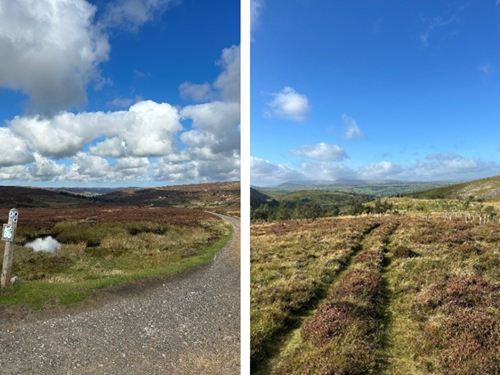
Views from various study sites while radiotracking black grouse (left) and completing woodland surveys (right).
I’ve also participated in the Maternal Grouse project, where multiple variables are being investigated to measure their effect on VHF radio-tagged female red grouse breeding productivity, including strongyle worm parasites and heather condition. Measures I helped gather included peat depths, vegetation height and level of egg visibility/nest concealment at this year’s nesting sites across various upland estates. This fieldwork taught me how complicated interactions in nature can be, as well as experience the harshness of upland landscapes.
More recently, I’ve had the opportunity to participate in the GWCT’s Black Grouse Range Expansion Project, where black grouse are being moved from their home in the North Pennines to a new site in the North York Moors. The project began in 2023 with a first successful translocation of 20 black grouse in autumn 2024, where eight males and eight females were fitted with radio tags prior to release. I had the opportunity to track the surviving tagged birds using a radio telemetry receiver and antenna, driving all through the North York Moors to get a signal off the tagged birds and triangulating their position.
Another batch of birds were translocated this autumn, and females were equipped with GPS tags. I was able to join the team to look for where the black grouse roost for the night to catch them later in the evening, a process requiring lots of patience. From this experience working on black grouse range expansion, I learned how to use thermal binoculars, and more importantly how much time, money and effort is needed for conservation work to be successful. Watching the handling and translocation of this endangered species was a one-of-a-kind experience, and a privilege I’m lucky enough to have had thanks to my placement.
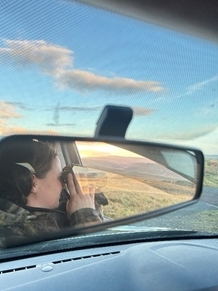
Using binoculars to track black grouse moving into their night-time roosts.
In the future, I am really looking forward to conducting lek counts in the spring in the North York Moors to see the newly translocated males displaying in their new home, as well as seeing the catching and radio-tagging of red grouse for the Maternal Grouse Project.
Overall, with just three months in the Uplands team and the GWCT, I’ve learned more about conservation work than any lecture could teach me. It is truly a unique experience, and I would highly recommend anyone thinking of applying to the GWCT’s placement positions to go for it, as it is truly a fantastic opportunity. It also comes with the bonus of amazing views no matter where you go!