By Mike Swan, Senior Advisor
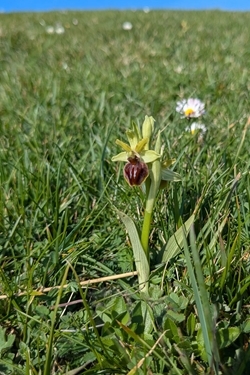 The little male mining bee landed briefly on the lip of the early spider orchid flower, but was gone in a flash. He had clearly been fooled again, and now took just a fraction of a second to work it out...
Orchids have been a life-long fascination for me, especially since discovering as a teenager that they were not all expensive tropical exotics. In fact,we have around 50 native species in the UK. While many are spectacularly beautiful, some are the very opposite of the big supermarket specials – tiny plants with little green flowers that can be very hard to find as they hide amongst the surrounding vegetation.
Some are also very rare, or at least highly restricted in their distribution. The early spider orchid (Ophrys sphegodes) is a case in point. In the UK it inhabits only the thinnest lime-rich soils and is found on just a few mainly clifftop sites in Dorset, the Isle of Wight, Sussex and Kent.
To my shame, I had never seen one until last Thursday, even though I knew that they are to be found on the limestone cliffs of Purbeck from way back when I first moved to this part of the world in 1982. A recent article about them in the Dorset Echo, flagged up by my colleague Jayna Connelly, finally spurred me into action, and I went for a clifftop walk in the early April sunshine.
I expected them to be hard to find, but that was not the case. I suppose having an eye for habitat helps, but I spotted a couple straight away in the thin turf alongside a small limestone outcrop when I first reached the clifftop. Following a stone wall down the slope to the main coast path revealed that there were literally hundreds to be seen once you got your eye in.
Unlike most flowers, orchids do not have loose pollen. Instead,it is held together in sticky clumps called pollinia, which attach to visiting insects. This is clearly an adaptation to the fact that they produce huge numbers of minute seeds. An odd grain being transferred from flower to flower on a hairy bee would be nothing like enough to fill a pod that probably contains thousands; this needs pollen in bulk. Perhaps the best way to think about this is to remember that vanilla is an orchid. Just ponder on how many tiny black seeds you get when you scrape out the contents of a pod.
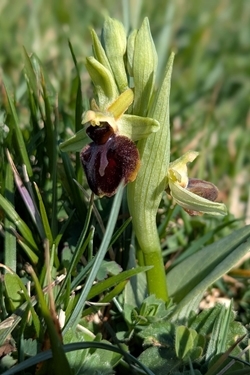 Orchids in general are not especially generous to pollinators. There is no loose pollen to provide protein for the likes of bee larvae, just maybe a little nectar at the end of flower spurs if your proboscis is long enough to reach. But, members of the genus Ophrys take this stinginess to the extreme, offering nothing but deception and wasted effort.
That split-second visit to the early spider orchid that I witnessed was not about trying to collect food, but an attempt to mate. Ophrys pollination is achieved through a very subtle process called pouyannian mimicry, in which the lip of the flower imitates a newly emerged female solitary bee or wasp. Alongside its visual similarity is the sweet scent of sex. The flowers produce an allomone that is in effect chemically identical to the pheromone of the virgin female of species imitated.
In the case of the early spider orchid, the species concerned is Andrena nigroaenea, sometimes known as the buffish mining bee. In common with most other Ophrys species, the peak flowering time is synchronized with the time when the male bees have emerged, and are waiting for their ladies to start to appear. At this time, the eager males are perhaps more easily deceived than when the real thing is available. It has even been suggested that some get so excited by the orchids that they not only get no reward, but also can waste sperm during their futile mating attempts. Judging by the briefness of the visit I saw, I am guessing that the wee chap concerned had previous experience of unsuccessful mating attempts.
This highly specialised pollination strategy may be wonderful for the orchid in terms of conserving resources, but it does not come without risk. Getting the timing right, and having the right species of insect present is just about essential.
So, what if those criteria are not met? Well, strange to tell, by far the most common Ophrys here in the UK is the bee orchid (O. apifera), but its normal pollinator, the solitary bee (Eucera longicornis), is really very rare and nothing like as widely distributed as the orchid.
The solution lies in the fact that most orchids, including our bee orchid, are self-fertile. They normally rely on pollinator activity to ensure cross pollination rather than physiological barriers. But, despite their wonderful showy flowers, British bee orchids are self-pollinated, having evolved weak stalks to the pollinia, which allow the pollen masses to hang down in front of the stigma. When the flower stem vibrates in the breeze, the dangling pollen masses stick on and fertilization follows.
Isn’t nature a wonderful thing?