By Jayna Connelly, Science Communicator
When you walk across grass, what goes through your mind? Do you notice how neat it looks, how green it is, or how many “weeds” you can see? Perhaps it depends on where you are. Many would agree that an ideal lawn looks very different from an ideal field, meadow or moorland – others might feel the opposite. Yet despite these differences, there are shared lessons in how we manage grassy places and what they can offer nature.
Gardens are where many people first experiment with letting nature in, but we already know that nature‑friendly management at landscape scale is essential for species conservation. Farmers have been working with these ideas for decades.
In 2019, Plantlife launched No Mow May, encouraging people to leave lawns uncut in early summer so wildflowers could bloom and provide crucial nectar for pollinators. The campaign struck a chord, helping to popularise a simple message about timing, flowers and insects. But the principles behind it were far from new.
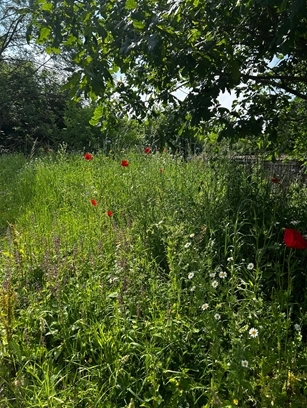 Long before No Mow May, agri‑environment schemes introduced from the 1990s onwards were already supporting late mowing, species‑rich grasslands and reduced cutting on farmland. These schemes recognised that allowing plants to flower and set seed, and reducing disturbance, benefits insects, birds and wider ecosystems. Around 2020–21, changes to UK farming policy coincided with growing public and political awareness of insect declines, early‑summer food shortages and the ecological impacts of intensive mowing in public spaces.
While No Mow May is not referenced directly in farming policy, its core principles are clearly embedded in current agri‑environment schemes. Today’s Sustainable Farming Incentive and Countryside Stewardship options reward later cuts, fewer cuts and flowering habitats, delivering these outcomes at scale, across working landscapes. One could argue that No Mow May has helped bring these ideas into gardens and towns, while farmers and land managers have been quietly putting them into practice for years.
Where No Mow May meets farming policy
Although No Mow May is best known as a campaign for gardens and public green spaces, its core principles, i.e. leaving vegetation undisturbed in spring, allowing plants to flower, and supporting insects early in the season, have long been part of farming policy.
In England, several Countryside Stewardship options explicitly encourage late or reduced mowing, often for the benefit of wildlife that depends on tall, flowering vegetation. Two of the clearest examples are CGS20 and CGS21, which are designed to conserve some of our most iconic farmland species.
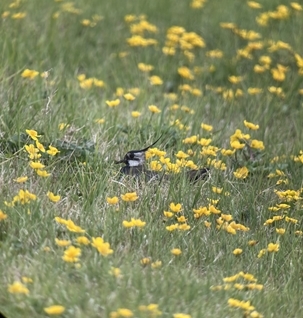 CGS20 – Manage wet grassland for breeding waders focuses on landscapes used by species such as lapwing, redshank and snipe. Cutting and grazing are delayed to maintain tall, mixed swards through spring and early summer, helping protect nests while also supporting the insects that chicks rely on for food. These wetter, less intensively managed grasslands mirror the ecological intent of No Mow May, but at a field and catchment scale where breeding birds can benefit.
Similarly, CGS21 – Manage grassland for target habitats, species or features supports late mowing and reduced cutting where grasslands are managed for particular conservation outcomes. This might include species‑rich grasslands or habitats important for declining farmland birds. By allowing plants to flower and set seed, CGS21 helps sustain insects, seed resources and structural diversity, all outcomes closely aligned with No Mow May principles, even if the option is more targeted and habitat‑specific.
Alongside these, long‑standing options such as GS6 (species‑rich grassland) and GS9 (wet grassland for breeding waders) also restrict cutting until mid‑summer, while grass and enhanced grass margins (BE3/BE6) are typically cut only once a year or less, with timing designed to protect flowers and insects.
Beyond May: Flexibility, timing and access
Under the Sustainable Farming Incentive (SFI), the connection is less explicit but often more flexible in practice. Actions such as multi‑species grassland, low‑input grassland, legume‑rich swards and flower‑rich margins and plots do not impose fixed calendar dates, but they reward longer swards, fewer cuts and flowering vegetation through spring and early summer. In effect, these options deliver many of the same ecological benefits that No Mow May promotes, while allowing farmers to adapt management to local conditions. The most recent SFI offer has streamlined the number of actions available, but still provides a broad and accessible route for many farms to deliver for wildlife alongside production.
Importantly, the principle does not have to stop in May. In many cases, there is a strong ecological argument for delaying cutting much later into the summer – sometimes until July or even August – particularly to avoid damaging second broods of ground‑nesting birds and to allow insects and plants to complete their life cycles. This reflects something farmers have long understood - timing matters as much as the act of cutting itself.
 Newer schemes such as SFI increasingly recognise this nuance. While they are more flexible than earlier programmes, andallow farmers to adjust cutting dates to suit local conditions, they also acknowledge and support practices that many land managers have been using for years. In that sense, the latest funding not only enables better outcomes for wildlife, but also begins to reward existing good management, giving credit to farmers who have already been working with nature to delay cutting and protect biodiversity across the season.Alongside this, Countryside Stewardship remains important for more targeted or higher‑ambition management. Options such as CGS20 (wet grassland for breeding waders) and CGS21 (grassland for target habitats and species), along with earlier grassland and margin options (e.g. GS6, GS9, BE3/BE6 and their newer equivalents), continue to support later cutting and more wildlife‑friendly management. However, access to many of these Higher Tier options is more limited, often requiring invitation and pre‑application advice before agreements can be entered into.
Taken together, these schemes show that while No Mow May has helped popularise the idea of letting grass grow for nature, farmers and agri‑environment schemes have long been putting these principles into practice, particularly where late mowing is essential for waders and other farmland birds whose survival depends on insects, cover and undisturbed habitats early in the summer. Today’s schemes increasingly reflect more flexible, locally adapted management and recognise these existing approaches, although some of the more targeted options remain limited in availability.
Create No Mow Network!
Whether in our gardens or across working farms, we can all adopt No Mow May principles in our own way. Farmers are already on the frontline of this work, linking up through Farmer Clusters and Environmental Farmers Groups to coordinate wildlife‑friendly management at a landscape scale, creating space for insects, birds and plants to thrive well beyond individual field boundaries.
Our gardens, parks and road verges are part of that same living network. By cutting a little less, planting a little more, and thinking differently about what “good” grass looks like, we can each help stitch together a richer, more resilient landscape. Together, from window boxes to whole catchments, we can give nature the time and space it needs to recover.
Photo credits: Photo 1 Jayna Connelly, Photo 2 Lizzie Grayshon, Photo 3 Jayna Connelly