Our long history of research into the drivers of population contraction and growth in grey partridges has taught us the importance of addressing the needs of the species at all the key points of the birds’ life cycle. Provision of nesting habitat, protecting nests from predation, insect food for young chicks, as well as winter food and cover, all contribute to population increases. In other species we are less able to intervene so intensively – our work shows that the key driver of brown hare populations is directly related to fox numbers, with habitat playing an important but less significant role. Likewise, song thrushes, where our pairs increased from 12 to 64 when we controlled predation by corvids and fell back to 14 pairs when we stopped.
Making the Allerton Project a home
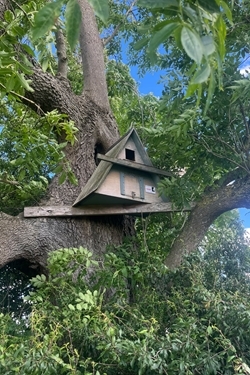 For barn owls, nesting sites have become an important factor in the life cycle. Loss of hollows in old trees through woodland clearance and replanting, the conversion of traditional barns on farmsteads to dwellings for humans, and the need for modern grain stores to be wildlife-free zones for food hygiene purposes have all contributed to the housing problem.
To alleviate this shortage at the Allerton Project, senior and long-standing Allerton ecologist John Szczur began building and erecting boxes on mature trees around the farm, carefully selecting locations where the adjacent habitat was likely to provide a convenient source of food. This strategy has paid dividends, as shown by the number of breeding pairs occupying the boxes and the chicks that have subsequently fledged.
Backing barn owls with science
This week our research team, with help from some volunteers, ringed four young birds in the box adjacent to our species rich ancient hay meadow, a likely home to small mammals. Even more impressive, five birds were found in the box adjacent to our agro-forestry trial, now ten years old, where growing trees combine with rough grazed pasture. We know that voles are plentiful in this area because when we remove the cylindrical tree guards we often encounter vole nests, from whence they venture at night to forage, where clearly some meet their fate in an encounter with the hunting barn owls.
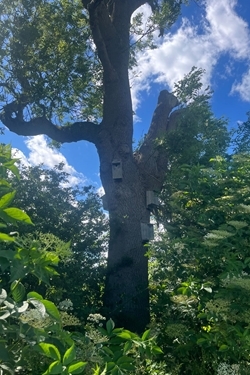 Not all the land on the estate will provide such high levels of prey – fields of arable crops frequently disturbed through machinery activity are less suitable habitat for voles and therefore for barn owls. However, these arable crops do provide a food source for other box breeding species such as tree sparrows. When we inherited the estate from the previous owners in 1992 there were no tree sparrows here, but they were first observed in the winter taking advantage of the food being scattered for gamebirds by the keeper. But they did not breed until John put up nesting boxes in some ash trees in a hedge line on the arable area of the farm.
Unlike the barn owl foraging habitats, which remain permanent, arable crops rotate around the farm, with crops of beans providing a useful source of food for tree sparrows when grown adjacent to the nest boxes, whilst when winter wheat was rotated close to the colony the parents were found to be travelling further from the nest box to forage and return less frequently with food, presumably impacting on chick survival rates.
All this goes to show the importance of understanding the life cycle needs of different species and carefully designing how we provision those needs, in a landscape dominated by the needs of our own.