What better time to optimise your bird identification efforts than now? With the Big Farmland Bird Count in full swing and before spring truly springs it seems appropriate to highlight a key scientific paper that can help focus your efforts.
Produced by GWCT’s Farmland Ecology research department as part of the FRAMEwork project, the new paper identifies key bird species which are likely to indicate good general bird diversity and abundance in your area. This short list can be a great starting point for anyone looking to improve their bird identification skills.
Insights from our scientists
Our post-doctoral researcher Rachel Nichols explains:
“The idea for this research came about from observing the diverse farmland bird communities on the English and Scottish Farmer Clusters in the FRAMEwork project. It emphasised the difficulties that practitioners face when trying to identify such a large number of species by sight and sound when monitoring the Clusters’ biodiversity. We wondered if it was possible to identify key farmland bird species whose presence or abundance would indicate a diverse farmland bird population, and therefore reduce the number of species practitioners are required to identify.
For farmers who are either conducting bird surveys independently or as part of a larger scheme such as the Big Farmland Bird Count, having a few key species to learn and record makes the task much less arduous and intimidating. This research suggests that if farmers in England are spotting corn bunting, linnet or skylark, there’s a good chance they have a high abundance of farmland specialists (dependent on resources provided on farmland for at least some part of their life) on their land. And if they are spotting goldfinch, then this would suggest they have a very good overall population of farmland birds on their land, high in both the numbers of birds and the different bird species.
These indicator species can be monitored through regular, formal surveys, or just through ad hoc recordings. Their presence should greatly encourage land managers that their biodiversity-friendly practices are benefiting a wide diversity of farmland birds. The presence of farmland specialist indicator species is particularly encouraging as they have undergone a severe decline in recent decades.”
Your favourite farmland species?
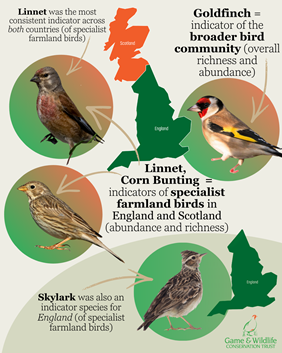 It may come as a surprise to some that certain familiar indicator species are not on this list but the key criteria is that they are consistently detectable through standardised survey methods and responsive to the broader pressures shaping farmland ecosystems. There’s an important distinction between species that act as broad ecological indicators and those that function more as umbrella or poster species.
Grey Partridge, for example, is an umbrella species whose presence is often associated with high farmland species and habitat diversity. However, its fortunes depend heavily on very specific, often localised management: predator control, brood‑rearing cover, insect availability in June, and overwinter feeding and they are not easy to detect using standard Breeding Bird Survey‑type techniques. Anyone who has spent time trying to monitor them in the field knows that partridges sit tight, flush unpredictably, and are best counted using dedicated protocols such as spring pair counts or autumn covey counts, which does not align with the generalised methods used to record multi‑species indicators. Moreover, they are not sufficiently widespread to act as an indicator of farmland bird populations across the country.
Concluding thoughts
Every record we submit of any species is crucial but this research shows that you don’t need to be an expert birder to gather valuable information about the health of your farmland. Spotting just a few key species can reveal a great deal about the wider bird community using your fields, margins and hedgerows. As the Big Farmland Bird Count continues, this research provides a timely reminder that even simple observations can feed into a much bigger picture of farmland biodiversity.