Written by Jayna Connelly, Science Communicator
It’s easy to take the comfort of our own homes for granted, yet suitable shelter is one of the most limiting resources for many of our wild neighbours. As natural nesting sites decline through changes in land use and tidier management of woods and gardens, well designed nest boxes have become an increasingly valuable addition to the landscape. National Nest Box Week is a chance to celebrate these simple structures and the role they play in supporting some of our most familiar species.
Alongside their crucial role for the wildlife themselves, nest boxes provide a unique opportunity to connect with some of our favourite feathered neighbours. They are a fantastic way for anyone to contribute to conservation efforts and bring some more of the charismatic characters in nature a little closer to home. This is not all, for conservation scientists nest boxes are a fantastic opportunity to gain insight into the lives of the species utilising the boxes, gaining insight into their behaviour, habitat preferences and breeding success.
The Barn Owl Box Initiative: A conservation success with lasting impact
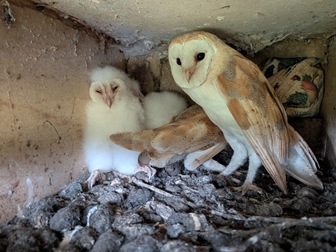 Barn owls, like many species who now rely on nest boxes, depend on safe cavities to breed, historically this would have been hollowed trees, later, old barns and rural buildings. With modern farming and building practices, many of these places have been removed. Well-designed nest boxes now replace these lost sites, giving barn owls secure places to raise their young and helping drive their national recovery.
In 2021, the Owl Box Initiative installed 64 barn owl boxes across several participating farmer clusters: Cranbourne Chase, Martin Down and Allenford, Avon Valley, Pewsey Downs Farmers Group and the Marlborough Downs Nature Enhancement Partnership.
These were monitored for around four years by our Farmland Ecology team, gathering data on barn owl breeding success, as well as GPS tracking data of adults showing their habitat use on working farmland whilst hunting to provide for their chicks.
This work directly contributed to a recently published paper highlighting the importance of grassland habitat for barn owls, reinforcing what many farmers already observe: that well managed grass margins, rough grassland and field edges support the small mammal populations barn owls rely on. A reminder that simple, well-placed interventions can have long-term impact when paired with good habitat management.
Building on Success: Many more nest boxes for many more species
In the last few years, a wider suite of nest box schemes have been establishing led by Megan Lock, GWCT Senior Farm Environment Advisor and Farmer Cluster Facilitator for Allenford and Martin Down Farmer Cluster, and Francis Buner, Senior Conservation Scientist and Head of Wildlife Recovery. By collaborating with farmers, these projects support a range of species facing different pressures across our farmed landscapes, including another 20 barn owl boxes!
Kestrels
Kestrels remain one of the UK’s most recognisable farmland birds, yet they are amber listed and continue to face pressure from habitat change, rodenticides and reduced prey availability. Purpose built nest boxes can make a real difference, particularly when installed in open straw barns or on solitary field trees where grey squirrel interference is reduced.
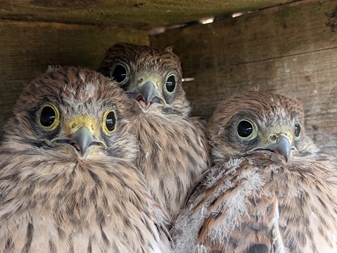 So far, around 90 kestrel boxes collectively have been installed across recent projects, including work with three farmer clusters in the South of England. This includes the Selborne Landscape Partnership Farmer Cluster, supported by the ProNature Fund from the South Downs National Park, and a joint project led by the Martin Down and Allenford Farmer Clusters funded through Farming in Protected Landscapes (FiPL).
At least 60 of these boxes were built by the Petersfield Men’s Shed team. With many more to come including 30 boxes planned across the Winchester Farmer Cluster by 2026.
A new project is currently being trialled across the SLP cluster using 20 Perdix Pro cameras, giving us detailed insights into prey delivery, breeding success, and competition between species such as jackdaws and tawny owls, as well as invasive species like grey squirrels and Egyptian geese. Our recent feature Kestrels, cameras and conservation: Lessons from a year in the field explores these findings in more depth.
Long-eared Owls
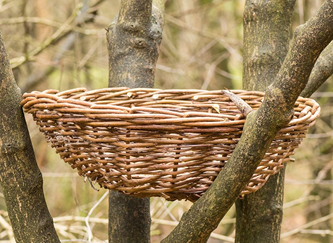 Long-eared owls are notoriously secretive, and providing suitable nesting structures can be challenging. Working with a local willow weaver, the team produced a set of bespoke woven baskets - 16 in total, with 8 funded by Hampshire County Council and 8 by farmers in the Martin Down and Allenford Farmer Cluster.
Installation is a team effort: cluster members, including James Morgan and William David placed the baskets deep into holly and other dense thorny cover where long-eared owls prefer to roost and nest.
House Sparrows, Starlings and Swifts
Some of our most recognisable garden birds are facing steep declines. House sparrows have dropped by several million in the last 30 years and are now red listed, while starlings have also suffered long-term losses. To support these species, the GWCT projects have installed 120 house sparrow boxes and 42 starling boxes.
For sparrows in particular, clustered boxes mimic their natural preference for communal nesting, while providing much needed roosting and breeding opportunities in modern landscapes where cavities are scarce.
Allenford and Martin Down Farmer Cluster worked with the Hampshire Swift Group, installing 31 swift boxes, which was financially supported by collaborative grants, the farmers themselves and the GWCT. As traditional nesting sites in older buildings disappear, these boxes offer a lifeline to a species that spends almost its entire life on the wing.
A Landscape-scale effort
The great work does not stop there. Amber Lole, GWCT Advisory and Cluster Facilitator, is also coordinating another 12 barn owl boxes and 18 swift boxes to go out across the Escarpment Cluster in north Dorset via FiPL funding. This project adds to the existing nest boxes across the new Cluster, helping to support and expand existing local populations. These boxes will also be monitored using wildlife cameras purchased through FiPL grant funding.
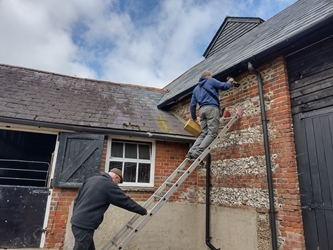 This brings GWCT projects to a grand total of at least 413 new nests for struggling birds in less than five years! Crucially, these boxes are not just a numbers game, each one has been meticulously made, installed in carefully chosen locations and many continue to be monitored using cutting-edge equipment, as well as, challenging our own understanding of each species’ ecology.
What unites all these projects is the commitment of the farmers and land managers who host, install and monitor the boxes. Their willingness to collaborate, and to share what works and what doesn’t, is what allows these schemes to grow from isolated actions into landscape‑scale conservation.
Nest boxes are not a substitute for good habitat, but they are a powerful complement to it. Through these schemes we are not only providing homes but crucial information and insights into struggling populations of iconic farmland birds so that we can better support them for generations to come.
As National Nest Box Week reminds us, small structures can make a big difference when placed in the right hands and the right habitats.
Please note, all birds are handled and monitored under BTO licensing for research purposes.
Photo credits
Photo 1 - Barn owl chicks - Francis Buner
Photo 2 - Kestrel chicks - Francis Buner
Photo 3 - Owl nest basket - CJS
Photo 4 - Farmer cluster members installing nest box - Megan Lock