Written by Rachel Grant, GWCT Wales Placement Student
Fungi flourished in more ways than one in 2025, with more global policies supporting the kingdom worldwide, as well as a booming year for fruiting bodies. Despite all this fungal success, there is still so much to learn and understand about their biology. Out of the 2.5 million estimated species of fungi, only 155,000 have been named, leaving roughly 99% still to be described.
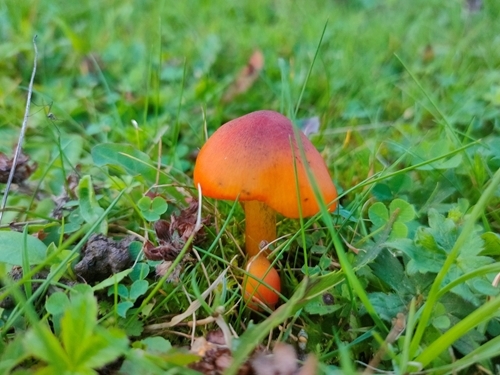
Blackening waxcap (Hygrocybe conica) at Whitty’s Pond, Wrexham (Credit: Rachel Grant)
Fruiting bodies, such as mushrooms or other above-ground structures, are only the tip of the iceberg. The greater network below ground, called mycorrhizae, is essential for soil health and structure, for example circulating and redistributing nutrients through decomposition. Around 90% of plants benefit from fungi through such processes, forming mutually beneficial relationships to trade resources like carbon and nitrogen. These fungal relationships also help plants become more resilient to stresses like disease and drought.
The diverse relationships fungi have with other organisms and their ecosystems could hold the answer to some of our current environmental and climatic problems. For example, promoting fungal relationships could boost agricultural yields, combat rising pesticide use, or help in storing carbon.
Is this a possible masting year for fruiting bodies?
The autumn of 2025 had many in the UK asking why mushrooms and other fruiting bodies were more abundant than usual. Personally, I was amazed by one of my local nature reserves in Minera, where I found a great abundance of Russula, Amanita and Lactarius mushrooms amongst the moss, forming a colourful carpet on the forest floor. Many fungal enthusiasts also shared on social media and community groups some rare and interesting sightings, and many others also noticed a surge in mushroom abundance in general.
Possible explanations for this fungal bloom include links to the masting of trees and other plants, the ideal climatic and environmental conditions, or a combination of these factors. For example, honey fungus (Armillaria) was an even more common sighting than usual among community groups. This could be due to the long, arid summer putting plants under stress. As honey fungus is parasitic, it has the potential to exploit weakened plants of nutrients. However, more data and experiments are needed on this to confirm whether this is because of increased engagement in fungal spotting or if the actual abundance of honey fungus increased.
There were also many examples of new fungal sightings across the UK in 2025. The rare Candelabra Coral was sighted in many new locations, such as in the New Forest. More rare and vulnerable waxcaps were recorded in grasslands in North Wales, especially in sites near Bangor. A survey from 2024 even found that these grassland species can now be found in accessible locations, such as urban amenity grasslands.
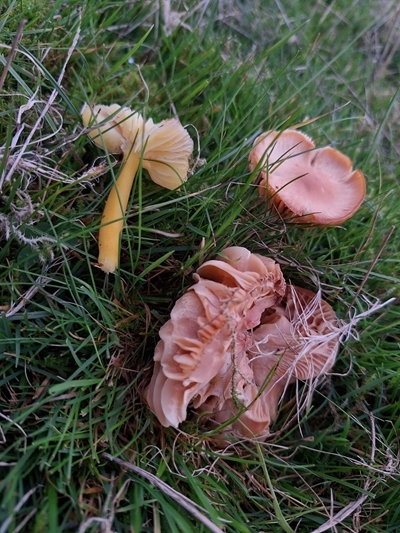 Waxcaps (possibly Golden and Ballerina waxcaps (Hygrocybe chlorophane and
Porpolomopsis calyptriformis) at Hope Mountain, Wrexham (Credit: Rachel Grant)
The rising recognition of fungi and what this means for you
In 2025, there were many steps forward in the world of fungi conservation. This was the year when the IUCN Red List recognised over 1,000 species of fungi globally, also revealing that around two tenths are at risk of extinction. The biggest global threats include habitat loss and disturbance, such as forest clearing and agricultural intensification on meadows.
Now the threats are clearer than ever, many scientists and enthusiasts have come together to fight for fungi conservation. Last year saw the founding of the Network for Fungal Conservation (NFC), which should help to provide the building blocks for the UK Strategy for Fungal Conservation by bridging mycology and policy. This ties in nicely with the inclusion of fungi in the updated National Biodiversity Strategies and Action Plans (NBSAPs).
Engagement and communications in fungal surveying and conservation from people increased in 2025 too, allowing for more records to be collected and leading to new findings. Plantlife’s Waxcap Watch had a record number of participants. Databases owned by the British Mycological Society and other organisations (like iNaturalist and PlutoF GO) also received more recordings, especially from the public. With these new sightings being recorded across the UK, there hopefully leaves greater opportunities for fungal surveys and experiments during this new year.
This highlights the impact of your submitted sightings, how they support fungi conservation on the land you care about, and how easy it is to do so.
Let us know what you think about the progress in fungi conservation and if you have seen any interesting mushrooms this year in the comments below.