Written by Dr Juliet Turner
In the previous piece, I explored how ant colonies resemble multicellular bodies. Here, I turn to my DPhil research, which investigated these ideas through comparative studies of social evolution.
My studies began around four years ago, as part of the Social Behaviour group at Oxford. The group is headed by Professors Stuart West and Ashleigh Griffin. We investigate how cooperation and sociality evolve, looking at a wide range of species and even at nested levels of biological organisation.
Cooperation is everywhere. Genes cooperate with each other to replicate as a collective genome. Cells cooperate with each other to form a multicellular body. Organisms cooperate in societies or colonies. When cooperation between organisms has reached a certain threshold, natural selection and adaptation can occur at a higher level: the colony. This means it has transformed into an entity above the level of the organism, and the colony can be referred to as a superorganism. Organisms in a superorganism are analogous to cells in a multicellular body. You can think of these layers of cooperation as nested levels of biological organisation, like Russian dolls.
To understand how cooperation evolves, we use a comparative approach, studying hundreds of species and mapping differences and similarities onto evolutionary trees. This allows us to infer how traits evolved and test hypotheses about the evolution of biological variation.
This method allows us to answer questions such as: Why do some lineages evolve extreme specialisation and division of labour, like multicellular organisms or superorganismal ant colonies, while other lineages remain small and relatively simple, like single-celled lifeforms or solitary organisms?
Other members of our group look at cooperation between cells, in genomes, or in birds, but my research was focused on insects. Insects show amazing variation in traits associated with social complexity, including division of labour between individuals such as queens and workers in ant colonies. By understanding how these systems of mutual dependence evolve, we can understand more about the conditions that favour cooperation more broadly.
One of the earliest projects I worked on provided evidence that the specialisation of ant workers into distinct roles such as forager or soldier was linked to the prior evolution of larger colony sizes. This result supports the size-complexity hypothesis; that larger systems have more division of labour (see more at Bell-Roberts et al., 2024.)
More recently, my focus has been on how sterile workers evolve. Although workers in ant colonies are often referred to as the ‘sterile caste’ many species actually have potential for reproduction. I studied worker reproductive potential across 546 species of ant to understand why some species evolve sterility (higher levels of cooperation and division of labour) while others don’t. I also looked at differences in size between queens and workers, again representing their degree of specialisation. In some species, this divide is extreme: Queens more than 300 times larger than workers. In other species, queens and workers are indistinguishable, except through dissection (see image below).
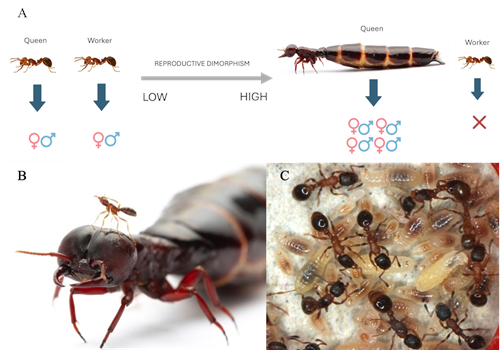
As with our first project on worker sub-caste specialisation, we again found evidence that differences in colony size are key to explaining variation in division of labour across species. In other words, we found that the evolution of larger colony sizes facilitate the evolution of more distinction between queens and workers, both in terms of reproductive differences and size dimorphism.
We also reconstructed the ancestral ant, and found that the common ancestor of modern ants most likely had full reproductive potential, though most likely did not reproduce in the presence of a queen (queens and other workers can inhibit others’ reproduction). We estimate that ant worker sterility has evolved as many as 17 times! (see below).
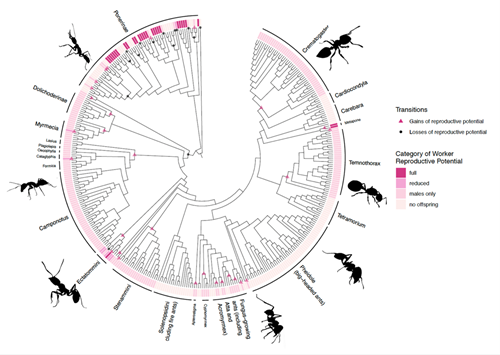
Our findings feed into the wider debate about what it means to call something a superorganism. Many assume that all ant colonies qualify as superorganismal because they have the divide between reproductive queens and non-reproductive workers. Our results show that complete worker sterility has actually evolved many times – far more often than assumed. If strict sterility is taken as the defining hallmark of a superorganism (as argued by Bernadou et al., 2021), then ants may represent multiple independent origins of superorganismality. Some species may not be superorganisms at all.
However, if superorganismality is instead defined by “effective sterility” (e.g. workers can reproduce in principle but normally do not in the presence of a queen) then it could still be argued that all ants are superorganismal since we found evidence that the ancestor was effectively sterile. Our results are therefore crucial for knowing how many times superorgansimality has evolved and contribute to the broader goal of counting how many times major evolutionary transitions have taken natural systems to new higher levels of organisation.
Much remains unresolved, including how to even define a superorganism and whether the patterns we identified remain constant across other systems e.g. the evolution of complex multicellularity. Either way, our results refine the picture and highlight that evolutionary transitions are rarely straightforward.
You can read my latest paper here: 'Larger colony sizes favour greater division of labour between queens and workers in ants'.