Written by Jayna Connelly, Science Communicator
The grey partridge, the Trust’s emblem species, reflects both our heritage and our ongoing commitment to evidence‑led farmland conservation. It is, for us, where we began. We have grown into so many other branches of countryside management and species conservation, but the principles remain the same throughout – how can we better understand the ecological dynamics of our countryside so that wildlife populations, agricultural production and countryside communities can live and work sustainably alongside each other?
Every one counts!
The grey partridge represents the Trust’s approach perfectly. Its story mirrors that of many other farmland species; once widespread it has seen a 92% decline since the 1980s. Yet, our research has consistently proven that it is possible to reverse these declines with proper management strategies. Furthermore, we have shown that the management initiatives established for these beautiful and charismatic birds provide benefits which extend well beyond them, to their arguably less charismatic (but still important) neighbours. Whether they have feathers, six legs or just leaves and flowers, the benefits of investing in Grey Partridge conservation are clear.
The foundations of this work date back to at least the 1930s. Our long-term data initiatives are a core part of what makes GWCT research so special. It was in 1933 that the Partridge Count Scheme began. This free and voluntary initiative was set out to collect information on the annual abundance and breeding success of Grey Partridges on a set of “Partridge Manors” across the UK. More than 90 years on and the subsequent motto “Every one counts!” still holds true. So, will you be taking part this year? Make sure you join up and help continue this crucial legacy.
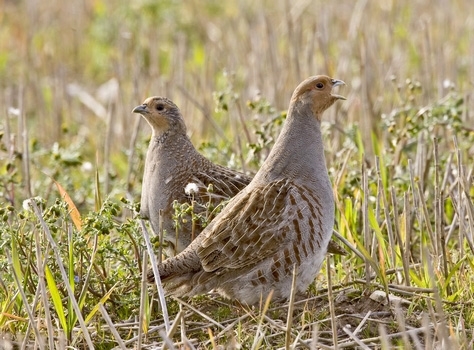
Living with greys
Alongside the science, the grey partridge has inspired people on a more personal level. Amongst those who have dedicated their time to saving this iconic bird is friend of GWCT, renowned photographer, wildlife enthusiast and author of 'Living With Greys', Tarquin Millington Drake. Having spent countless hours in the field, often sitting quietly in a hide or waiting patiently in his vehicle, Tarquin has developed an extraordinary understanding of grey partridge behaviour. His photographs are remarkable not just for their quality, but for the trust he built with the birds themselves. Over time, they grew so accustomed to his presence that they would continue feeding or preening even as he pulled up in his car, a level of calm that only comes from deep familiarity.
“If you want to understand greys, you have to give them time,” Tarquin once said, a simple line that captures the heart of his approach. He didn’t just photograph these birds; he lived alongside them. His book is the product of early mornings, long waits, and a genuine affection for a species that rewards patience with glimpses into its private world.
Living With Greys is more than a photographic record, it is a testament to what happens when you slow down, pay attention, and let wildlife set the pace. For anyone wanting to connect more deeply with the grey partridge, Tarquin’s work is a rare and inspiring window into their lives.
The Three Legged Stool
From beautiful books to something you’d be far less keen to have sat on your coffee table. Our researchers have had a rather different but crucial experience working with grey partridges. Extensive insect sampling revealed early on that chick food abundance is crucial for supporting grey partridge populations. From developing the Grey Partridge Chick Food Index in the late 1960s to celebrating the Sussex study’s 50th year of invertebrate monitoring in 2018, the GWCT research teams have been at the front line of wild partridge conservation for decades.
Results from another monitoring study using the Grey Partridge Chick Food Index in 2025 show that, although organic fields often support more abundant and diverse insect communities than conventional ones, both systems frequently fall below the levels needed for chick survival. This reinforces the importance of non‑crop habitats, such as hedgerows, flower margins, and beetle banks, which consistently provide the insect abundance needed to sustain healthy grey partridge populations.
Every one counts in more than just data collection. It takes whole communities, across generations to conserve this species and those living under its umbrella. As a gamebird, grey partridge has traditionally provided incentives for privately funding the creation and management of suitable habitat across the countryside. These areas of habitat include, hedgerows, field margins, winter bird food mixes, and conservation headlands - all maintained specifically with wildlife in mind. With continued difficulties around government funded agri-environment schemes, this kind of private investment in habitat management remains crucial.
Further measures such as predation management and supplementary feeding are also crucially funded by game management and together make the three legged stool of conservation management. We have many locations where we have proven that following these principles has successfully reversed declines in these and other farmland birds. Many projects over the years have built on our understanding of grey partridge populations both in the UK and further afield such as the Interreg PARTRIDGE Project. This project in particular provided a crucial tool for boosting grey partridge populations through the Grey Partridge Seed mix.
Spring into action and join the Partridge Count Scheme
Spring feels like it’s teasing its way through some gloomy winter days and so we hope you will take inspiration from this blog and Tarquin’s stunning photos to spring into action yourself and take part in the PCS for the sake of the iconic grey partridges and the precious countryside wildlife it represents. Find out more about how to take part in the Partridge Count Scheme.