For over 90 years, the GWCT has remained a science based organisation at its core, committed to finding practical insights for the challenges faced in countryside management. Much of what we do is rooted in long term consistency, our D-Vac suction samplers still chug through summer fieldwork, our pointing dogs continue to guide moorland monitoring, and our datasets stretch back decades. But staying at the forefront of conservation research also takes evolution, fresh perspectives and a diversity of great minds. Thankfully, the Trust’s staff now includes many more women, each a specialist in her own right, bringing expertise, passion and rigour to the publications and advice we pride ourselves on.
Women researchers at the GWCT have produced some of our most influential, field shaping science, spanning upland ecology, farmland biodiversity, predator–prey dynamics, river restoration and the environmental impacts of veterinary chemicals.
Designing the flower mixes that pollinators really need
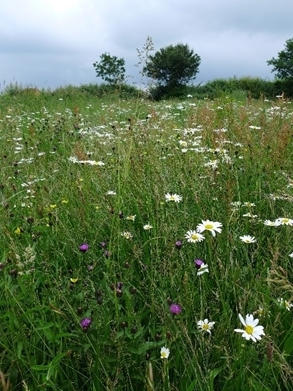 Our post doc research assistant Rachel Nichols PhD work offered a practical, evidence-based way to help struggling pollinator numbers. Her 2023 paper in Insect Conservation and Diversity tested a novel wildflower seed mix designed specifically to support a broader range of pollinating insects than the standard mixes used in agri-evironment schemes.
The key, conveniently digestible output from Rachel’s work was the identification of 11 key floral species that support a higher diversity and abundance of pollinators, including solitary bees, which are often overlooked in standard seed mixes. Surprisingly dandelion was the most popular flower followed by spear thistle, wild carrot, hedgerow cranesbill, smooth hawksbeard, rough hawkbit, hedge mustard, alsike clover, viper’s bugloss, common poppy and scentless mayweed. The top four species were used by 34 of the 40 wild bee species recorded in the study!
Rachael’s work showed that it is possible to create flower mixes that not only establish well but also provide the right forage for a wider suite of species, not just bumblebees and honeybees. As she explains:
“These findings suggest that it is possible for farmers and land managers to better support wild bees on farmland, which is what we need. The current mixes just aren’t providing enough of the key species that attract a wider range of pollinating insects. The next step is to test these seed mixes on a wider range of soil types, before turning what is currently a bespoke mix, into a standard mix that seed companies can produce, lowering the costs to the farmers and making it a more commonplace mix to sow.”
The crucial role of Ranunculus in supporting salmon and trout
Jess Marsh was our 100th successful PhD student, and her research marks a milestone in the continued expansion of our work beyond gamebirds and farmland ecology. Her PhD has transformed our understanding of lowland rivers, revealing that Ranunculus is far more than familiar aquatic vegetation, it is a habitat‑forming species that shapes the conditions juvenile salmon and trout depend on.
Across both catchment-wide surveys and in-river experiments, Jess found that higher Ranunculus cover consistently supported more juvenile salmon, with the plant explaining up to one third of the variation in salmon densities. By creating a mosaic of depths and flow conditions, Ranunculus provides feeding and sheltering opportunities that boost growth rates and reduce competition between species.
It’s rare to have such clear, quantitative evidence for the importance of a single macrophyte, and Jess’s findings position Ranunculus as a keystone habitat forming taxa in lowland rivers, with direct implications for river restoration and salmonid conservation.
Since defending her PhD, Jess has continued to research the environmental and biological drivers shaping fish population dynamics. Her work usually involves wrangling with large datasets and developing bespoke statistical models to tease out influential factors of fish abundance, survival, or growth. Some of her recent studies demonstrate how milder winters are impacting salmon recruitment, and how the drivers of survival and growth of the European grayling vary by life-stage.
Understanding curlew nesting choices in the New Forest
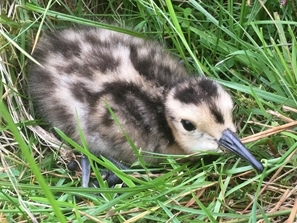 Curlew are one of the UK’s most rapidly declining waders, and Elli’s ongoing PhD research is helping to uncover the habitat features that matter most for their breeding success. As part of her work, she monitored 76 nests across the New Forest between 2020 and 2022, revealing clear patterns in where curlew choose to nest, and how successful those nests are.
Despite dry heath being the most abundant habitat, curlew showed a strong preference for wetter areas: 39.5% of nests were in wet heath, 31.6% in dry heath, and 8.3% in mire. Grassland and woodland were avoided entirely.
Nest survival was low overall, at just 13%, but the differences between habitats were striking. Mire supported the highest survival at 21%, and this remained stable throughout the breeding season. Wet heath had similar survival to the overall average, while dry heath performed poorly, with only 5% of nests surviving.
Elli’s work also highlights the importance of the surrounding landscape: the 500‑metre area around each nest plays a critical role in habitat selection. Although this is just one published chapter of her wider PhD, it is already offering valuable insights for land managers seeking to protect and restore curlew breeding habitat.
Exploring ecological complexity through ants, networks and the hidden rules of ecosystems
Alongside her role as a research assistant in GWCT’s Farmland Ecology department, Juliet Turner has recently completed her DPhil that explored how complex life evolves – from multicellular organisms to super-organismal insect societies. She has since been continuing to publish papers on her thesis, from her work on the evolutionary origins of ant worker sterility to her study showing how larger colony sizes favoured the evolution of more specialised worker castes, her work is truly fascinating.
Juliet describes ecological systems as often appearing chaotic yet are shaped by underlying rules and interactions that can be modelled and understood. Her work aims to uncover these patterns, helping us better predict how ecosystems respond to change.
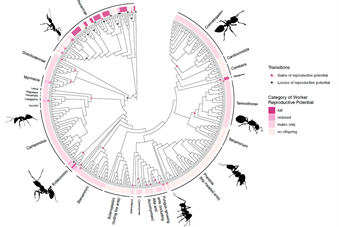 In another blog, she reflects on ant colonies as a metaphor for distributed intelligence, systems where no single individual has the full picture, yet the collective produces remarkably coordinated outcomes. It’s a perspective that resonates strongly with modern ecology, where understanding interactions is often more important than studying species in isolation.
Juliet’s thesis work aligns closely with her GWCT research through a shared focus on uncovering the hidden structures that shape ecological systems. While her doctoral work used theoretical tools to reveal the rules behind complex insect societies, her GWCT role applies the same way of thinking to real farmland communities, using data to understand how interactions drive ecological outcomes. Together, these perspectives bridge fundamental science and practical conservation, offering a richer lens through which to interpret change in the countryside.
Juliet’s research sits at the intersection of theory and application, offering new ways to think about farmland ecosystems and the decisions we make within them. Her ability to communicate complex ideas with clarity and creativity is already making her work stand out. She is now also channelling this perspective into a forthcoming book on complexity in insects and other biological systems.
Our work doesn’t stop there!
It is near impossible to represent all of the incredible women who have contributed to conservation science during the lifetime of the GWCT. However, our celebration wouldn’t be complete without recognising the women whose contributions have shaped GWCT science for decades. Researchers like Dr Kathy Fletcher and Dr Julie Ewald have continued to build on the work they began years ago, remaining leading voices both within their fields and across our teams today. Kathy’s pioneering experimental work on predator impacts in the uplands via the Otterburn Project and Julie’s landscape scale analyses of farmland biodiversity via the Sussex Study still underpin much of the Trust’s evidence base.
Their ongoing commitment, alongside the new generation of researchers now coming through, reflects the strength and continuity of women’s expertise at the GWCT, a legacy that continues to grow, evolve and inspire.
Full papers here:
A novel farmland wildflower seed mix attracts a greater abundance and richness of pollinating insects than standard mixes - Nichols - 2023 - Insect Conservation and Diversity - Wiley Online Library
Freshwater Biology is a freshwater ecology journal publishing innovative papers on the aquatic biology of freshwater environments.
Factors influencing nest site selection in a rapidly declining shorebird, the Eurasian curlew - Rivers - 2025 - Journal of Avian Biology - Wiley Online Library
Warm winters and cool springs negatively influence recruitment of Atlantic salmon (Salmo salar L.) in a southern England chalk stream - Marsh - 2021 - Journal of Fish Biology - Wiley Online Library
Medium-term environmental changes influence age-specific survival estimates in a salmonid population - Marsh - 2021 - Freshwater Biology - Wiley Online Library
High summer macrophyte cover increases abundance, growth, and feeding of juvenile Atlantic salmon - Marsh - 2022 - Ecological Applications - Wiley Online Library
Above parr: Lowland river habitat characteristics associated with higher juvenile Atlantic salmon (Salmo salar) and brown trout (S. trutta) densities - Marsh - 2020 - Ecology of Freshwater Fish - Wiley Online Library
Density-dependence and environmental variability have stage-specific influences on European grayling growth | Oecologia | Springer Nature Link