Written by Katie Gildert and Rebecca Clough
The Nitrogen Climate Smart project (NCS) is a farmer-led programme which champions the integration of pulse and legume cropping into the arable rotation with view to reducing reliance on imported soya for livestock feed. The overarching aim of reducing UK carbon emissions by 3.4Mt per annum sets the project apart as a significant enterprise for UK agriculture.
 As one of the 17 partners of NCS, The Allerton Project conducted a Spring peas and oats bi-cropping trial in the 2024/2025 season. This study assessed the feasibility of growing peas on heavy clay soils, using oats as a bi-crop, and the impact of a pulse bi-crop on greenhouse gas emissions and soil nitrogen.
‘From Soya to Sustainability’ is held as part of the NCS project, bringing together expert sources and leaders from across the agri-food sector to disseminate new research and innovation. The second annual conference took place in January 2026 at The KingsGate Conference Centre, with a fantastic attendance of partners, Pulse Pioneers, and a host of excellent speakers.
Big picture themes from the 2025 conference:
- Strong consensus that reducing reliance on imported soya is essential for climate, supply-chain resilience, and ethical land use.
- UK-grown pulses and legumes are emerging as credible, scalable alternatives for both arable and livestock systems.
- The conference showcased practical trials, modelling tools, and farmer-led innovation, signalling real momentum behind the NCS Project.
- Overall, the conference highlights the significant progress made by the project over two years. There was a strong sense that UK agriculture is moving toward a more pulse-integrated, lower-carbon future.
Key stats from the 2025 conference:
- Only 4.5% of global soy is currently deforestation and conversion-free. Economic incentives and global supply-chain reform are essential to halt land conversion. (Nicola Brennan, WWF-UK)
- Adding 20% pulses to UK rotations could: Cut CO₂ emissions by 600Kt and increase pulse production by 1.6 million tonnes. (James Webster-Rusk, Andersons Centre)
- A 5-year rotation with pulses and cover crops emits 25% less CO₂ than a basic 3-year rotation. Prioritising UK pulse feed reduces reliance on high-emission imported linked to deforestation. (Liz Bowles, Farm Carbon Toolkit)
- CropGOBLIN showed that pea and bean production could rise from 7.3% to 17.8% with only a small 4.1% reduction in wheat area. This demonstrates that the UK can expand pulse cropping through modest, practical adjustments rather than a major overhaul of existing rotations. (Pete Lanetta, James Hutton Institute)
Conference talk summaries:
Session 1
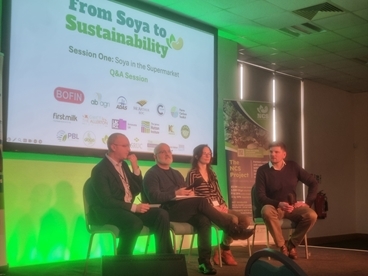
The first session provided context on soya production in a climate-conscious world. Nicola Brennan of the WWF-UK summarised the challenges for sustainable soya production in South America. Currently, only 4.5% of soy is sourced from areas that are deforestation and conversion free. Without economic incentives to drive change, deforestation continues to characterise soya farming in prominent areas of production. With 60% of Brazilian soy sourced from the Cerrado, the world’s most biodiverse savanna, it is paramount to push sustainable practices globally.
Looking closer to home, Niel Ward followed with the UK’s position on the path to sustainability. Ward highlighted current issues, including an import dependent British food system at risk from climate change and poor diets that are becoming an economic problem. He offered a ‘Roadmap for Resilience’, with four scenarios, some more optimistic than others. Either surviving by staggering from crises to crises, or undertaking greater action. Adjustments may be slight or significant, though fragmented approaches were criticised. Instead, it was suggested that integrated land use and resilient farming strategies must work in tandem if we hope to offer healthy and attainable diets to the public.
In the third presentation of this section Will Schreiber provided another perspective. Co-Founder and Director of the Retail Soy Group, Schreiber remarked this might be the only time you hear retailers ask for more regulation. Retailers, while often not responsible for many choices made in the chain of production, will take the brunt of criticism. For this reason, he explained, the traceability of soya products is one necessary step towards empowering consumers. To facilitate this, the soy supply chain should be improved for all market providers rather than creating a small number of premium providers. Schreiber ended on a positive note, expressing that there’s high potential to build on what has been accomplished through greater company commitments and regulation incentivisation.
Following a break, the Conference divided. A livestock focussed discussion chaired by John McArthur delved into faba bean substitution and poultry diets, whilst Tom Allen-Stevens led a Pulse Pioneer Workshop next door.
Session 2: Plant Pioneer Workshop
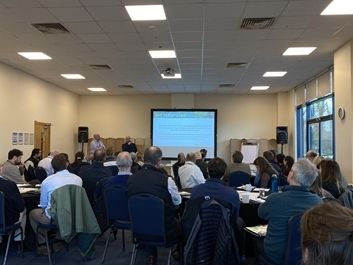 The workshop was an opportunity to address the balance of food production and environmental considerations through a range of voices and experiences. Pulse Pioneers, farmers conducting funded pulse-cropping trails, led each group’s discussion on prompts spanning best practice and directions for future research. Tom Allen-Stevens noted points on nitrogen fixation and ecosystem services associated with pulse crops. It was heartening to see the enthusiasm of those conducting trails and comparing their outcomes, with others eager to hear about challenges and successes.
Session 2: Embracing change
The livestock session gave an insight into recently conducted trials, with Jos Houdijk on the soya replacement potential of processed faba beans and Brian Kenyon discussing the enhanced use of beans in commercial poultry diets. These trial updates outlined soya alternatives relevant to the British market, namely the potential for British-grown faba beans.
These trails highlighted the barriers to uptake that faba beans face, such as limited digestibility and problems in tannin content, mycoproteins, and phytic acid. Kenyon addressed this by suggesting that processing may be key to unlocking better performance. Conducted trials and their updates help to steer the direction of British soya and are a valuable aspect of the conference.
Session 3
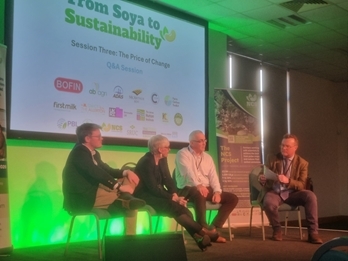 Bringing together the two groups, the final session considered our direction of change. Opening with James Webster-Rusk of The Andersons Centre, we heard the potential pulses present for the country’s net zero target. By adding 20% pulses to rotation, we would be forecast to reduce CO2 emissions by 600Kt. Equivalent to an additional 1.6 million tonnes of pulse production.
In response, Liz Bowles, CEO of Farm Carbon Toolkit, addressed the evidence behind the claims of pulse cultivation cutting carbon emissions. Breaking it down into the stages of growth and processing, Bowles pointed out that overall emissions could be lowered through reduced fertiliser use, a correlating reduction in fuel, and the benefits of added nitrogen on the following crop. Moreover, prioritising pulse feed over soya draws us away from importation, which is emission heavy and encourages the unregulated practices of deforestation and land conversion, as we heard in the morning session. A 5-year rotation which includes pulses and a cover crop produces 25% less carbon dioxide emissions than a basic 3-year rotation, said Bowles.
In the final presentation of the day, Pete Lanetta introduced the James Hutton Institute’s new mathematical model CropGOBLIN. This model helps to provide a framework to assess the environmental impacts of crop sequences for optimised pulse inclusion. This model found there is space to increase the pea and bean share from 7.3% to 17.8% with marginal shifts in the current crop rotation, such as reducing wheat cropping by 4.1%. Overall, Lanetta’s approach aims to evolve the soya system without complete revolution.
At the end of the day, Tom Allen-Stevens returned to reflect on the progress the NCS Project has seen in the past two years, and what they hope to see in the final 12 months. We look forward to the final From Soya to Sustainability Conference, which takes place in January 2027.