By Felix Meister, D.Phil., Senior Advisor Scotland
GWCT Scotland hosted another series of Pie & Pint evenings across Scotland in the second half of February 2026, with locations in Dumfriesshire, Scottish Borders, Angus, Banffshire, and Strathspey. We are much obliged to all the venues that kindly agreed to host these events.
Whereas the 2025 Pie & Pint evenings were addressed to land managers in the uplands and provided information on the provisions of the Wildlife Management and Muirburn (Scotland) Act 2024, this year’s series focused on Scotland’s lowlands. The programme reflected this focus: Dr Nick Hesford, Director of GWCT Scotland, set out policy scenarios beyond the upcoming Scottish elections and identified potential challenges for gamebird management; Dr Felix Meister, Senior Advisor, outlined the services that the GWCT has available to enable land managers to prepare for upcoming legislative changes; and Alistair Green, Research Assistant, presented on the GWCT research programme that is currently underway to address knowledge gaps about gamebird releasing in Scotland.
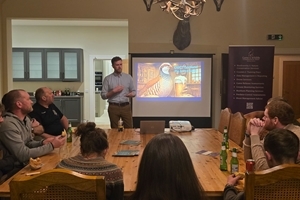
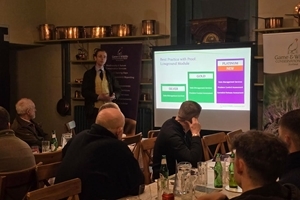
The events were well attended and led to stimulating conversations about how to future-proof gamebird management and associated biodiversity benefits. There was broad consensus that, although the lowgrounds had been largely omitted in recent debates about land management and ownership in Scotland, the sector cannot afford to be complacent. Rather than being forced to react to policy after it has been passed, land managers need to act now and proactively prepare for a shift in public focus. Collaboration with our research team will be critical in the near future, when we set out to gather information about release densities and habitats across Scotland.
“The Pie & Pint evening at Mayen Estate was a great success with a super turnout and lots of interesting discussions. It was a good opportunity for networking also. The content that GWCT provided was very beneficial to our local area” - Rebecca Cheyne, Estate Coordinator, Mayen Estate
In the meantime, there are steps that shoots can take to safeguard their position. The GWCT’s Best Practice with Proof Initiative enables land managers to collect data on all management operations in a consistent manner, and involves annual assessments carried out by GWCT experts on predator control methods and gamebird releases against available legislation and best-practice guidance. Crucially, we also carry out comprehensive ecological surveys of habitats within release pens and surrounding them to monitor potential impacts, positive or negative, of released birds on flora and fauna alongside recommendations for improvement. Subsequent data analysis and reporting done by GWCT helps create a much-needed documentation of responsible management and commitment to due diligence.
For further information about our research programme or Best Practice with Proof Initiative, please contact scottishadvisory@gwct.org.uk.