Written by Alastair Leake, Joe Stanley, Ben Jones, Gemma Fox
Who would have thought that when we put our new experimental drainage system into a poorly drained arable field here at the Allerton Project, that it would rain just about every single day since? And who would have thought that such an experiment would also arouse the deluge of public criticism to match the volume of water coming out of the end of the new drainage pipe?
In a modern age which rejects concrete and pumps, so called “hard engineering solutions”, in favour of “soft nature-based solutions” to manage flooding, the installation of subterranean hardware which accelerates water movement off agricultural land to fill up somebody’s living room downstream seems utterly unconscionable.
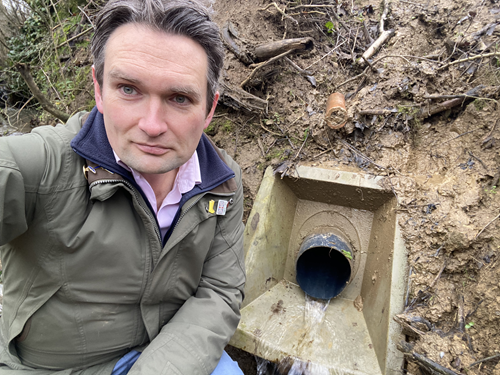
But is it? Our work on farmland, soil and water pathways at Allerton goes back 25 years. During this time, we have learnt a great deal about water management on-farm, and even at this point, with the work incomplete, I conclude that the dynamic of water flows on farmland is much more complex than anyone could possibly imagine.
In our first research project, called SOWAP (Soil & WAter Protection), we created hydrologically isolated plots which subjected to three tillage treatments – ploughing, minimal cultivations (min till) and direct seeding (zero till). Using huge tanks, we measured the amount of runoff and sediment in each system, finding that the plough-based system gave rise to greater surface run-off, due we think to the layer of sub-surface compaction known as the “plough pan”, and greatest soil loss. We also measured the negative impact this eroded soil had on the wildlife in the adjacent water courses and observed 60% fewer skylarks foraging on the plough plots in winter, indicating lower soil biological activity.
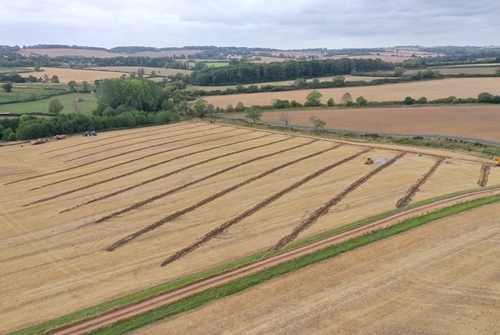
We learnt that soil structure and composition, particularly organic residues, were important to infiltration, and key agents of soil porosity are earthworms, who dislike the cold steel of the plough share. Subsequent research showed that features such as beetle banks placed across slopes reduced surface runoff and soil erosion by creating an infield barrier which takes the energy and erosive power out of the surface-flowing water (picture 2). And because beetle banks are full of wormholes the water drains away harmlessly and the soil is deposited before it can pollute the river below.
Then we found that by changing the tyres on our tractors and using an ultra-low ground pressure tyre we could cut the amount of runoff travelling in the wheelings by over 50%. The SoilCare Project showed that compacted soil in wet conditions also emitted more nitrous oxide, counter to our 2040 Net Zero ambition.
Planting crops early in the autumn or putting “cover crops” into fields not due to be cropped until spring soaked up free nitrate which would otherwise leach out and provided plant roots to hold the soil in place. In addition, the stems and leaves cushion the impact of large raindrops on the soil surface, which can otherwise dislodge soil particles, which are then carried away in run-off. Cover crops, surface trash and less intensive tillage were also associated with higher over-wintering bird numbers.
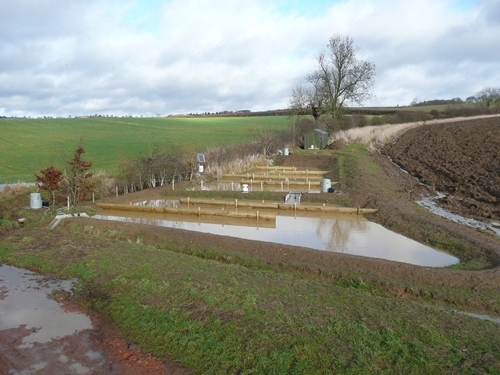
Having learnt a great deal about how to manage water within our fields we moved on to look at what we could do to improve water quality and reduce downstream flooding by manipulating our drainage ditches, water courses and riparian strips. We found that leaky dams and small field corner settlement ponds fed by ditch water did hold water flow up, but didn’t clean it like the big wetland area, where 60% of the soil particles settled out of the water as sediment leaving clearer water in the process.
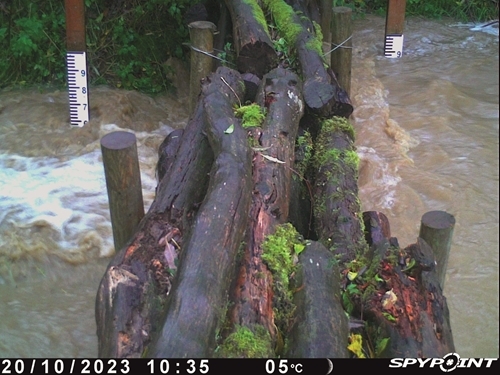
We learnt a lot about how phosphate gets into water, what we can do to stop it and even remediate it, and how in winter farms are largely responsible, while in summer rural septic tanks and small sewage “treatment” plants are often to blame
We found having grass buffer strips next to water courses reduces the amount of farm chemicals entering the river and we are currently examining whether we can remove even more by spreading Biochar (charcoal) in the waterside strips to filter the water absorbing and deactivating the chemicals naturally.
So, having done all this, is our drainage experiment a backward step?
Well, I would say not. We are currently monitoring what happens to the soil when rainfall passes down through the soil, which in our location can be around a metre deep and into the sub-surface drainage system, compared to what happens when it remains saturated and runs off the field surface.
The first month’s data looks interesting. We had just over 100mm of rain in January which across the 4-ha drained section of the field amounts to 4 million litres. Although we have yet to fully master the monitoring of the flow rate of the outflow, working on an average discharge of 3,000 litres per hour, this means it will take until the end of March for all that water to leave the field through the drain, demonstrating just how absorbent a well-managed arable field can be. Water flowing out underneath creates air spaces above which can in-turn intercept the next deluge. Fields without sub-soil drainage systems remain saturated and any fresh rainfall has nowhere to go and just runs off the surface, carrying soil with it into the river and ultimately the sea. The same volume of water hitting a hard surface would be in the river and heading downstream within minutes towards someone’s living room.
Going forward we can hypothesise, for example, that without drainage we will experience greater runoff, and we know from the work above that means more soil erosion too, and damage to aquatic ecology. We would expect waterlogged soils to emit nitrous oxide (300 times more potent than the CO2 we are trying to reduce) and “marsh gas” (methane) too, which is a mere 12 times more potent. These externalities are conveniently ignored because we can’t see them, but they should not be if we are to hold accurate inventories of agricultural GHG emissions.
We can expect higher earthworm mortality through drowning. Earthworms breathe through their skin, so if the soil becomes saturated, they instinctively move to the surface to reach oxygen. If the soil surface is flooded, they then drown. Earthworms are critical to increasing water infiltration as their burrows provide drainage channels to absorb water. Fewer worms mean fewer burrows and more runoff, so the effects exacerbate future flood events.
Come springtime waterlogged crops will be patchy, with areas covered with eroded soil which will cap over as the summer sun bakes the clay solid, bringing with it crop losses and all the problems farmers have become accustomed to in recent years. Fields with less porous soil and fewer earthworm burrows can hold less water, which in turn makes crops more susceptible to drought. One month you have excess water, the next not enough.
Resilience to climate change then needs to come in many forms. We need to secure our food supply while protecting properties from flooding. Turning out a few beavers and keeping our fingers crossed that they build dams in the right places has not served communities in Poland or the Netherlands well. Managing the movement of excessive water through design, from the wrong place to the right place, can bring a host of win/wins and this is what we must seek to do. There is no silver bullet. All our research shows that stacking multiple mechanisms is the way to go – a mosaic of measures.
Taking water from field drainage systems, holding and filtering that same water in constructed wildlife wetland habitat within the flood plain, smoothing out the flow peaks (with or without the beavers) sounds a great deal more sensible to us than abandoning our wheat fields to become paddy fields, but without the rice.