By Hannah Marsh and Charlotte Russell, Farmland Ecology Placement Students
It’s hard to believe how quickly the last six months have passed. The placement has flown by in a busy whirl of tubing samples, identification, data entry and analysis, and the occasional bits of fieldwork. Since September, much of our time has been concentrated in the lab, learning key invertebrate identification skills whilst working through samples collected during last summer.
How our placement is going
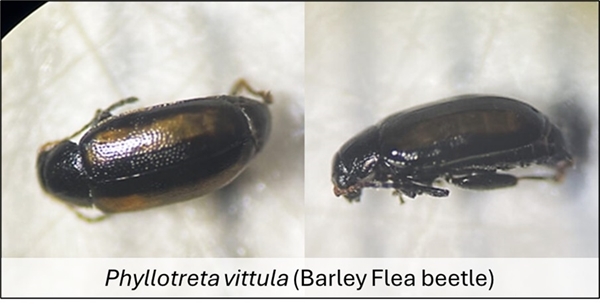
This placement has reinforced just how vital invertebrates are to healthy ecosystems. They provide essential services such as pollination, pest control, and decomposition, and they are a crucial food source for farmland birds. Much of our work has focused on collecting data on the abundance and diversity of invertebrates in different agricultural habitats, including flowering strips, various crops, and agroforestry. From the data, invertebrates are then split into different categories based on their agricultural impact, into natural enemies, pests or other. The data also provide information on how different agricultural habitats influence invertebrate diversity and abundance as a food source for farmland birds.
Charismatic clowns and colours
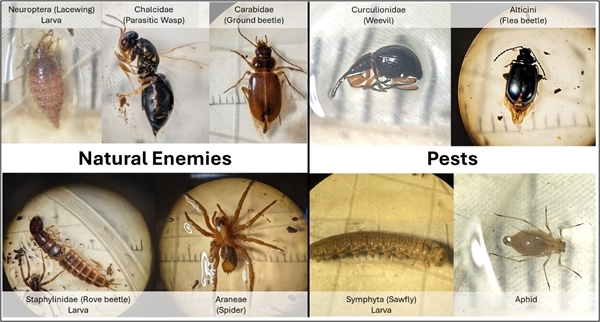
One group we have grown particularly fond of is the beetles (Coleoptera). They are an incredibly diverse group with a remarkable range of body shape and colours. A favorite of ours is the false oil beetle (Oedemera nobilis), which has a beautiful metallic sheen, and males are especially distinct due to their enlarged hind femur. These beetles are active pollinators, frequently moving between flowering plants. Another fascinating group of beetles are the clown beetles (Histeridae). Their thick, robust front legs help them to navigate the soil surface where they play an important role in both decomposition and pest control. Interestingly, clown beetles have also been used in forensic investigations, with their presences and life cycle stage used to help inform the potential time of death.
Lacewings: Nature’s aphid lions
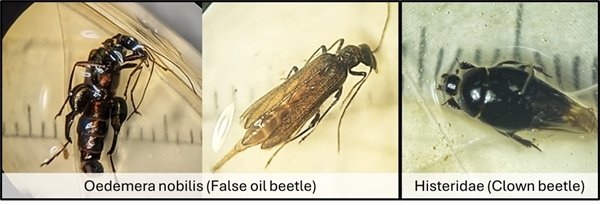
Another invertebrate group we have especially enjoyed seeing down the microscope are the lacewings, part of a large family in the order Neuroptera. There are 14 species of green lacewing and 29 species of brown lacewing in the UK. We often find Neuroptera larvae, and less frequently adults too, in D-Vac samples taken on arable farmland. Lacewings are so named for their characteristic net-like wing venation.
They are formidable natural enemies, with larvae, and adults of some species, feeding voraciously on soft-bodied pests such as aphids and spider mites; a single larva can kill multiple hundreds of aphids across its 2-3-week larval stage, earning them the nickname ‘aphid lions’. The larvae use their long, curved mandibles to pierce their soft-bodied prey, sucking out bodily juices. The appetite of the larvae, together with the ability of females to lay over 200 eggs in one season, means that lacewings can play an important role in biological control.
Fascinating flea beetles
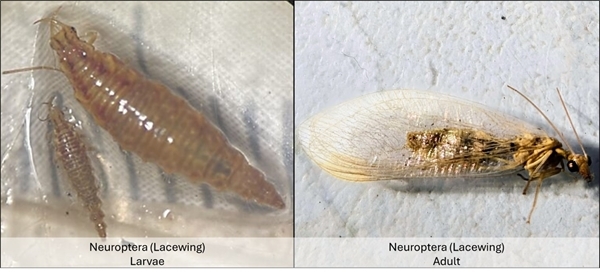
Amongst our samples, we frequently encountered a large numbers of flea beetles (Alticini), sometimes several hundred in a single 0.5m² sample. In one field, particularly in July, there was a noticeable spike in the abundance of barley flea beetle (Phyllotreta vittula). These small, striped beetles start life in the soil before emerging in spring to feed on cereal crops. The warm temperatures in June 2025 likely contributed to this outbreak as these beetles thrive in the heat as higher temperatures accelerate their lifecycle, which enables them to rapidly reproduce. In the UK, it is not just the barley flea beetle benefiting from the warmer climate but all flea beetles, like the related cabbage stem flea beetle (Psylliodes chrysocephala), as the recent milder winters and warmer springs have allowed adults to emerge earlier, aiding their success.
Sampling ground-dwelling invertebrates
In December, we braved the wet weather to set pitfall traps as part of a project looking at the effects on invertebrate biodiversity of different treatments and habitat types on arable farmland. Pitfall traps are an effective sampling method for ground-dwelling invertebrates, such as ground beetles (Carabidae) and spiders (Araneae), both important natural enemies.
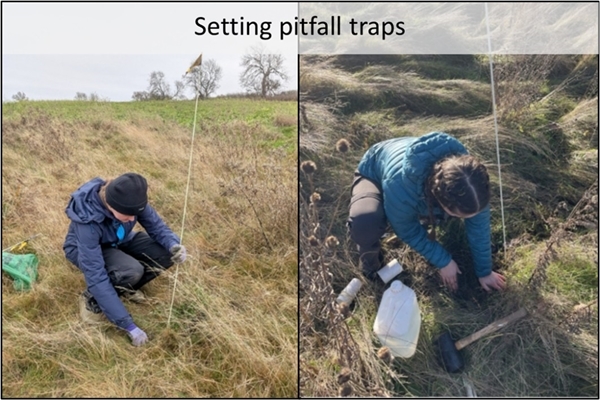
From May to July, we will be setting more pitfall traps; we will also be sampling invertebrates using a D-Vac suction sampler, essentially a large vacuum somewhat resembling a Ghostbusters’ proton pack that sucks up invertebrates! Using two different sampling methods allows a wider range of invertebrates to be studied, as D-Vacs are effective at collecting foliage-dwelling invertebrates as well as those on the soil surface.
Looking forward to corn bunting conservation
Another exciting fieldwork opportunity will be with corn buntings, a ground-nesting farmland bird currently on the UK red list. We will be assisting with finding their nests and monitoring the numbers of chicks fledging.
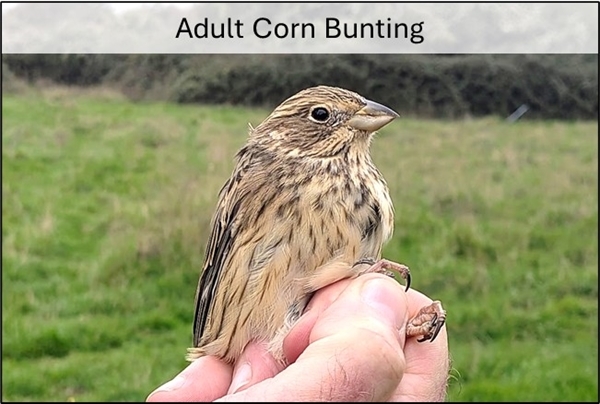 Bird handled under BTO ringing licence.
During this fieldwork, we will also collect chick faecal samples and compare them to insects from sweep samples taken in the area surrounding the nest to increase understanding of corn bunting chicks’ diet and the potential availability of food in the nearby area.