Written by Ellie Ness, Farmland Ecology Research Assistant
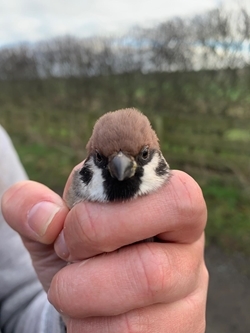 So many staff across our field teams, advisors and scientists are dedicated to understanding and supporting farmland bird communities, sparrows included! Whether it’s surveying populations, installing nest boxes with farmers, or analysing tree sparrow disease levels. At the GWCT, sparrows benefit from expertise at landscape-scale.
Most of our farmland birds nest out in the open, either on the ground (skylark, grey partridge, lapwing, corn bunting), or tucked in a hedge or some scrub (whitethroat, yellowhammer, linnet). The tree sparrow is one of the few farmland specialist birds that are cavity nesting; this means that they like nesting within an enclosed cavity, whether that’s a hole tucked under a barn roof or, even better, a nice sturdy, safe nest box. Tree sparrows are currently declining nationally and are a red-listed species, and one of the things that can be done to help them is by providing nest boxes for them to breed in.
Photo credit: Raymond Duncan. All birds are handled under BTO licence for research purposes.
The ideal tree sparrow nest box
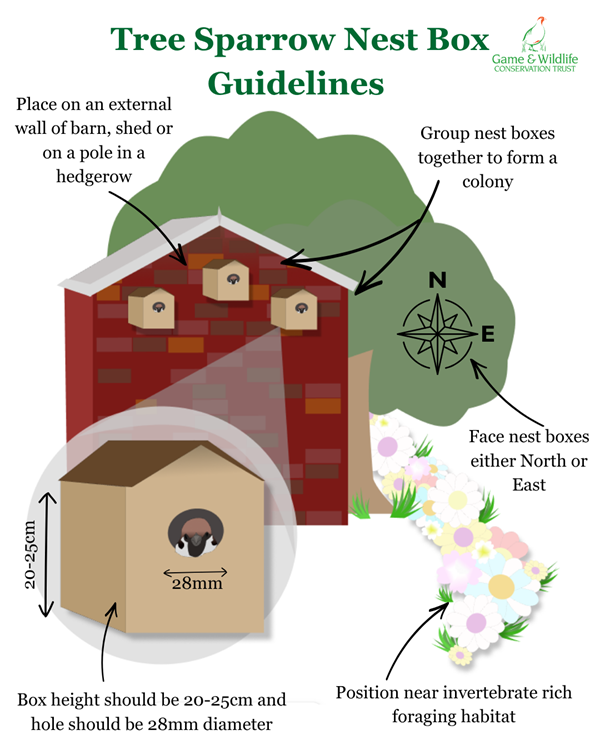
Small wooden boxes, similar to ones for tit species, are ideal for tree sparrow. The most important things to get right are the box measurements and the box placement.
For the box height, aim for around 20-25cm. A box that is too big means the birds expend more energy filling it up with nesting material, too small and it’s too cramped. For the entrance hole, a 28mm hole is the ideal size as this allows the tree sparrows to easily fit in the hole, but excludes larger species that would otherwise compete for the box.
Where to put the nest box
For the box placement, tree sparrows usually prefer boxes placed on the outside of buildings rather than inside, so external shed or barn walls are often ideal, facing north or east. Tree sparrows are colonial nesters, meaning you will get multiple pairs all nesting close together so you should put multiple boxes close together to help encourage a breeding colony to form. Boxes can also be mounted on posts and put out along hedges and field boundaries, again close together to form a colony.
Ideally, you want the boxes close to some good foraging habitat, so try to situate them near some invertebrate-rich habitat like field margins so they can easily provide food for their chicks without having to travel too far. Wherever the box is, it needs a clear flight path to and from the box hole for the birds to come and go.
Get ready for your new neighbours!
Once the boxes are up, leave them to it. Tree sparrows can have three broods within a season, so are busy for most of the spring and summer. In the winter (October-February), you can clean out the old nesting material to give the birds a fresh start the following year, but otherwise just leave them alone. Hopefully you will be lucky enough to have some tree sparrows decide to move in!