By Joe Stanley, Head of Sustainable Farming at the Allerton Project
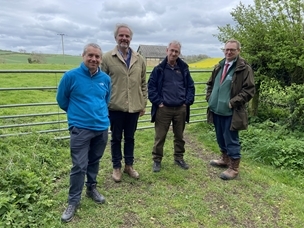 In mid-April the Allerton Project was pleased to host senior representatives from Defra in the shape of Mike Rowe, Director of the Farming and Countryside Programme, Jonathan Marsden, Head of Content for SFI and CS, and Ashley Winter, Head of Strategic Communications and Engagement. This was the second time in recent years that Allerton had hosted this senior team, with Janet Hughes (former FCP director) and colleagues visiting in 2022 and follows recent engagement with the Defra ministerial team in 2025 and shadow farming minister earlier this year.
They were hosted on the day by Dr Alastair Leake, Director of Allerton Project and GWCT policy, myself and Rob Shephard, GWCT member, farmer and chair of the Environmental Farmers Group (EFG). Given the long-term hiatus in applications to the SFI, and a second looming ‘cliff edge’ concerning existing SFI and Mid-Tier schemes through 2026, we were keen to press the point that long-term stability in agri-environmental schemes is a basic pre-requisite for success, and that there was a real risk – using data from the Allerton Project as an example – of significant national gains in both biodiversity and carbon storage being lost were these schemes to expire without the potential to progress into new options. We also used our data to support the requirement for transitional support for farmers as more regenerative practices are adopted, especially given the highly challenging market conditions prevalent in recent years.
There was much discussion of GWCT’s experience of collaborative working, using farmer clusters and the EFG as models of how this is already being made to work across the country and bearing in mind government’s recent announcement of a £30m ‘Farmer Collaboration Fund’. It’s vital that any such mechanism ensures that the maximum possible amount of public money reaches the farm gate to achieve the desired public goods.
Naturally, there was also discussion of Allerton research, from our long-running ‘3-legged stool’ study into how habitat creation, supplementary feeding and predation control are all vital elements for biodiversity recovery to our new field drainage project, which seeks to demonstrate not just the production benefits of well-drained agricultural land but – perhaps more importantly in the modern context – its environmental benefits too as we seek to raise this issue in prominence within government and the supply chain. It was also good to discuss our ongoing Baseline Agricultural Training which is being delivered to some 600 Defra staff every year.
We were of course very grateful that the Defra team took the time to visit us at Loddington. Our working research and demonstration farm is an invaluable asset on which to be able to demonstrate some of the best of what is possible in our modern farmed landscape, and certainly more compelling than a Powerpoint presentation!