Written by Henrietta Appleton, Policy Officer (England)
The just published RSPB/Leeds University paper (Graham et al 2026) on the negative impact that prescribed burning has on air quality through modelling provides a useful contribution to the debate on the role of prescribed or managed burning in ecosystem service delivery. But it should not be the sole basis for policy determination.
Whilst any fire will generate smoke and therefore impact human health, it is the duration of the exposure, the type of fire (and its fuel source), the nature of its combustion (flaming or smouldering), and the co-exposure to different air pollutants that determines that emissions from wildfires, compared to those from smaller scale prescribed fires, are the bigger risk to human health. (Readers may wish to read our contribution to the recent Environmental Audit Committee’s inquiry into Air Pollution here.)
The supplementary evidence to the paper states that “[...] our modelling results should be interpreted as a representation of the potential impacts of prescribed moorland burning on air pollution”, given that all the determinants of whether to burn or not cannot be modelled. This is important as the bigger picture must not be ignored and the results put in context.
The context
It is important to note the timing of the research conducted into prescribed burning due to the changing regulatory context. The data for modelling was selected from the 2017/2018 season which was before the introduction of both the 2021 and 2025 heather and grass burning regulations. The 2021 regulations came in on 1 May 2021. So only data from 2022/23 was under those regulations when the area of moorland burned was c45% of the area the year before and 55% of the average, resulting in lower emissions. (see table S1 from Graham et al 2026). (Note: the year only relates to the period October to April).
| Year |
Moorland Burning
Burned Area (km²) |
Moorland Burning PM2.5
Emissions (Tonnes) |
Country-level Moorland Burning
PM2.5 Emissions (Tonnes) |
| Scotland |
England |
Wales |
| 2017/18 |
120.01±8.78 |
1012±74.1 |
512 |
492 |
7 |
| 2018/19 |
209.74±11.94 |
1770±100.8 |
964 |
762 |
42 |
| 2019/20 |
164.87±0.76 |
1392±6.4 |
681 |
691 |
20 |
| 2020/21 |
185.79±14.19 |
1568±119.8 |
1145 |
385 |
38 |
| 2022/23 |
83.33±13.03 |
703±110.0 |
515 |
157 |
31 |
| Average |
152.75±9.74 |
1289±82.2 |
763 |
497 |
28 |
In addition, these outcomes should be viewed in the context of wildfire emissions. Whilst prescribed burning can lead to up to a 16% increase in PM2.5 concentrations as this paper shows, the Saddleworth Moor wildfire led to increases of more than 300%.
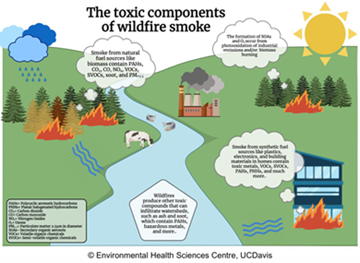 Another distinction is fire severity and the nature of the combustion. Prescribed fires are controlled ‘cool’ burns, which remove the surface vegetation leaving the peat below unscarred. Wildfires are uncontrolled fires of extreme heat resulting in the combustion of the carbon dense underlying peat, thereby not only emitting much larger quantities of particulate matter, but also a highly complex mix of toxic pollutants to the atmosphere, including CO, NOx, SO2 and PM10, black carbon/soot, volatile organic chemicals. Due to reactions within the smoke plume, this can lead to the formation of secondary pollutants such as ozone (see graphic).
In addition, as we know from recent events at Langdale, wildfires can occur over weeks and months in the spring and summer providing an on-going source of air pollution whereas prescribed fires occur over much shorter periods over the winter and in early spring, often just a day given the need for the right weather conditions. Given the duration of a wildfire, the conditions that affect smoke dispersal can change such as wind speed and direction, fire intensity and fuel source. Policy decisions must therefore consider the trade-off between the benefits from the fuel load management tool used by trained operators to reduce wildfire impacts that creates short-term, local-scale smoke pollution events and the longer time-scale, broader population, highly toxic exposures of a wildfire.
We acknowledge that emissions from prescribed burning are an annual event during the legal burning season (1 October to 15 April). Whereas wildfire emissions are episodic yet could occur at any time of year, including the summer when many more people are likely to be out of doors. So rather than calling for further restrictions as the RSPB has done, we feel that the information provided by such a modelling exercise should be used to improve heather burning practices so as to reduce the impact on surrounding communities. Indeed, the lessons from this work could also be used to help protect the health of practitioners such as gamekeepers and FRS personnel who undertake prescribed burns for varying reasons such as wildfire control (operational burns) and fuel load reduction – not just “to promote heather growth for recreational red grouse shooting”.
That said, upland land managers are a step ahead. Since the 2017/18 year used by this paper to highlight the potential impacts, best practice in heather burning has continued to evolve. Guidance provided by the Moorland Association and others encourages use of a smoke dispersal tool to help land managers make decisions about when to burn to protect local communities downwind. This builds on existing best practice advice in the Muirburn Code and training that includes knowledge of optimal meteorological and dispersion conditions.
The bigger picture
We believe the benefits of restricting prescribed fire for human health reasons must not be over-exaggerated. Indeed, such an approach would be contrary to the approach in other fire-prone countries of employing prescribed fire as a means of mitigating harm to human health from wildfires. It would also be viewing the role of fire through a very narrow lens.
Whilst the impact on health risk needs quantifying and mitigating, understanding the numerous trade-offs in the debate over the role of fire in our landscape is also important. Restricting or banning prescribed fire may reduce the frequent, moderate PM2.5 events modelled in the paper, but it risks the probability of increasingly frequent wildfires with their far greater implications for very high PM2.5 exposure, the release of other toxic pollutants, the significant loss of the carbon stored in the peat, the increased risk of flooding and peat erosion due to the removal of surface roughness (vegetation). Significantly prescribed burns take place outside the nesting season, whereas wildfires largely do not and so there is also an impact on red listed ground-nesting species and other mammals, amphibians and insects, which are active during the summer months. And then there are the impacts on businesses, infrastructure and visitors to the uplands to be accounted for.
Fire is also a “natural process” resulting in our uplands becoming a fire-adapted ecosystem (97% of UK taxa assessed had fire-adaptive traits), yet it has become demonised by the ideological debate over grouse shooting.
The loss of prescribed or managed fire to upland ecosystems would be detrimental to many other outcomes, both environmental and socio-economic. It is time we moved on and encouraged environmental policy that uses research to refine and evolve land management practices and focuses on co-existence and social process rather than one that furthers entrenched opinions.