By Dr Ayman Asiri, Landscape Agronomist (Allerton Project)
Hedgerows are one of the quiet cornerstones of the British farmed landscape, yet their importance is often underestimated. During and after the Second World War, thousands of miles of hedgerow were removed in the drive for food production and field enlargement, leaving many areas stripped of the wildlife corridors, shelter, and soil protection they once provided. In recent decades, farmers have been steadily re-establishing hedges, but accurate national data on how many have been planted, and crucially, on their condition, remains patchy at best.
Getting new hedges established has not always been straightforward. Some farmers have struggled to get plantings to thrive, while many more work hard to keep existing ones manageable, often through annual trimming regimes that can unintentionally limit their ecological value. A more nuanced approach to hedgerow management, underpinned by better data on what we actually have, is increasingly recognised as essential if these living boundaries are to deliver the full range of benefits they are capable of.
That is precisely the challenge the Allerton Project team has taken on in partnership with Nestlé. The project sets out to evaluate hedgerows, trees, soils and existing woody cover across the Nestlé supply shed, building a picture of hedge and tree carbon stocks and how these contribute to Biodiversity Net Gain (BNG). The result will be a carbon and biodiversity dataset that serves as a baseline, one that can inform future decisions on where and how to expand tree and hedgerow cover, and how best to manage what is already there.
Quality, not just quantity
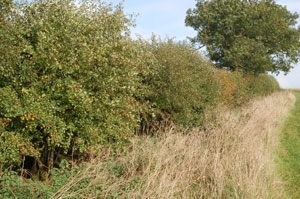 There are enough hedgerows in Britain to stretch nearly twice the distance to the moon. A key insight driving the project is that the value of a hedgerow lies not simply in its presence, but in its quality. Hedgerows function as biodiversity corridors for pollinators, birds, bats, small mammals, spiders and a host of other organisms that are fundamental to how farming landscapes work. Similarly, integrating trees into the farmed landscape through agroforestry, where trees are deliberately grown alongside crops or livestock, can complement these corridors by acting as stepping stones.
Different animal species have very different needs from hedges and trees. Higher flowering plant diversity within a hedgerow, for instance, tends to benefit pollinators by extending the period over which flowers are available, filling crucial gaps in food supply during the season. Most hedgerows are dominated by blackthorn and hawthorn, both valuable species, but ones that flower within a relatively narrow window. Blackthorn typically flowers first, in March and April, followed by hawthorn from April into May. This means the bulk of hedgerow flowering is over by late spring, leaving a forage gap for pollinators from July onwards. Including species that flower at different times, and paying attention to the flowering plants within the hedgerow understory, not just the woody structure itself, can help fill that gap and support insects throughout the season.
For other species, continuity matters above all else. Unbroken, gap-free hedges that allow uninterrupted movement and provide undisturbed nesting sites have been shown to benefit money spiders and bats in particular. Some species, such as wolf spiders, go further still, requiring vertical complexity and benefitting from the presence of trees within the hedgerow structure. However, their value is greatest when they form part of a connected network, linking remnant patches of good quality habitat and allowing animals to move through otherwise ecologically poor landscapes.
Reading the wider landscape
Where hedgerows sit in relation to the surrounding landscape also shapes how much biodiversity benefit they deliver. In areas already rich in semi-natural habitat, additional hedgerows may be less impactful; bees, for example, have been found to use hedgerows less frequently where there is abundant natural foraging available nearby, a phenomenon known as ‘ecological contrasts’. Conversely, in intensively farmed areas with little semi-natural cover, a well-managed hedgerow can be exceptionally valuable.
Placement decisions should therefore take in the whole farming landscape: identifying remnant patches of natural habitat, considering how hedgerows might link them, and thinking across farm boundaries where possible. A woodland shared between two neighbouring farms, connected by hedgerows and agroforestry systems running through the fields either side, can create a corridor that allows animal movement across an entire landscape.
Getting management right
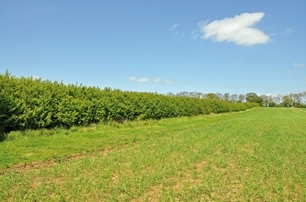 How hedgerows are managed can be just as important as whether they exist at all. Annual cutting is a common regime on farms, but comes at a significant cost to wildlife. A hedge cut every two years rather than every year can support significantly more money spiders; extend that to three or more years, and the hedge can produce more than three times the berry mass, a direct benefit to birds, bats and small mammals heading into winter, and a compelling argument for giving hedges a little more breathing room. Taller, denser hedges also provide important windbreaks and act as insect hotspots, in turn attracting the animals that feed on them.
The type of cutting matters as well as the frequency. Hedge laying, the traditional practice of partially cutting and weaving stems along the hedgerow, is a well-established management approach that rejuvenates aging or gappy hedges, creates a dense stock-proof structure, and generates dead wood habitat valuable to invertebrates and small mammals. Coppicing can similarly restore seriously neglected hedges, but temporarily strips out all shelter and floral resources while the hedge recovers. Pollarding takes a lighter touch, retaining mature trees and creating microhabitats used by bats and insects, making it the preferable option where the goal is to balance ongoing management with biodiversity.
A direct return for farmers
There is a strong case, of course, for hedgerow investment in terms of BNG credits and carbon storage. But it is worth emphasising the direct on-farm benefits too. Well-managed hedgerows support pollinators throughout the season, providing forage and nesting habitat that contributes directly to crop pollination in neighbouring fields. Many of the other species that use good quality hedgerows, wolf spiders, money spiders and rove beetles among them, are natural enemies of crop pests and play a meaningful role in integrated pest management. Research has shown that high-quality hedgerows, those that are gap-free, structurally diverse and include trees, act as reservoirs for these predatory species, which can spill over into neighbouring fields and help keep pest populations in check.
Hearing from farmers first
The project is currently in its early stages, and before any recommendations can be made, the team needs to understand how farmers themselves view hedgerow management, what is practically feasible, what motivates them, and where the barriers lie. Farmer engagement workshops have been held in Yorkshire and the East of England, using structured interactive discussions to explore attitudes towards different hedgerow and tree-planting approaches.
Getting this right matters. The aim is not to add to the burden on farm businesses, but to help farmers direct their resources (whether time, money or land) towards the approaches that will deliver the greatest gains for carbon and biodiversity, as efficiently as possible.