By Jayna Connelly, Science Communicator and Ellie Ness, Farmland Ecology Research Assistant
Last summer we shared an update on the Corn Bunting Project, explaining how detailed fieldwork and chick diet analysis were helping us understand why this once‑common farmland bird continues to struggle. Since then, another breeding season has passed, and it proved to be a challenging one.
By combining sweep‑net sampling of invertebrates with faecal analysis from corn bunting chicks, we can see not just what food is available in the landscape, but what adult birds are actually managing to bring back to the nest. In 2025, this approach revealed some clear and concerning changes.
A sharp shift in chick food
From previous years of work, we know that corn bunting chicks rely heavily on high‑protein invertebrate prey, particularly caterpillars, alongside harvestmen, spiders, crickets and grasshoppers, snails and flies. In 2024, caterpillars were by far the most important food item found in chick faecal samples.
In 2025, that changed dramatically. Caterpillars all but crashed in the diet, and adult corn buntings were forced to compensate by bringing back more spiders, harvestmen and crickets and grasshoppers instead. We also saw an increase in the proportion of grain in chick diets, a poorer substitute that lacks the protein chicks need for rapid growth.
This dietary shift had real consequences. During the 2025 breeding season we observed stunted chick growth and higher chick losses, with some chicks weighing less than a quarter of their siblings’ weight. The faecal analysis and field sampling together strongly suggest that food shortages were a key factor.
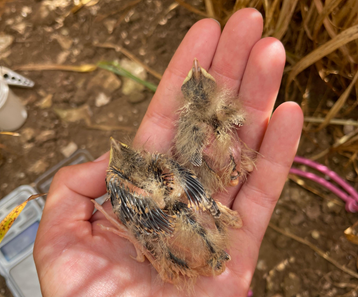 Corn bunting chicks - handled under a BTO ringing licence. Credit: Ellie Ness
What was happening in the fields?
Sweep‑net sampling mirrored what we saw in the nests. In 2025, caterpillar numbers were lower across all habitats, including non‑crop areas. Snails also declined compared to the previous year. These are groups that tend to need damper conditions and lush vegetation, both of which were in short supply.
By contrast, more generalist invertebrates such as spiders, harvestmen and flies coped much better in the hot, dry summer of 2025, and their numbers increased across many habitats. Interestingly, while crickets and grasshoppers appeared in higher numbers in chick diets, they were found in lower numbers in sweep samples. This suggests that adult corn buntings were actively seeking out these large, energy‑rich prey items, even when they were relatively scarce.
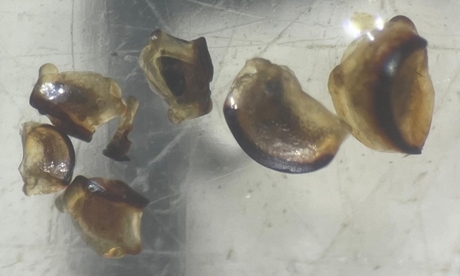 Caterpillar mandibles from the faecal sample viewed from down a microscope. Credit: Ellie Ness
The continued importance of non‑crop habitats
One finding that remained consistent, and even strengthened, was the importance of non‑crop habitats. In 2025, conventional farms showed significantly higher numbers of all the key corn bunting chick‑food groups in non‑crop habitats than in crops. On organic farms the contrast was less stark, but non‑crop areas still outperformed crops for most key prey groups.
This pattern is also reflected in broader bird‑food measures. In 2025, 50% of non‑crop habitats sampled exceeded the Grey Partridge Chick Food Index threshold associated with supporting breeding populations, compared to 23% of crop fields. While corn buntings struggled due to the loss of specific prey like caterpillars, these same habitats still provided abundant food for other farmland birds with different dietary needs.
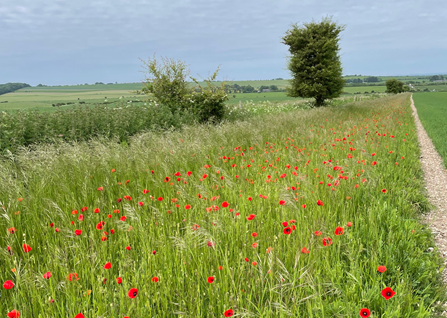 A flower-rich margin (IPM2) Credit: Ellie Ness
A mixed year, but a clear message
Overall, 2025 was a difficult year for corn buntings, largely driven by dry weather and the knock‑on effects on key insect prey. But it was also a year that reinforced a crucial message: diverse, high‑quality non‑crop habitats remain essential. They support a wide range of invertebrates, buffer some of the impacts of poor weather, and provide food for many farmland bird species, even when conditions are far from ideal.
As climate extremes become more common, this kind of resilience will only grow in importance. Our ongoing work will continue to track how weather, habitat and food availability interact, and how practical land management can give corn buntings and other farmland birds the best possible chance.
Please note, all birds were handled under a BTO ringing licence.