Joe Stanley, Head of Sustainable Farming, Allerton Project
Over the last few years, it’s become increasingly clear that farming businesses cannot rely on stability as a given. Global shocks have a habit of landing directly on the farm gate. Conflict in key food-producing regions such as Russia and Ukraine, rising geopolitical tensions and bottlenecks elsewhere as exemplified in the Middle East, and mounting climate pressures have all exposed how vulnerable food and farming systems become when they depend heavily on imported inputs and long supply chains. At the same time, weather extremes are becoming the norm rather than the exception even here in normally temperate Britain.
Against that backdrop, nature‑friendly and regenerative farming is no longer just an environmental conversation – it is a business resilience strategy.
On farms like the Allerton Project, we see emerging evidence that working with biological systems reduces exposure to risk. Reduced cultivations are a good example. By lowering fuel use, they insulate businesses from volatile diesel prices. Just as importantly, in the medium term (and done in the appropriate context of the farm and field) they improve soil structure, allowing soils to drain better in wet years and hang on to moisture in dry ones. In a climate that swings between the two, that matters.
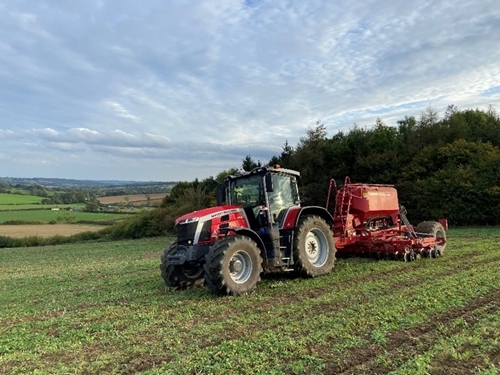 5-year comparative establishment trials demonstrate a 44% reduction in fuel use between conventionally established and direct-drilled cropping at Allerton.
Integrated pest management is another essential tool. Encouraging beneficial insects through diverse rotations, flowering margins, beetle banks and cover crops gives farmers more options when pest pressure builds. Rather than reaching straight for chemistry, we can use thresholds, monitoring and biological control to make smarter, more targeted decisions. That reduces costs, slows resistance and gives businesses flexibility when products are scarce or prices spike.
One of the simplest regenerative actions is also one of the most powerful: being honest about land capability. On every farm there are awkward corners, wet patches, steep banks, thin soils or low‑yielding headlands. Trying to push maximum production from these areas often costs more than it returns. Putting them into well‑managed habitats – grass margins, species‑rich strips, beetle banks or hedgerows – can improve whole‑field performance by reducing pest pressure, improving water management and creating space for machinery to work efficiently. Nature options, when placed strategically, aren’t land taken “out of production”; they are part of a more functional system.
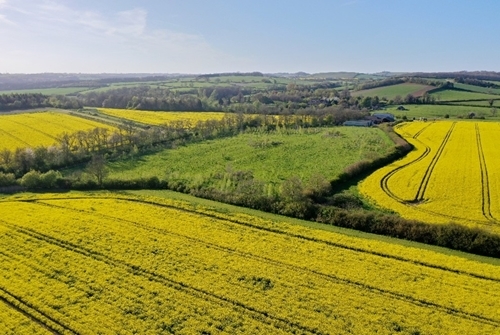 Grass margins, hedgerows, floristic strips and agroforestry all contributing to beneficial crop pest predators. Allerton is more than a decade without use of insecticides.
Crucially, these approaches build resilience from the inside out. Healthier soils cycle nutrients more effectively, reducing reliance on imported fertiliser. Diverse systems cope better with shocks, whether that shock is a sudden price rise, a supply disruption or an extreme weather event. None of this means walking away from productivity – it means producing in a way that is robust over time. What’s more, such options as described generate their own stable income streams through schemes such as the Sustainable Farming Incentive or Landscape Enterprise Networks – providing, of course, you are quick enough to catch them.
This is not to ignore the challenges, and the Allerton Project has experienced no shortage of these. The initial transitional period between tillage regimes can be tough; in some seasons beneficial insects can fail to turn up to work in sufficient numbers; for small and tenant farmers, there are particular challenges of investment and land-use change.
Yet the events of recent years have reminded us that the external world is unpredictable. What farmers can control is how resilient their own systems are. Nature‑friendly farming offers a practical route to reduce dependence on inputs we do not control and rebuild the natural capital that underpins our businesses. In uncertain times, that is not idealism – it’s sound farm management.
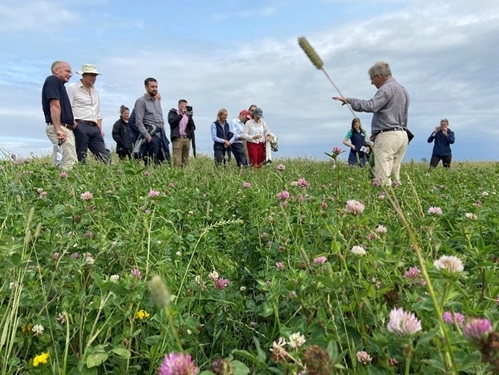 The Allerton Project hosts some 2,000 visitors per year from across the food & farming industry and associated sectors. If you want to learn more about our research into nature-friendly farming and landscape management, get in touch allertontraining@gwct.org.uk