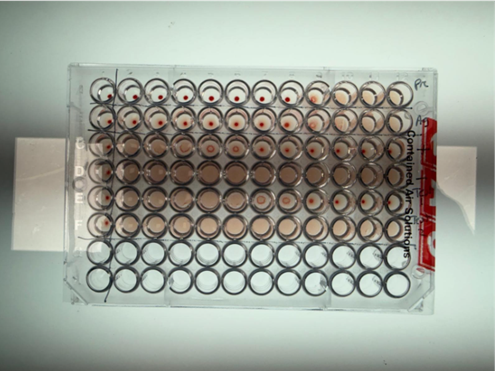
In February, two members of our Uplands Research and Advisory staff were invited to the Virological Surveillance Unit at the Moredun Research Institute (MRI) to mark the start of a closer collaboration between the Game and Wildlife Conservation Trust (GWCT) and the MRI. The visit involved a discussion on how we can work together towards peer-reviewed scientific papers, a tour of the laboratory including a demonstration on how the louping-ill tests are conducted, and presentations on the new vaccine, and current and past work.
The MRI is a scientific centre dedicated to improving the health and welfare of farmed livestock. Based in Midlothian, Scotland, it is internationally recognised for its work on infectious diseases. For more than a century, its scientists and veterinarians have been on the front lines of developing diagnostic tests and novel vaccines - work that helps shape everything from animal welfare to global food security. While the MRI is best known for its pioneering livestock research, its expertise in parasitology and infectious diseases naturally extends to wildlife species that interact with managed farmland and moorlands. Therefore, they also play a key role in understanding the health challenges facing red grouse.
Like sheep, red grouse are vulnerable to louping-ill, a tick‑borne virus. Louping-ill takes its name from the old Scots word ‘loup’, meaning ‘to leap’, signifying the uncoordinated gait seen in neurologically affected animals. Both organisations have led on separate instrumental research on this virus in the past, with the MRI mainly focussing on sheep and the then Game Conservancy, focussing on the effects on red grouse populations.
This research supports tick‑control strategies and informs management approaches specifically for livestock. The loss of the previous louping-ill vaccine in 2017 created a major challenge for animal welfare, conservation, and sustainable grouse population management. The MRI are currently in a phase of fundraising for the new louping-ill vaccine for sheep, which once approved, will indirectly benefit red grouse and other species. Looking forward, the GWCT and the MRI will now work more closely together to achieve this joint goal.
Alongside this research collaboration, the GWCT offers two tests for the prevalence of louping-ill virus in various game species. The first is a haemagglutination inhibition (HAI) test, which involves taking blood samples from freshly shot birds to determine if that individual animal has antibodies for louping-ill, indicating that the individual has been infected by the virus at some point in its life. The second is a polymerase chain reaction (PCR) test, which uses brain tissue to determine whether the individual was infected with the virus at the point of death. Both tests are widely available in Scotland and northern England.
The virus’ prevalence has increased markedly in recent years, which may be due to increased awareness and testing. Not only has recent testing carried out by the GWCT resulted in positive louping-ill blood tests for red grouse throughout Scotland and England, but worryingly, gamebirds in low-ground habitats are also testing positive. This highlights how much is yet to be understood about the virus and which species are affected. Anyone who has witnessed the consequences of louping-ill will appreciate the serious welfare implications of this tick-borne virus as it can affect not only sheep and gamebirds but also cattle, horses and dogs. Beyond its impact on livestock and wildlife, concerns around ticks are also growing from a public health perspective. Knowledge is key and, working together, we hope to gain a better understanding of the virus’ prevalence, distribution and its impact on wildlife populations.
To find out more about the vaccine development or to help support the project, please visit: moredun.org.uk/donate-louping-ill
Alternatively, if you are interested in carrying out louping-ill testing, please contact:
England: advisory@gwct.org.uk 01425 651013
Scotland: scottishadvisory@gwct.org.uk 01312 027670