By Adriana Dermetzis & Holly Appleby, Uplands Research
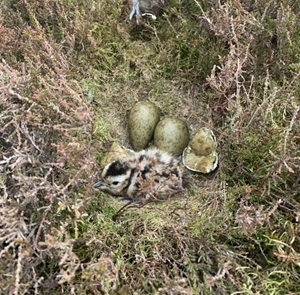 With the upcoming long-awaited good weather, dog walkers and their canine companions will soon be enjoying the scenic walks and health benefits the outdoors have to offer. At the same time, many of our ground-nesting birds will be incubating while later arrivals will be starting to build their nests.
There are many ground-nesting birds across the UK. Those found in the uplands often use bare scrapes, heather or rush pasture to nest in, leaving them at high risk of being disturbed by people and animals, such as dogs and livestock. Such species include curlew, skylark, lapwing, meadow pipit, oystercatcher, woodcock, snipe, black grouse and red grouse.
For all wild bird species, their eggs and nests are protected by law. You cannot intentionally:
- Kill or injure a wild bird
- Take, damage or destroy a wild bird’s nest whilst it is being used or built
- Take or destroy a wild bird’s eggs
Some birds, known as ‘schedule 1 birds’ (e.g. barn owls, dotterel, merlin) have extra legal protection. For these bird species it’s also an offence to disturb them while they’re nesting, building a nest, in or near a nest that contains their young, or to disturb their dependent young.
What is the CROW Act and how does it relate to dog walkers?
 In England, the Countryside and Rights of Way (CROW) Act became law in 2000, providing a statutory right of access to mountain, moorland, heath, down and common. This land, which includes most of English uplands, is referred to as ‘open access land’.
Between 1 March and 31 July each year, open access land has a short lead rule. This means that dogs must be always kept under effective control and on a short lead of no more than 2 metres. This rule applies near livestock on open access land at all times of the year. In some circumstances, people with dogs can be excluded completely from small lambing fields and grouse moors. Specified people can apply for a licence from Natural England to disturb birds in certain circumstances such as for science, education or research, or to conserve plants and animals (including other wild birds).
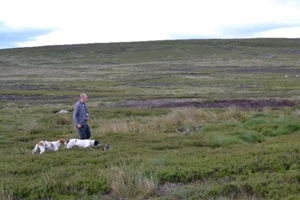 The reason why these restrictions are in place is because dogs can so easily disturb or interfere with birds, specifically ground-nesting birds, during the breeding and nesting season. Ground-nesting birds perceive dogs as predators, causing heightened vigilance, and when flushed, these birds can expend a large amount of energy which they could otherwise spend doing their natural activities such as nest building, incubating eggs, rearing chicks or feeding. In some cases, nests can be damaged, eggs can be eaten, and chicks can be abandoned.
Previous studies have shown how damaging human recreational disturbance can be for breeding birds in a range of habitats. Research conducted by the GWCT on open access land in the North Pennines found that black grouse that were exposed to higher disturbance rates increased their flushing distances by 60%. Seemingly, regular or increased disturbance could impact negatively on survival rates, if alternative areas were of poorer quality or were limited in extent. Another study found that dog walking in woodlands led to a 35% reduction in bird diversity and a 41% reduction in abundance. More recently, researchers at the Royal Holloway University of London found that 85% of dog walkers, in four lowland heathlands in the UK, always walked their dogs off the lead. This significantly reduced the undisturbed potential breeding habitat available for birds in the lowland heath habitats studied.
In addition to the effects of dog walking on our breeding birds, dogs are also known to worry livestock. The Dogs (Protection of Livestock) (Amendment) Act 2025 came into effect on Wednesday 18 March 2026. This legislation allows courts to impose unlimited fines on owners whose dogs worry livestock, when previously this fine was capped at £1,000. This change to the law is about making sure people can continue to enjoy the countryside whilst keeping livestock safe, protecting animal welfare and supporting the work farmers do every day.
What can you do about it? Follow the Countryside Code
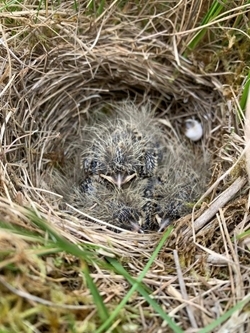 1. Always keep dogs on a lead and make sure not to cause damage or disturbance by venturing off footpaths
It is up to owners to keep all dogs, no matter their breed or temperament, under control to prevent disturbance to wildlife and livestock. On open access land between 1 March and 31 July, the short lead rule (no more than 2 metres) should be followed, and outside of this period, dogs should be kept under control. Near livestock, the short lead rule should again be followed to avoid worrying livestock and possibly receive an uncapped fine.
2. Bin dog poo
Leaving dog poo for nature to ‘take care of’ can have a harmful impact on the nutrient balances of the habitat. Make sure to clean up after your pet and leave no trace of your walk.
3. Educate others about the impacts of dogs
Some people may not be aware of the existing legislation or the risks to breeding birds, so whenever possible inform people of the risks. If you see someone walking their dog off a lead or walking off designated paths, kindly inform them of the risk and ask them to put their dog on a lead and/or walk on the footpath. It may be awkward, but it is crucial for protecting breeding birds and increasing the chances of survival.
4. Take your litter home – leave no trace of your visit
Littering has severe negative impacts on the environment, wildlife and even human health through soil and water contamination, as well as the risk of wildlife swallowing indigestible rubbish. Do not contribute and bin your rubbish.
References and useful links
- Banks, P.B. and Bryant, J.V. (2007). Four-legged friend or foe? Dog walking displaces native birds from natural areas. Biology Letters, 3(6), pp. 611–613. doi: 10.1098/rsbl.2007.0374.
- Thomas, R.L., Papworth, S.K., and Fellowes, M.D. (2024). Unleashed: walking dogs off the lead greatly increases habitat disturbance in UK lowland heathlands. Urban Ecosystems, 27, pp.1-10. doi: 10.1007/s11252-024-01568-4.
- Warren, P., Baines, D. and Richardson, M. (2009). Mitigating against the impacts of human disturbance on black grouse Tetrao tetrix in northern England. Folia Zoologica, 58(2), p.183.
- Wild birds: protection and licences - GOV.UK
- Walking among ground nesting birds: where the earth is both a cradle and a battlefield. - Game & Wildlife Conservation Trust
- Open access land: management, rights and responsibilities - GOV.UK
- The Countryside Code - GOV.UK
- Law changes strengthen protection for livestock – The Farming Blog