Some of the first studies looking at conservation headlands were done at the Manydown Estate in Hampshire, which began to establish the possible benefits for conservation and natural pest control in arable environments.
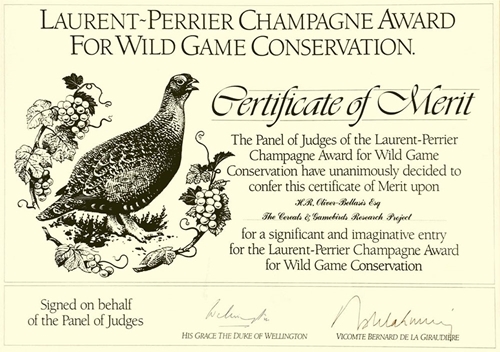
The study was called the ‘Cereals and Gamebirds’ research project, and it was a pioneering work that led to the publication of many papers, conference presentations and, importantly, data supporting the inclusion of conservation headlands in agri-environment schemes.
Hugh Oliver-Bellasis and his team allowed unsprayed conservation headlands to be established on three areas around the farm, which could be compared to reference areas that were fully sprayed as normal. Detailed data was collected about many aspects of the farming, insects, weeds and partridge survival, and the effects were studied carefully. You can read more about the history of our work on the estate with Hugh Oliver-Bellasis’ overview of the project here.
Over 50 publications resulted from the Cereals and Gamebirds project, with much of the work carried out at Manydown. A brief selection of these are shown below, with the key messages:
- Rands, M.R.W. (1985). Pesticide use on cereals and the survival of grey partridge chicks: a field experiment
The survival of chicks on areas with unsprayed headlands was much higher than chick survival in fully sprayed fields.
- Sotherton, N.W. (1991). Conservation Headlands: a practical combination of intensive cereal farming and conservation
In unsprayed headlands there were more weeds, more chick food insects, and grey partridge broods were larger on these areas.
- Rands, M.R.W. & Sotherton, N.W. (1986). Pesticide use on cereal crops and changes in the abundance of butterflies on arable farmland in England
More than twice as many butterflies were seen on sites with unsprayed headlands, than fully sprayed fields. Of 17 species, 13 were more abundant where headlands were not sprayed.
- Sotherton, N.W., Moreby, S.J. & Langley, M.G. (1987). The effects of the foliar fungicide pyrazophos on beneficial arthropods in barley fields
The fungicide pyzarophos significantly reduced the number of many beneficial insects such as the natural enemies of cereal pests, and grey partridge chick-food insects.
- Thomas, M.B., Wratten, S.D. & Sotherton, N.W. (1991). Creation of ‘island’ habitats in farmland to manipulate populations of beneficial arthropods: predator densities and emigration
Creation of beetle banks provided overwintering sites for beneficial insects in the first year. In year two the grasses became more established and over 1,500 insects per square metre were found. The increased number in the beetle bank had an effect on their presence in the crop.
- Boatman, N.D. & Sotherton, N.W. (1988). The agronomic consequences and costs of managing field margins for game and wildlife conservation
Studying the management and cost implications of including conservation headlands in cereal fields with heavy soils. Taking into account yield and weed contamination, the study concludes that conservation headlands are a viable option at moderate cost and with little overall effect on crop productivity.
- Boatman, N.D. (1987). Selective grass weed control in cereal headlands to encourage game and wildlife
Selective herbicides used in conservation headlands can remove grass weeds but leave insect host plants.
- Tew, T.E., Macdonald, D.W. & Rands, M.R.W. (1992). Herbicide application affects microhabitat use by arable wood mice (Apodemus sylvaticus)
Conservation headlands can be beneficial to small mammals.
- Longley, M., Çilgi, T., Jepson, P.C. & Sotherton, N.W. (1997). Measurements of pesticide spray drift deposition into field boundaries and hedgerows I. Summer applications
Having conservation headlands at the edge of fields can reduce the amount of pesticide that drifts into the bottom of hedgerows.
- Wilson, P.J. (1995). The potential for herbicide use in the conservation of Britain’s arable flora
Conservation headlands are beneficial to rare arable plants and weeds.
A full chronological list can be downloaded here.