December moth
 We have had a few frosts now here in Hampshire and winter is finally upon us we tip over into December. Again this year has whizzed past, and as I was driving to the Farmer Cluster Christmas party that I had organised for Allenford and Martin Down the other evening, it only felt like a few weeks ago since we had our last! It also made me realise I better get on and write this Species of the Month, before I head off for Christmas!
As always, I like to connect the species to the month, so here goes…
When most insects have vanished for the year and winter settles in, a small, shaggy moth begins its quiet ritual. The December moth (Poecilocampa populi) (Poecilo is Ancient Greek for ‘varied’ or ‘spotted’, campa meaning ‘field’ and populi meaning "of the poplar” (genitive of Populus), referring to the caterpillar’s food plant), is one of the rare Lepidopteran species that doesn’t fear the cold — indeed, it thrives in it. With its fuzzy brown body and soft brown wings edged like frost-bitten velvet, this species has charmed naturalists for centuries and found a quiet niche in European winter folklore.
Appearance
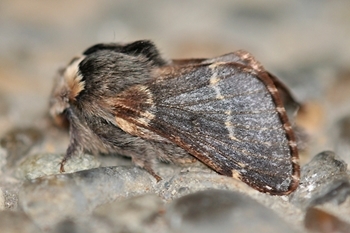
The December moth is an unmistakable medium-sized moth, with a plump, densely hairy dark brown body that provides insulation against cold November and December nights, with a creamy white head. Their thick ‘fur’ is an evolutionary marvel, allowing them to remain active in temperatures that would stun or kill most insects. The wingspan is 3-4cm and the wings are charcoal coloured, with two creamy white lines across them. The second line is strongly waved and often more obvious. The males are smaller than females and the males have feathery antennae used to track the female pheromones through cold still air.
A moth of winter: Biology and life cycle
Despite its name, the December moth’s story begins long before the year’s end. Their life cycle is timed in reverse to most moths as the adults emerge late autumn to early winter (typically November–December) but the adults don’t feed (they lack functional mouthparts), as their short winter lives are entirely devoted to mating and continuing the cycle. The eggs are laid on tree bark, especially poplar, birch, willow and sometimes fruit trees, which hatch in early spring, feeding on the leaves of a wide variety of native deciduous tree and hedge species including birch, blackthorn, oak and hawthorn, when the first leaves appear. The caterpillars feed at night through late spring, growing shaggy and greyish-black and by early summer, they pupate in leaf litter, where they remain dormant until the year’s cold returns, when the cycle goes around again.
This moth has a clever strategy in getting a head start over other insect by beating them to food plants earlier as caterpillars, and having compounds of alcohol in their blood to stop them from freezing, so they can fly in the dead of winter while avoiding predation from bats as they are hibernating. But they can’t beat everything, as their eggs are easily picked off by starving winter birds like flocks of long-tailed tits or wrens as they forage in the hedges and woods. So, even with a reversed life cycle, it appears that there is no easy way of winning in the race for food or avoiding being eaten!
Where to see them
- Range: Widely distributed across Europe and parts of Asia.
The December moth feeds at night when you might spot them on the wing while letting the dogs out, or you might hear them banging at the windows of the house if you have a light on. They spend the day resting and can be found in woodland, hedgerows, scrub, parks and sometimes gardens. They have a peculiar habit of pretending to be dead if disturbed whilst resting in the day; they will simply drop to the ground and remain still. If they are disturbed further they then flap about, moving their wings in a strange, slow, jerking way. When they are put somewhere safe to go back to sleep, you can tell they have nodded off again as they will tuck their antennae under their wings!
Folklore and cultural connections
Compared to butterflies or iconic summer moths, the December moth doesn’t dominate myth, yet its winter appearances have given rise to quiet folklore across parts of Europe. A ‘Yule visitor’ in rural Britain and Scandinavia, a moth appearing in the darkest months was seen as a harbinger of the solstice. It has also been referred to as the ‘dream moth’, as if a winter moth beats at the window, a dream you’ve forgotten will return to you.
It also represents an inversion of expectations:
- Moths shouldn’t fly in freezing temperatures — but this one does.
- Winter is thought of as lifeless — but here is an insect freshly emerged, searching for a mate.
- The year feels like it is ending — but this moth’s emergence marks the beginning of its life cycle.
In that sense, the December moth is one of nature’s small paradoxes, one of winter’s hidden delights, and a species which is considered stable and common, which is not bad for an insect choosing winter as its stage!
Merry Christmas and I’ll be back in the New Year!
Megan Lock
Advisory
Photo credit: Walter Schön