American mink
Adaptable and agile hunters that are meaner than they look!
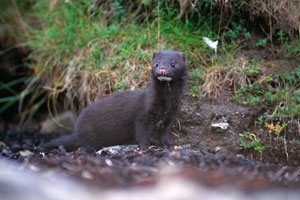 Finally the sun has made an appearance; the soil is starting to dry out a little here in Hampshire; the great tits (Parus major) are calling constantly with their ‘squeaky wheelbarrow’ like call; I have seen well over 100 brimstone butterflies (Gonepteryx rhamni) on the wing now; and the excitement of finding frog and toad spawn is tangible for my little daughter (and me!). So much so we spent quite a lot of time searching for some on Sunday with great success. However, while searching the lake, reedbed and ditches around, we did find a lot of discarded frogspawn all over the boardwalk like something had been squeezing it out of the frogs, with remnants of frogs, so we think there might be a mink around – trail camera and a GWCT Mink Raft will be deployed! Which neatly leads me to writing about the American mink (Neovison vison).
Identification
The American mink is a mustelid, which is carnivorous family that includes stoats, weasels, martens, otters and badger. It usually has dark, chocolate-brown fur, which looks black when it is wet and has small and variable white patches on the chin, throat, chest and groin.
The American mink has a narrow snout and small face and is similar size to a ferret/polecat, but smaller and more brazen in behaviour than an Eurasian otter. It has a short, fluffy tail (approximately 18cm long), with an average body length of 37cm head and body (or approximately 60cm in total).
They are often spotted swimming in lakes and rivers, with about half the body above the water.
Weight
Kittens 100-160g at birth. Adult males 800-1,500g and females being much smaller at 500-800g.
Lifespan
Average 10-12 years in the wild.
About and distribution
The mink we have in Britain are non-native, originating from mink brought over for fur-farming from North America in the 1920s. There is a widespread modern misconception that the UK’s wild population of American mink originated from mass releases of mink from fur farms by animal rights activists in the 1990s, but in fact, the wild population was established decades earlier from multiple escapes (and perhaps deliberate releases) all over the country – like many of our non-native species that we have resident here now! Mink were first confirmed to be breeding in the wild in 1956 and by December 1967, wild mink were present in over half the counties of England and Wales, and in much of lowland Scotland.
Habitat
Rivers and wetland, coastal, farmland and marshland.
I have seen mink in several habitats and even running along roads. One of the most memorable sightings I have had was watching one running along the edge of a cricket pitch near the River Test in the middle of the day. The local crows and jackdaws alerted me to its presence as they mobbed its every stride! They are quite a confident species, which don’t shy away like otters or badgers, and are often seen in open countryside or even in farmyards chasing rats.
Mink are strictly territorial, with males occupying exclusive ranges of 1-6km in length. Females have smaller territories within or overlapped by those of males. They use their scats (droppings) to mark the boundaries of their territory, and the neighbourhood of their den, which is usually within 10m of the water.
Diet
Mink are agile and ferocious hunters that eat a wide range of mammals, birds and fish, typically about a third of the diet coming from each. In some areas nearer the coast, they also eat invertebrates such as crabs and crayfish. They also demonstrate surplus killing behaviour, which means they kill more than they can consume, particularly in situations when prey is abundant like colonial nesting seabirds on breeding islands in Scottish sea lochs and henhouses for example.
General ecology
 Mink are extremely well-adapted generalists – they have the ability to utilise a range of habitats and feed from a mixture of prey and take advantage of any species that is locally or seasonally available. Therefore, where mink are abundant, other species do suffer and can decline, which is why numbers must be controlled.
The Game Research Association – forerunner of the GWCT – argued in 1961 that this was an extra predator in the UK which would disrupt our native ecosystem, and urged MAFF (Ministry of Agriculture, Fisheries and Food) to control the numbers while it was still possible. They eventually did, at least after a fashion, for the sake of game and other native wildlife. Notably our water voles have proved the greatest cause of concern, as female mink are able to get into water vole tunnels and predate adults and young.
Breeding
The female has just one litter a year of 4-6 hairless and blind kits in May. They begin to take meat from 5-6 weeks, and reach adult size by the autumn. They can breed at one year old.
However, the GWCT did record up to ten embryos in pregnant females when we first used GWCT Mink Rafts on the River Itchen.
Field signs
Footprints
They are five-toed and are about 3-3.5cm in width and 2.5-4cm in length.
Droppings
They often contain bones and fur and are long and twisted in shape, with tapered ends. Approximately 6-8cm long, 10mm thick. Greenish, black, brown in colour and smell foul, like burnt rubber and rotten meat, which is very unpleasant – unlike that of otter spraint, which smells of jasmine tea – top tip!
Conclusion
As I have said, these well-adapted hunters can utilise most habitats, have spread successfully across the United Kingdom, and hunt anything that moves, so if you think you may have a mink, it is best to gather evidence and utilise the GWCT’s guidance to control them and book onto one of our GWCT Mink Control courses if you want some hands on tuition, to safeguarding our native and vulnerable species.
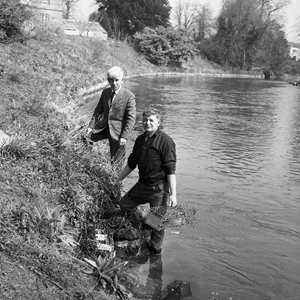
Dedicated to the Mr Charlie Swan and his son Dr Mike Swan (pictured above) for their research, practical expertise and vast knowledge.
Megan Lock
Advisory
Mink photo credit: Laurie Campbell