Brown trout
The golden icons and indicators of our rivers
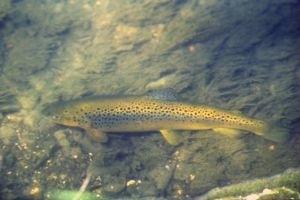 Chalk streams are a very special type of river, and in my mind the best because they are almost unique to England, where 85% of the 200 chalkstreams in the world are found.
Their crystal clear ‘gin-like’ water is primarily fed by spring water from the chalk aquifer, not from rain, which means they are cold, with stable flows and generally clear when not under threat from polluters! Due to the rich mineral content in the water, especially calcium, this ‘base-rich’ environment supports a very distinctive and rich ecology. So much so, anglers from around the globe visit our world famous, iconic chalk streams of Wessex – the River Test and Itchen here in Hampshire and the Wiltshire/Hampshire Avon – but others are found farther afield in East Yorkshire, through to Norfolk and the Chilterns back down to Dorset. These are vitally important, protected and precious rivers, but they suffer from many problems like abstraction and pollution and need protection.
Being a Hampshire girl, I have grown up on the chalk, surrounded by these iconic rivers. One of my most precious childhood memories is feeding the monstrous-sized trout in the River Test, at a part you can get to it as it cuts through Stockbridge high street, with my dear grandfather when I was knee high, and now I do that with my daughter. But I have never been tempted to get the rod out, as I have heard that that piece of river is the most watched in the country with CCTV everywhere – but perhaps that is a Hampshire tale!
However, last week I was lucky enough to get the rod out and live out a dream of fishing one of the chalk streams in my home county, the River Test. I have longed to walk the river bank and see parts that are so unseen, so I jumped at the chance when a dear friend of mine had a day and invited me along to have a few casts. That’s where going to Sparsholt College has been a gift that just keeps giving – my friends that I’ve known since I was 16 are all working in industry around me, close and far, but we all have the same interest and keep in contact!
So if you haven’t guessed, this Species of the Month is the brown trout (Salmo trutta) on Duffers’ fortnight! (If you are not familiar with that saying, it is when there is a big hatch of mayfly from late May to June, which is what trout feed on, making it an ideal time for flyfishing, as it more likely for a high level of success even if you’re not a pro like me!)
I headed to Orvis in Stockbridge, had a lovely chat with the store manager, Olly Newberry, and bought some new leaders and looked at the flies with great anticipation, and even met one of my sporting heroes, Sir Ian Botham! So I was all stocked up and raring to go, and the day was not a disappointment, but now I just want to fish more, as it’s been some time since I had the chance last!
What do they look like?
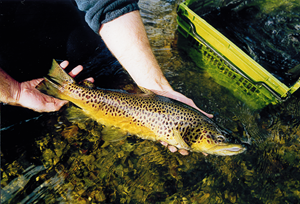 They are a medium to large fish (50-80cm) and can weigh up to 14kg.
Brown trout are absolutely stunning fish, with a fantastic range of colour from golden to darker brown, which is dictated by their genetics and their environment, used as camouflage to avoid predation. They have reddish spotting patterns with pale borders and creamy yellow bellies.
It is much smaller than the Atlantic salmon, and it can be distinguished from the similar rainbow trout by its plain, dark tail fin and by the lack of a purple side-stripe.
Distribution
A long-lived species (15 to 20 years) with a large native range, from Iceland to the Atlas Mountains of North Africa and as far as the Caspian and Aral seas in Kazakhstan. However, us humans love to take a bit of home with us when we travel, and particularly the British have introduced the brown trout to farther reaches in places like North and South America, Australia, New Zealand and Japan to increase our sport. Having had non-native species released or escaped here in the UK that have upset the ecosystem, this could be viewed as quite irresponsible.
Genetics
Did you know that sea trout and brown trout have recently been recognised as the same species, Salmo trutta, even though they look different and have different life cycles? Well, they have! The sea trout is migratory, spending most of its life at sea and returning to fresh water to spawn, but the brown trout stays in fresh water its whole life. However, without getting too technical, arriving at this neat definition hasn’t been easy! According to the Wild Trout Trust, there are reported to have been over 50 different species previously named within what then became the single Salmo trutta species (or species complex). To add to the complexity, resident brown trout can choose to become sea-based on a mixture of genetic and environment cues – how adaptable is that to go from freshwater to saltwater!
Food
Brown trout live in fast-flowing rivers with stony or gravelly beds. They are predatory fish that feed on insect larvae, small fish, and emerging and flying insects such as mayflies and damselflies.
Spawning
Brown trout lay their eggs on gravelly beds known as redds. The female (hen) builds a nest/redd usually between November and January, as this is the best time as the water is cold and fully oxygenated. The eggs are fertilised externally – as the hens release the eggs the males (cocks) release sperm or milt over the eggs to fertilise them. The young fish, called ‘alevins’, hatch in a few months (depending on water temperature) and feed on the nutritious yolk sac while living in the gravel. They emerge as ‘fry’, set up territories and grow into ‘parr’ before becoming adults.
Did you know that only around 5% of young trout survive their first year!
Threats
However adaptable and genetically complex this species is, it is also very sensitive and that is why they are used as indicator species of the health of our rivers – good and bad. The three fundamentals that brown trout and other wildlife need from our rivers are good quality water (clean and oxygenated), water quantity (lots of clean cool water, so it doesn’t warm up and alter the ecosystem) and good quality habitat. Brown trout and other species in these iconic rivers cannot tolerate low levels of oxygen, which is often associated with organic pollution from sewage and slurry, high water temperatures, or low summer flows, but they must live in ideal conditions within accessible connected habitat that isn’t obstructed by weirs and culverts to support all stages of their life cycle (spawning, juvenile and adult).
Finally
They may just look like just fish to some, but to me they are true icons of our rivers. They have a passionate following of riverkeepers, scientists, anglers and wildlife enthusiasts. They are culturally important, with great traditional ties, which is important to our heritage. We must do more to hold those to account who are polluting our rivers and make informed decisions on what we use in our homes, be it cleaning products that go down our drains (chose eco-friendly alternative cleaning products for laundry/dishwasher/sprays and cleaners) or flea treatments on our dogs that get into the river as they jump in after a ball, which kill insect life and therefore affect the food web, aiding in the decline for many species!
Next time you are near a river, have a look over the bank or bridge and take some time to see what fish species you can see and marvel at their beauty.
Megan Lock
Advisory