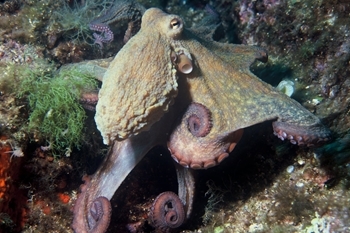
Common octopus
Highly intelligent and effective predator, with more hearts than most and the ability to solve complex problems
 Sometimes it can be difficult to choose which species to write about, especially as the list is getting shorter now that this blog has been running since August 2008! But I love to rely on chance conversations, random questions I get asked about nature, or from what I have seen to inspire me, with the hope it hasn’t already been crossed off the list.
First of all, I apologise that this Species of the Month is rather late into the month, but I have been quite busy delivering a large project on the Farmer Clusters that I am the Facilitator for, which has meant my time in the office has been quite limited.
But while I was out in the field, I had an interesting chance conversation with a man called ‘Crabby Jack’, who had headed away from his fishing boat that goes out from Dartmouth, to spend some time with friends at the end of the season. I must admit, it was quite an education hearing about quotas, rules and regulations that fisherman have to adhere to. It made me realise that my life is very much landscape rather than seascape, and how it’s easy to understand or appreciate species that you see, like we do on the land and air, but those in the sea are less visible and less spoken about, so maybe not so appreciated or protected. So I am dedicating this species of the month to Crabby Jack, and his inspiring and interesting conversation about crabbing!
But this wont be about the brown crab (Cancer pagurus), also known as the edible crab, but the species that is emptying Crabby Jack’s shellfish pots and eating the crabs before he has time to retrieve them – the common octopus (Octopus vulgaris).
Crabby Jack told me in some quite detail that his catch is falling as the number of common octopus in UK waters are significantly increasing, so significant that the catch of octopus were 65 times higher in 2025 than previous years – something that hasn’t been seen for 75 years!
However, even though the name may suggests that the octopus is common in our waters around the UK, it is in fact not. Instead it favours the warmer water of southern Europe, the Mediterranean and north Africa. But there have been occasional rare blooms, such as in 1900, 1950 and now 2025, when the numbers exploded off the south-west coast of England. According to the Plymouth Marine Laboratory, the 2025 bloom and all previous blooms were strongly associated with unusually warm sea and air temperatures, which creates conditions that likely enhanced breeding success and juvenile survival and growth.
Because of this increase, it is changing marine food chains and disrupting the local fishing industry, but with every problem there can be an opportunity, and with more octopus being landed a new market has opened up, with an estimated £6.7m to £9.4m worth of octopus being landed in the South West last year. But even with this new income, fishermen worry that the octopus have affected the brown crab, scallop and lobster population for the future, and with climate change, does it mean that the common octopus are here to stay?
The common octopus is a relative of squid and cuttlefish – a group of molluscs known as cephalopods, which are highly intelligent and often amongst the top predators in their ecosystem.
How to identify
It is large octopus with a soft, bag-like body, which is warty and changes colour depending on the environment and its mood, though it normally appears brownish-green. They have eight long arms attached to their head, each with two rows of suckers, and have the ability to squeeze into the smallest of spaces to avoid predators or hide from their prey.
Diet
Their favourite food is crabs, along with lobsters and molluscs. The piles of discarded shells are called a midden.
Distribution
Most common on south and west coasts of the UK.
Lifecycle
Despite the large size they can grow to, they generally only live for less than two years. The females lay and guard their eggs, ensuring they are protected and oxygenated by flushing them with water from their funnels. The females die after their eggs hatch and the males also die after breeding.
A few fun facts
Mutual benefit
There is an interesting relationship between hermit crab and sea anemone – a common facultative mutualism, which is a type of symbiotic relationship where both species benefit from their interaction but can survive independently without each other. According to David Attenborough, the hermit crab tickles the sea anemone to coax it onto its shell, which protects it from predators such as octopus! The crab provides the anemone with a hard substrate to live on, increases access to oxygenated water, and offers a food supply from discarded food from the crab, along with the protection it gives from predators.
Heart
An octopus has five hearts.
Intelligence
Considered the most intelligent of all invertebrates with the ability to solve complex problems, memory, and behavioural complexity comparable to some mammals.
Secret weapon
They have special glands, producing a venom that they use to incapacitate their prey!
Sensitive to change
Octopus populations are highly affected by changes in environmental conditions.
And one last fun fact, according to Crabby Jack: when they look at you, they really look into your eyes and into your soul!
So when you are next crabbing and wonder why you aren’t catching many, it might be because of the common octopus and the rise in sea temperature!
Megan Lock
Advisory
Photo credit: Albert Kok